
It’s 10 am on a busy Tuesday when every point-of-sale screen freezes. A regional ISP outage is costing your shop $137–$427 a minute, analysts warn. The cure is vendor-agnostic connectivity—one stack that blends fiber, cable, 5G, or even satellite and fails over automatically. Marketplaces like TD SYNNEX’s ConnectSolv let you mix those links almost as easily as ordering toner. Flexibility now outranks loyalty; the five platforms below prove it.
Key Takeaways
- A vendor-agnostic approach enhances connectivity and minimizes downtime costs for businesses.
- Five platforms emerged as top choices for flexibility: TD SYNNEX ConnectSolv, Cato Networks, Aryaka, KORE Wireless, and Bigleaf Networks.
- Each provider offers unique solutions, whether through multi-network support, managed services, or global eSIM connectivity.
- Using these platforms simplifies management, enhances security, and adapts to growing needs without locking in to specific carriers.
- Future-proofing features like native 5G support and mature APIs ensure long-term viability for businesses.
Table of contents
- How We Picked the Final Five Vendor-Agnostic Connectivity Platforms
- 1. TD SYNNEX Connectsolv: The One-Stop Connectivity Concierge
- 2. Cato Networks: The Cloud Backbone That Plays Well with Every ISP
- 3. Aryaka: White-Glove SASE For Teams That Want Everything Handled
- 4. KORE Wireless: One Esim, 400 Networks, Zero Roaming Drama
- 5. Bigleaf Networks: Turn Two Shaky Circuits into One Reliable Link
- Quick Look Comparison Between Vendor-Agnostic Platforms
- Buyer’s Guide: Six Answers You Need Before You Sign Anything
How We Picked the Final Five Vendor-Agnostic Connectivity Platforms
We evaluated more than 20 “vendor-neutral” connectivity providers and kept only five.
First, we removed any service that locks you to its own hardware or a single carrier; freedom was non-negotiable.
Second, we checked SMB-friendly pricing. Aryaka, for example, publicly commits to about $150 per site per month, according to SDxCentral (March 29 2023), showing that enterprise-grade SASE can fit a small-business budget.
Third, each remaining provider had to pass five must-have tests:
- Multi-network support: fiber, 4G/5G, and at least one alternative such as satellite
- Cloud orchestration with an API, not a pile of CLI commands
- Security built in from day one
- Transparent, scalable pricing: pay for the site you run today, add more tomorrow
- Published customer stories or uptime SLAs that prove real-world resilience
After that sweep, only five platforms were left. Each solves the uptime problem in a different way, giving you real choice without hidden strings.
1. TD SYNNEX Connectsolv: The One-Stop Connectivity Concierge
Think of ConnectSolv as a local guide who lines up the right carriers so you never wait in another support queue. Instead of locking you into a single contract, the portal bundles fiber, cable, 5G and satellite links, then hands you one dashboard and one invoice. Behind that simplicity sits TD SYNNEX’s business connectivity practice, which gives partners a commissions portal, vendor-agnostic solution consultants and field services, so the financial and technical pieces fall into place as fast as the circuits.
Set-up is quick. Order a router through your channel partner and it arrives pre-configured with an active SIM. Plug it in, power up, and you’re online with a primary circuit, wireless failover and optional VoIP trunks. No late-night firmware hunts, no juggling support numbers.
Because TD SYNNEX is a global distributor, scale is built in. A retailer can pilot five stores today and roll the same stack to fifty next quarter without rewriting a contract. Finance teams like the single bill; ops teams appreciate calling one help desk that speaks both telecom and warehouse workflows.
The trade-off is price transparency. Each package is custom, so comparison shopping takes extra effort. And if you prefer to tune routing tables yourself, a managed model can feel restrictive. For most SMBs, though, ConnectSolv turns multi-vendor complexity into an always-on service, letting you focus on customers instead of outages.
2. Cato Networks: The Cloud Backbone That Plays Well with Every ISP

Cato replaces edge hardware with a single, cloud-managed backbone. You tunnel each branch, remote user and workload into Cato’s private network, then let the service steer traffic across 70-plus global points of presence. The access link can be fiber in Chicago, 5G in Boise or DSL at a rural depot; Cato only sees encrypted tunnels and optimizes the path.
Why does that matter to you? Performance improves without the price or contract drag of MPLS, and security travels with every packet. The same portal that spins up a new store in 15 minutes also enforces firewall rules, Zero Trust access and threat prevention everywhere.
Recent numbers support the momentum. In 2025 Cato passed $300 million in annual recurring revenue and raised another $50 million to build AI-driven security features, according to itpro.com (March 2025).
Trade-off: you leave carrier lock-in behind but place trust in one overlay provider. For most small IT teams, swapping do-it-yourself complexity for a managed, resilient fabric feels like a smart bargain.
3. Aryaka: White-Glove SASE For Teams That Want Everything Handled
Think of Aryaka as a managed network partner. You keep link freedom—broadband, LTE or satellite—but Aryaka orders the circuits, installs the edge device and monitors performance around the clock.
Its private Layer-2 core carries traffic as soon as it leaves your site, skipping the public internet. The result is lower latency, steadier jitter and apps that feel local even when servers sit on another continent.
In 2025 Aryaka priced its Unified SASE bundle at about $150 per site. The fee covers SD-WAN, next-generation firewall and zero-trust remote access, plus one SLA that includes both the access line and the overlay fabric. If a circuit fails at 2 am, Aryaka’s network operations center contacts the carrier before your help desk even opens a ticket.
The trade-off is fine-grained control. You submit change requests instead of adjusting settings yourself. For lean IT teams focused on growth rather than packet paths, that hand-off is usually a relief.
4. KORE Wireless: One Esim, 400 Networks, Zero Roaming Drama
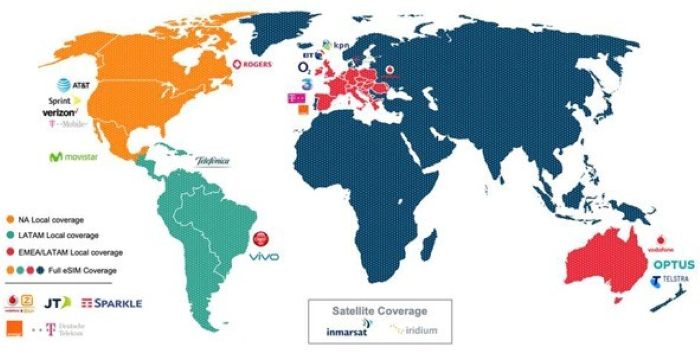
Laptops and cash registers are not the only assets that need connectivity. Vending machines, delivery vans and temperature sensors also rely on always-on data wherever they operate. That need is KORE’s specialty.
Instead of managing carrier contracts in every country, you place a KORE global eSIM in each device. When the unit powers up, it selects the strongest local signal from more than 400 cellular networks. If the device crosses a border, the SIM rewrites its own profile, so there is no site visit and no surprise roaming bill.
Administration stays simple. The KORE One portal shows every SIM, its data use and its current network in one view. Need to cap usage on a chatty tracker? Click, done. Want an alert when a refrigerated trailer loses coverage? Set a rule in two minutes.
Scale is proven. KORE already manages tens of millions of connected devices, so whether you deploy fifty kiosks or fifty-thousand sensors, the plumbing is tested.
KORE will not fix your office Wi-Fi; that is not its job. But if revenue depends on smart devices that cannot afford downtime, a carrier-agnostic eSIM strategy delivers global insurance.
5. Bigleaf Networks: Turn Two Shaky Circuits into One Reliable Link
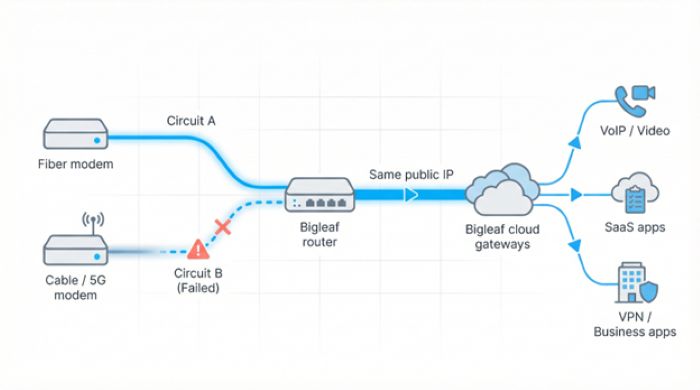
Bigleaf solves a classic SMB pain point: the status says “connected,” yet Zoom still stutters. A compact router bonds the links you provide (fiber, cable, or a 5G hotspot) and routes traffic through Bigleaf cloud gateways behind a single public IP.
If the main line drops, active calls move to the backup path in milliseconds. Because the public IP stays the same, SaaS sessions and VPN handshakes continue without interruption. Most users notice only a brief blip.
Setup takes about the length of a coffee break. Plug both modems into the router, connect your firewall, and watch the dashboard light up. Bigleaf identifies critical apps and prioritizes them; you can fine-tune policies when needed.
Plans start at $160 per site, with hardware and support included. Month-to-month terms and a trial period lower the risk.
Bigleaf will not manage your security tools or order circuits, but it does what it promises: keeps your connection alive and your calls clear, even when the local ISP acts up.
Quick Look Comparison Between Vendor-Agnostic Platforms
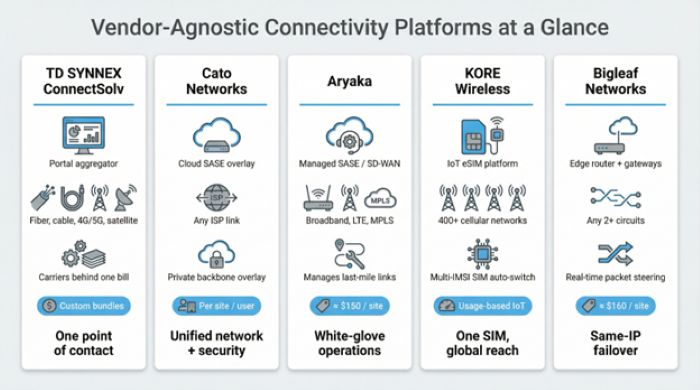
Below is a side-by-side snapshot to help you match each platform to your must-haves before scheduling demos.
| Platform | Deployment style | Networks it bonds | How it stays vendor-agnostic | Cost vibe | What makes it stand out |
| TD SYNNEX ConnectSolv | Portal-driven aggregator with pre-configured gear | Fiber, cable, 4G/5G, satellite | Mixes multiple carrier contracts behind one bill | Custom bundles | One point of contact for circuits and hardware |
| Cato Networks | Cloud SASE overlay, small edge socket | Any ISP link | Tunnels traffic into a private backbone | Subscription per site or user | Unified network and security fabric |
| Aryaka | Fully managed SD-WAN and SASE service | Broadband, LTE, MPLS and more | Aryaka procures and manages last-mile links | About $150 per site tier | White-glove ops plus private Layer-2 core |
| KORE Wireless | eSIM connectivity for devices | 400+ cellular networks and some satellite | Multi-IMSI SIM auto-switches carriers | Usage-based IoT plans | One SIM, global reach, rich API |
| Bigleaf Networks | Edge router with cloud gateways | Any two or more circuits | Real-time packet steering across links | About $160 per site plan | Same-IP failover for steady voice and SaaS |
The grid captures the essence: ConnectSolv offers breadth, Cato and Aryaka pair security with transport, KORE rules the device world, and Bigleaf keeps cloud apps alive through local outages.
Buyer’s Guide: Six Answers You Need Before You Sign Anything
Do we need a multi-vendor platform?
If an hour of downtime costs about $8,220 (at $137 per minute), sticking with one ISP is risky. A vendor-agnostic model keeps a spare lane open and strengthens your position when contracts renew.
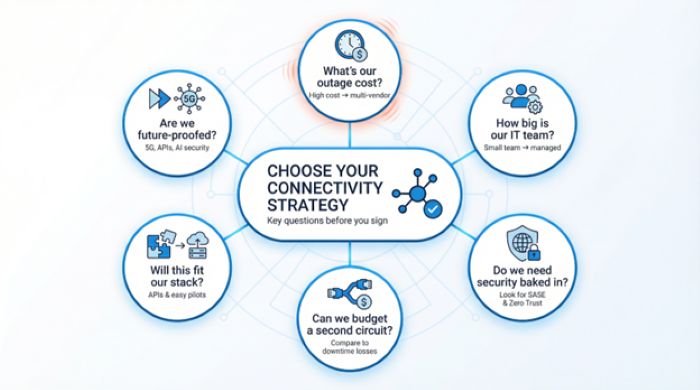
Will this be too technical for a small team?
No. Bigleaf ships plug-and-play routers, Aryaka assigns a concierge crew, and ConnectSolv delivers gear pre-configured. The admin portals feel closer to online banking than to a complex command line.
What about security?
Cato and Aryaka include firewalls, zero trust access and threat detection in the same fabric that routes your traffic. ConnectSolv bundles similar SD-WAN hardware when requested. Even Bigleaf, which sits outside the firewall, encrypts every tunnel to its gateways. Multiple links do not create extra attack surfaces when they share one secure overlay.
Won’t two circuits cost double?
A backup line adds expense, yet a silent POS or idle warehouse can cost far more. Many firms recoup the monthly fee after a single avoided outage. Aryaka swaps pricey MPLS for commodity broadband, and KORE’s eSIM picks the lowest-cost local carrier automatically.
How hard is integration with our current stack?
Each platform operates at the edge or in the cloud, not deep inside your LAN. Keep your existing firewall rules, IP plan and SaaS logins. KORE exposes REST APIs for device data, while Cato and Aryaka plug directly into AWS and Azure. Most pilots finish in days, not quarters.
What future-proofing should we ask for?
Look for native 5G support, clear SASE roadmaps and mature APIs. Providers offering Wi-Fi 6 or AI-based threat hunting are thinking ahead. All five vendors meet those requirements, so you can focus on fit instead of obsolescence.
Conclusion
Flexibility now outranks loyalty with vendor-agnostic connectivity platforms; the five platforms above prove it.