
The European Union’s approach to assessing public administration candidates through EU civil service recruitment has undergone a dramatic digital transformation. In late 2023, EPSO (the EU’s central recruiting body) made a pivotal decision: it abandoned physical test centers entirely, shifting to 100% remote, AI-proctored examinations delivered across 24 languages. This evolution mirrors broader e-government ambitions but has also exposed the growing pains of large-scale digital assessment.
One widely discussed example that helps illustrate this transformation is the Frontex knowledge test, which reflects a broader European approach to evaluating what candidates know, how they structure information, and how well they understand institutional mandates. Like EPSO’s generalist competitions, Frontex knowledge tests have moved toward digital delivery, testing candidates on legal frameworks, institutional roles, and operational principles relevant to border security and migration management.
Key Takeaways
- EU civil service recruitment has fully transitioned to remote, digital-first testing, eliminating physical test centers.
- AI-based proctoring now replaces human oversight, improving scalability but raising candidate experience concerns.
- EPSO does not use AI for scoring, ensuring compliance with the EU AI Act’s high-risk recruitment requirements.
- Digital competency standards are anchored in the DigComp framework and are now mandatory across many EU roles.
- Specialized agencies like Frontex rely on digitally delivered knowledge tests to assess legal, institutional, and operational understanding.
- While technology increases efficiency and reach, candidate trust and satisfaction remain key challenges for future recruitment systems.
Table of contents
EU Civil Service Recruitment Testing Infrastructure Overhaul
The European Personnel Selection Office processes roughly 60,000 to 70,000 applications annually to fill positions across EU institutions, including specialized agencies like Frontex. For over 13 years, Prometric operated as EPSO’s exclusive testing vendor, delivering examinations through a global network of 8,000+ test centers. That partnership collapsed spectacularly in 2023 and 2024.
The crisis began in October 2023 when EPSO paused test delivery due to significant technical difficulties with automated proctoring systems. By February 2024, EPSO unilaterally terminated its Prometric contract. French company TestWe stepped in as an interim provider, but the transition wasn’t seamless. A new €16.7 million framework contract awarded in October 2024 established a two-supplier cascade system: Open Assessment Technologies S.A. (Luxembourg-based) as primary provider, with Prometric Ireland as backup.
Machine Proctoring Replaces Human Oversight
The shift to automated proctoring represents perhaps the most consequential technological change. Since September 2023, AI-based systems have replaced human proctors for exam monitoring. Candidates now experience a streamlined process: ID verification via webcam, a 360-degree room scan, then continuous video and audio recording with algorithmic monitoring for suspicious behavior.
EPSO emphasizes that no biometric data is collected, with recordings stored in EU-based data centers under strict GDPR protections. The system flags anomalies for later human review rather than interrupting candidates mid-exam. However, candidate satisfaction has suffered. Approval ratings dropped to 65% in 2024, falling far below EPSO’s 90% target. Satisfaction split sharply by proctoring type in 2023: 74% for live-proctored sessions versus just 60% for automated monitoring.
The EU AI Act’s Impact on Recruitment
Despite automation in delivery and proctoring, EPSO explicitly does not use AI for scoring candidates. All written tests are evaluated by human markers who are trained EU officials. This approach aligns with the EU AI Act, which took effect in August 2024. The legislation classifies AI systems used in recruitment as “high-risk,” requiring transparency, human oversight, bias prevention testing, and fundamental rights impact assessments.
EU civil service recruitment has particular implications for specialized agencies like Frontex, where knowledge tests assess sensitive areas including border security protocols, migration policy, and fundamental rights obligations. The human-scored approach ensures accountability in domains where automated assessment could raise significant ethical concerns.
DigComp Sets the Digital Competency Standard
The EU’s digital skills requirements for public servants are anchored in DigComp, the European Digital Competence Framework. Developed by the Joint Research Center, the framework defines 21 competences across five areas: information literacy, communication, digital content creation, online safety, and problem-solving. EPSO now integrates DigComp-aligned Digital Skills Tests into generalist administrator competitions, evaluating practical applied skills rather than programming specialization.
Member states are adopting DigComp for their own civil services. Romania’s EU-funded program stands out: by November 2024, it had certified 8,840 civil servants at DigComp Level 5 (advanced), with a target of 30,000. Training blends 20% face-to-face instruction with 80% online modules.
The Numbers Behind EU Digital Governance
The Digital Decade policy program establishes ambitious 2030 targets that directly shape public administration hiring priorities. The EU aims to have 80% of adults with basic digital skills by 2030, up from current levels that vary dramatically by country. The eGovernment Benchmark evaluates public service websites across 98 services, revealing stark disparities—Nordic countries lead in digital public service delivery while Southern and Eastern European nations lag significantly behind.
These disparities explain why digital competency testing has become non-negotiable for EU civil service roles. Institutions—from the Commission to specialized agencies like Frontex—need staff capable of designing and delivering digital public services that work for citizens across vastly different technological contexts.
Recent Developments Reshape Recruitment
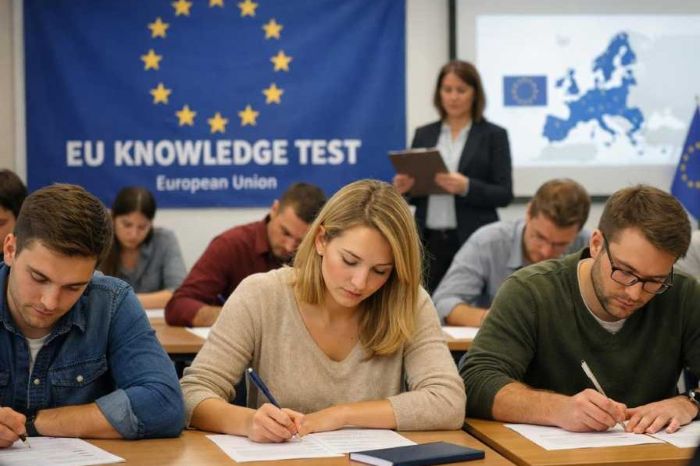
EPSO’s January 2023 competition model overhaul eliminated traditional Assessment Centers—the in-person oral examinations that had been a cornerstone of EU recruitment. All testing now occurs remotely, with new formats including Field-Related Multiple-Choice Questions for specialist roles and EU Knowledge Tests. The Interreg Europe program now supports initiatives like DSBPGovernance, focused specifically on digital skills for better public governance across member states.
What’s Next for Digital Assessment
The trajectory is clear: EU civil service recruitment will become increasingly digital, remote, and skills-focused. Research shows computer-based testing produces comparable scores to paper formats while offering immediate scoring, reduced environmental impact, question randomization, and adaptive difficulty capabilities.
However, EPSO’s satisfaction metrics reveal an implementation reality gap—technology that works isn’t always technology that candidates trust. The coming years will test whether the EU can balance three competing imperatives: assessment reliability across 24 languages, candidate experience in fully remote settings, and compliance with its own AI regulations. For Europe’s technology sector, this represents both a significant procurement opportunity and a high-visibility proving ground for digital assessment innovation.