
As global innovation accelerates, patent portfolios are no longer passive legal records. In 2026, they operate as complex systems spanning multiple jurisdictions, currencies, renewal rules, and regulatory timelines. For intellectual property teams, patent renewal management has evolved from a clerical responsibility into an enterprise-level challenge with direct financial and compliance implications.
Patent renewals, often referred to as annuities, are periodic payments required to keep patents legally enforceable. While the concept is straightforward, execution becomes increasingly complex as portfolios grow. Each jurisdiction applies distinct fee structures, deadlines, grace periods, and surcharge rules. At volume, even small inconsistencies can lead to missed renewals, unnecessary payments, or the unintended loss of valuable assets.
This complexity is further intensified by rising costs at major patent offices. The UK Intellectual Property Office, for example, has announced average patent fee increases of approximately 25% effective April 1, 2026, adding significant pressure to renewal budgets. In this environment, late filings, duplicate payments, or overlooked jurisdictional rules no longer represent minor administrative issues; they translate directly into avoidable financial losses and heightened compliance risk for organizations managing large, international patent portfolios.
Table of contents
Why Manual Patent Renewal Methods No Longer Work
Many organizations still rely on spreadsheets, calendar reminders, emails, and loosely coordinated service providers to manage patent renewals. These tools were never designed to operate across dozens of patent offices, time zones, and regulatory frameworks simultaneously.
Manual workflows rely heavily on static fee tables that can lag official patent office updates. Teams often fail to synchronize deadline tracking across regions, and they perform currency conversions without real-time validation. Records often remain fragmented across teams or vendors, increasing the risk of duplicate renewals and ongoing payments for assets that no longer hold strategic value.
Importantly, manual methods provide limited visibility. Without centralized systems, IP and finance teams struggle to accurately forecast renewal costs, monitor jurisdictional exposure, or efficiently produce audit-ready records. As portfolios expand in fast-moving sectors such as artificial intelligence, biotechnology, and clean energy, these limitations translate directly into financial leakage and operational risk.
Patent Renewal as an Enterprise Software Challenge
At scale, patent renewal management is not an administrative issue. It is a software infrastructure problem.
Effective renewals require continuous data synchronization between patent offices, internal IP records, financial systems, and payment networks. Most failures occur not because of human intent, but because disconnected tools lack real-time validation, automated controls, and consistent governance mechanisms.
This shift in complexity has reshaped expectations. In 2026, the central question is no longer whether renewals should be automated, whether existing systems are architected to manage them reliably and at scale.
What a Modern Patent Renewal Solution Must Deliver
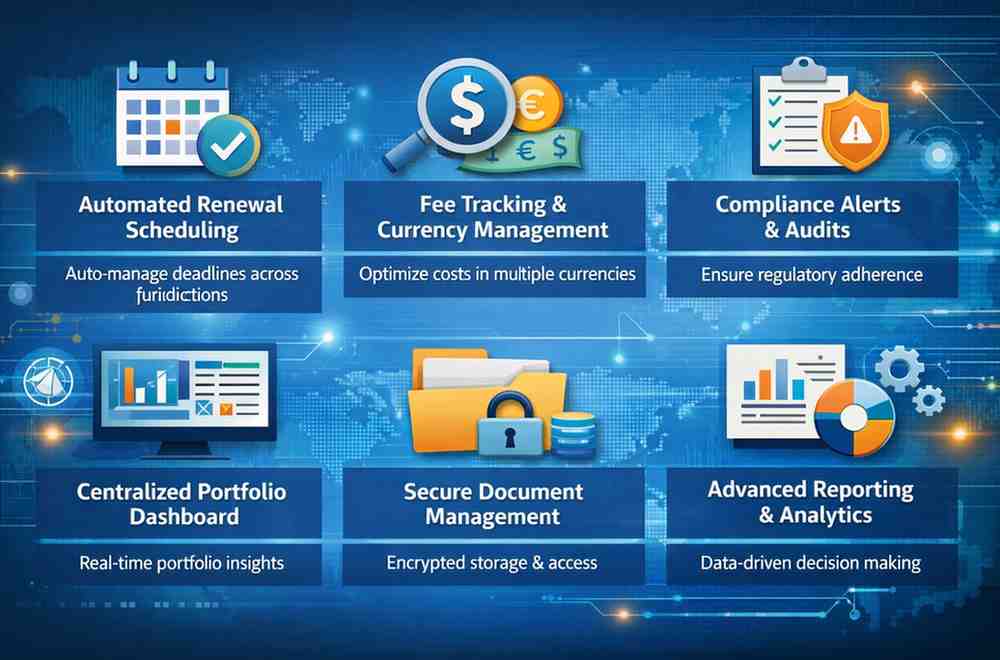
A modern patent renewal solution must function as enterprise-grade software rather than a manual service overlay. Direct integration with official patent office data sources is essential to keep deadlines, fee schedules, and legal status updates current as regulations change.
Renewal execution should be driven by rule-based automation that validates fees, enforces deadlines, authorizes payments, and archives documentation with minimal manual intervention. At the same time, organizations require consolidated financial visibility, currency validation, and reporting capabilities that support forecasting, compliance, and audit requirements.
Scalability is critical. As patent portfolios grow, the system must support additional assets without increasing operational complexity. Increasingly, renewal data is also expected to support higher-level analysis, informing portfolio optimization and long-term cost planning.
How Questel Fits into Modern Patent Renewal Management
Within the enterprise IP software landscape, Questel addresses these requirements through integrated patent data, portfolio management, and renewal automation. Rather than treating renewals as a standalone service, its approach embeds renewal execution within a broader digital IP infrastructure.
In this context, Patent Renewal(s) with Questel illustrates how software-driven workflows can reduce renewal errors while improving cost predictability. By aligning real-time patent office data with automated validation, synchronized deadlines, and centralized reporting, organizations can replace fragmented manual processes with consistent, repeatable execution.
This structure supports global portfolios by maintaining a single source of truth for renewal status, costs, and compliance across jurisdictions. As a result, IP teams gain stronger operational control while finance teams benefit from improved transparency and audit readiness.
Conclusion
As patent portfolios continue to grow in size and complexity throughout 2026, renewal management is increasingly evaluated alongside other core enterprise systems. Accuracy, scalability, and transparency are no longer optional. They define whether IP operations function as a strategic asset or an ongoing source of risk.
Patent renewal management is no longer just about preserving legal status. It is about building resilient digital infrastructure that protects innovation and supports long-term competitiveness.