
In a world where devices, cloud services, and SaaS multiply overnight, many IT teams still lack full visibility into their tech estate, according to Flexera’s January 2024 ITAM report. That blind spot drives up security risk, wastes money on licenses, and can trigger costly audits.
This guide compares 11 leading IT asset management platforms using a clear scorecard: lifecycle coverage, integrations, usability, scalability, and cost. Grounded in 2026 realities like hybrid work, AI automation, and EU NIS2 compliance, it offers quick tables, plain-language profiles, and a practical checklist to help teams regain visibility and align IT, finance, and security.
Key Takeaways
- Many IT teams lack visibility into their tech estate, increasing security risks and audit costs.
- The article compares 11 IT asset management platforms based on lifecycle coverage, integrations, usability, scalability, and cost.
- New trends, such as hybrid work, demand continuous visibility and automated asset discovery.
- Platforms like Allwhere and ServiceNow provide tailored solutions for procurement and unified management, respectively.
- Effective IT asset management now focuses on controlling risk and optimizing costs in a complex tech environment.
Table of contents
- How We Scored Every IT Asset Management Platform
- The Trends Steering Your 2026 Short-List
- Allwhere: Procurement-To-Onboarding Harmony
- Servicenow It Asset Management: Enterprise End-To-End Control
- Freshservice: Mid-Market Itsm and Itam in One Neat Package
- ManageEngine AssetExplorer: Discovery Muscle on a Modest Budget
- Ivanti Neurons for IT Asset Management: Automation Meets Unified Endpoint Insight
- Lansweeper: Agentless Discovery and Shadow IT Detection
- Asset Panda: Customizable, Mobile-First Tracking for Everything
- Ninjaone: Real-Time Asset Insight Plus Remote Control in One Tab
- Snipe-It: Open-Source Essentials for Budget-Minded Teams
- Flexera One: License Optimization Powerhouse for Big Spenders
- Zluri: Taming SaaS Sprawl with Surgical Precision
- Conclusion
How We Scored Every IT Asset Management Platform
We built a straightforward scorecard you can trust and applied it to every tool on the short list.
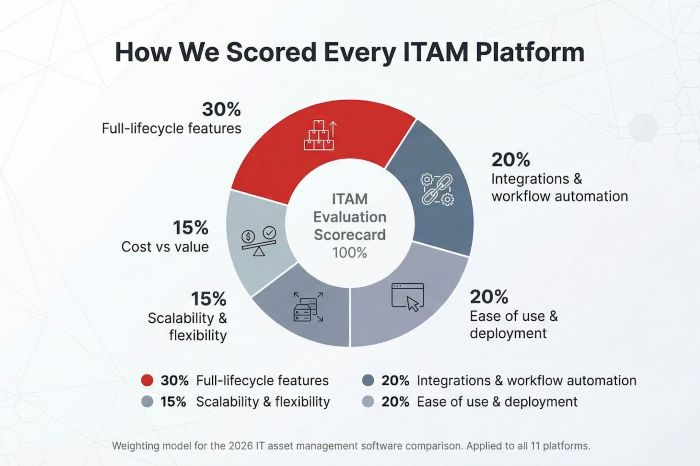
We weigh IT asset management platforms by what matters most: 30% for full lifecycle coverage, 20% for integrations and automation, and 20% for ease of use and deployment. Scalability and cost each account for 15%. Our scoring follows SCMDojo’s March 2025 framework and is based on recent demos, reviews, and verified vendor documentation.
Table 1 – ITAM platforms at a glance
| Platform | Best For | Deployment | Free Tier | Pricing Snapshot* |
|---|---|---|---|---|
| Allwhere | Remote onboarding | SaaS | No | Quote |
| ServiceNow ITAM | Large enterprise suites | SaaS | No | $$, quote |
| Freshservice | Mid-market ITSM combo | SaaS | Trial | $19 /agent+ |
| ManageEngine AssetExplorer | Budget discovery | SaaS / On-prem | Yes (25 assets) | $955 /yr 250 assets |
| Ivanti Neurons | Automation & UEM tie-in | SaaS / On-prem | No | Quote |
| Lansweeper | Deep discovery | Hybrid | Yes (100 assets) | €219 /yr 200 assets |
| Asset Panda | Mobile customization | SaaS | Trial | Quote, per asset |
| NinjaOne | RMM + ITAM | SaaS | Trial | $2–5 /device mo |
| Snipe-IT | Open source basics | Self-host / SaaS | Yes | Free self-host |
| Flexera One | License optimization | SaaS | No | $$, quote |
| Zluri | SaaS sprawl control | SaaS | No | Quote |
With the criteria set, you can see exactly how each contender stacks up before we explore the individual profiles.
The Trends Steering Your 2026 Short-List
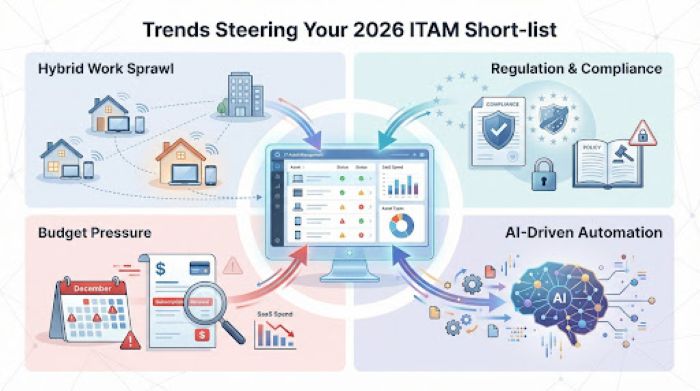
Hybrid work pushed the perimeter to every kitchen table. Laptops, phones, and IoT widgets now live far outside the old firewall, and many never cycle back to headquarters. That sprawl has IT leaders scrambling for continuous discovery rather than once-a-year audits. The right ITAM platform turns that hunt into a dashboard, surfacing idle licenses before the vendor’s auto-renewal lands on your card.
Customer results on Allwhere’s site show that automating procurement-to-delivery logistics slashes IT’s hands-on onboarding time from about an hour to under 2 minutes and turns a 3-month international retrieval into a few clicks, all while maintaining a 96% on-time delivery rate.
Allwhere: Procurement-To-Onboarding Harmony
Allwhere targets a pain most IT asset management suites ignore, the chaos between “approved purchase” and “device in hand.” Its IT equipment procurement engine draws on a global supplier network and delivers a verified 96 percent on-time arrival rate, while the same dashboard consolidates imaging, shipping, and retrieval into a single real-time view.
Allwhere IT Equipment Procurement and Onboarding Workflow Dashboard
Trigger an order, and Allwhere secures the laptop, images it to your gold build, then tracks the courier all the way to the new hire’s door. When an employee leaves, the workflow reverses, scheduling pickup and certified data wipe without a single spreadsheet.
Because the service includes logistics, pricing is quoted. What you give up in feature breadth, there’s no software-licence reconciliation, you gain in a smooth Day-1 experience and recovered hardware that would otherwise vanish into desk drawers.
Pick Allwhere if you run a remote-first company or onboard dozens of employees each month and want procurement off your plate. Pair it with a discovery-heavy tool for full coverage, and you close the lifecycle loop from first click to final pickup.
Servicenow It Asset Management: Enterprise End-To-End Control
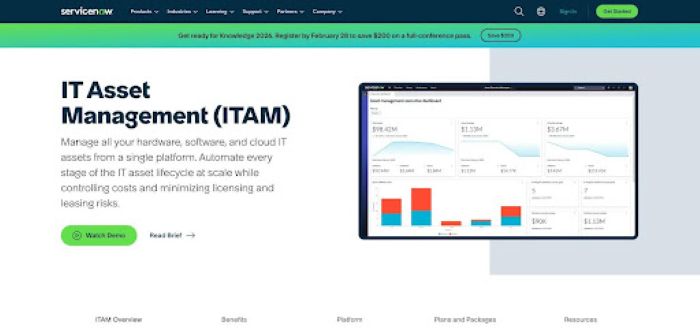
If your CIO wants one unified console, ServiceNow comes closest. The ITAM module plugs into the Now Platform, sharing a single data model with the service desk, CMDB, and change management. Open a ticket, and the linked asset record shows purchase date, warranty, software titles, and who touched it last—no tab hopping.
The trade-off is heft. Licensing is quote only and firmly in enterprise territory. Deploying the platform requires committed admins and clear process maps; without them, you may rebuild old silos inside a shinier interface.
Choose ServiceNow when you already live inside its ITSM suite or when regulatory pressure demands exhaustive audit trails. For global enterprises with deep pockets, it turns asset chaos into an organized workflow. For smaller teams, the cost and complexity outweigh the shine.
Freshservice: Mid-Market Itsm and Itam in One Neat Package
Freshservice feels familiar from day one. The interface resembles a modern SaaS inbox, so agents click less and resolve more. Asset records sit alongside tickets, so the support team sees device details the moment a request arrives, with no context switching or copy-paste.
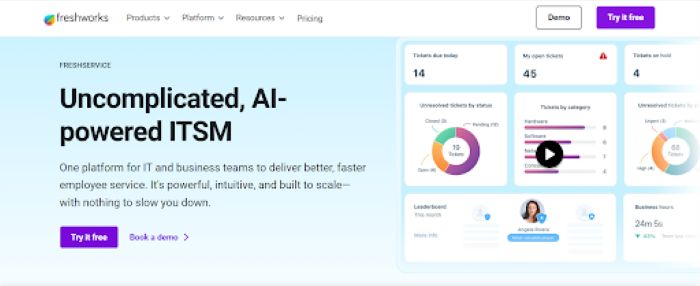
Cost clarity helps, too. Plans start at around $19 per agent per month, and trials spin up in minutes. The compromise is depth: Freshservice covers the essentials—hardware inventory, license counts, and contract dates, but buyers who need deep license optimization or complex procurement workflows will reach their limits.
For companies with 50 to 500 employees, the blend of help desk, change management, and asset tracking in a single browser tab often beats stitching together three single-purpose tools. If you value speed, simplicity, and predictable billing, Freshservice is a sweet spot.
ManageEngine AssetExplorer: Discovery Muscle on a Modest Budget
AssetExplorer shows you do not need enterprise cash to gain strong visibility. Install the server, point it at your network ranges, and within minutes, you see every switch, VM, and workstation, complete with hardware specs and installed software.
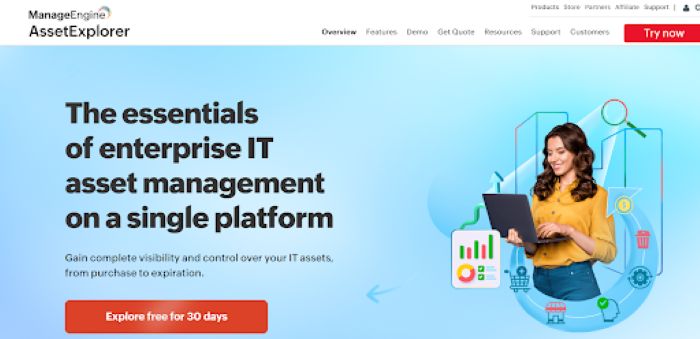
Pricing stays clear. A perpetual on-prem license starts at under $1,000 for 250 assets, and a free tier is available for microenvironments. The thrift brings trade-offs: the interface feels utilitarian, and deep integrations outside the Zoho ecosystem require API work. You also will not find SaaS subscription optimization or AI-driven insights here.
If your goal is to replace Excel with a reliable, automated inventory without draining the budget, AssetExplorer is a pragmatic pick. Pair it with your current help desk or run it alongside ManageEngine ServiceDesk Plus for an all-Zoho stack, and you cover the basics for less than one enterprise licence elsewhere.
Ivanti Neurons for IT Asset Management: Automation Meets Unified Endpoint Insight
Ivanti stitches asset data into endpoint management, service desk, and security, creating a live map of every device and the people who use it. Deploy the Neurons agent, and you not only discover the laptop; you also patch it, enforce policy, and lock it down from the same console.
Flexibility sets Ivanti apart. Run it as SaaS, in a private cloud, or in a traditional on-prem environment, which helps regulated industries that still fence off data centres. Pricing falls below ServiceNow but above typical SMB budgets, and implementation usually takes weeks rather than months if you commit staff to configure workflows.
Choose Ivanti when you want rich endpoint telemetry feeding directly into asset records, and you have the headcount to fine-tune automation. It works especially well for organizations already using Ivanti UEM or security modules, because adding IT asset management feels more like turning on another dashboard tile than starting a new project.
Lansweeper: Agentless Discovery and Shadow IT Detection
Plug Lansweeper into your IT asset management network and prepare for a few surprises. The platform sweeps every reachable IP range using protocols such as SNMP and SSH, cataloguing servers, switches, printers, and even rogue IoT sensors you never knew existed. Because the scan is agentless, rollout takes hours, not weeks, and you avoid the politics of pushing software to every endpoint.

The real value appears after discovery. Lansweeper assigns a freshness score to each asset, flags devices that drop off the radar, and highlights anything missed by Intune or SCCM. Security teams appreciate this instant list of unmanaged gear, a helpful starting point for patch drives and zero-trust audits.
Pricing stays SMB-friendly. A few hundred euros per year covers the first couple of hundred assets, and a free tier exists for testing or very small shops. Choose Lansweeper when undiscovered devices keep you up at night. Pair it with a ticketing system or financial module later, but start here to answer the first audit question: “What do we actually own?”
Asset Panda: Customizable, Mobile-First Tracking for Everything
Asset Panda turns your phone into a barcode scanner and your asset database into something anyone can tweak without code. Field techs scan a laptop’s QR tag, snap a photo of a cracked screen, and the record updates instantly. Need a new data point? Add a custom field in seconds, with no tickets to IT and no weekend upgrades.
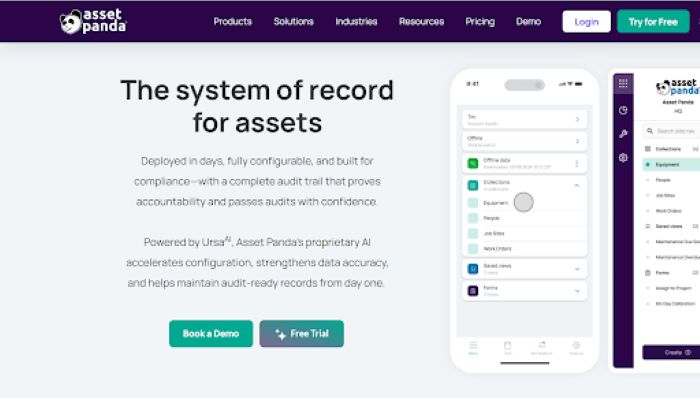
Depth is the trade-off. Asset Panda will not crawl your network or reconcile Adobe licenses on its own. You feed data manually, through imports, or via API from other systems. Large datasets with heavy customization can feel sluggish, and deep ITSM hooks need extra integration work.
Choose Asset Panda when you need flexible, mobile asset control across mixed departments and value ease of use over deep IT analytics. For organizations tracking everything from laptops to lab microscopes, one simple workflow covers it all.
Ninjaone: Real-Time Asset Insight Plus Remote Control in One Tab
NinjaOne started life as an RMM, so the agent on every endpoint keeps a constant heartbeat to the cloud. That signal powers two jobs at once: a live asset database and the ability to remote in, patch, or script fixes without switching tools. For lean IT teams, the blend feels transformational.
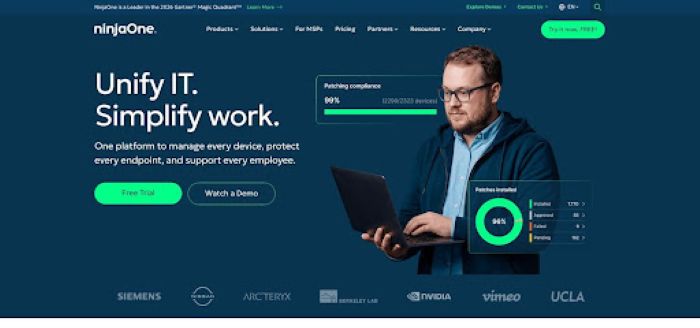
Pricing stays clear. Pay by device, usually two to five dollars per month at scale, and you unlock monitoring, remote access, and asset management together. The trade-off is scope. Ninja focuses on endpoints with agents; it will not discover a switch or printer on the wire, and it lacks modules for procurement, depreciation, or contracts.
If your main headache is keeping desktops and laptops patched, secured, and fully inventoried, NinjaOne can cut your tool stack in half overnight. Pair it later with a financial or procurement system for complete lifecycle coverage, but start here to control what powers on each morning.
Snipe-It: Open-Source Essentials for Budget-Minded Teams
Snipe-IT keeps asset tracking clear, free, and self-hosted. Spin up the LAMP stack, import your hardware list, and you are ready to assign laptops, monitors, or cameras to users through a clean interface. Email reminders chase overdue returns, and check-in/checkout logs keep auditors satisfied.
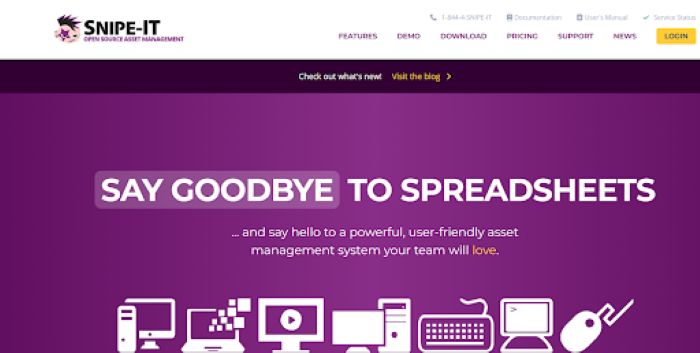
What you will not get is automation. Snipe-IT never scans the network or reconciles licenses; every update depends on disciplined data entry or custom scripts. Scaling beyond a few thousand records means tuning your database and accepting slower page loads.
Choose Snipe-IT when ownership visibility, not full lifecycle analytics, is the immediate goal and you have a Linux box plus a bit of admin talent. It serves as a practical step between spreadsheet chaos and a future, fuller IT asset management suite.
Flexera One: License Optimization Powerhouse for Big Spenders
Flexera One treats software and cloud services as line items waiting for negotiation. The platform collects install data from SCCM, Intune, and cloud APIs, then reconciles those records against purchase orders to reveal a dollar figure of unused licenses. Clients often find millions in reclaimable spend within the first quarter.
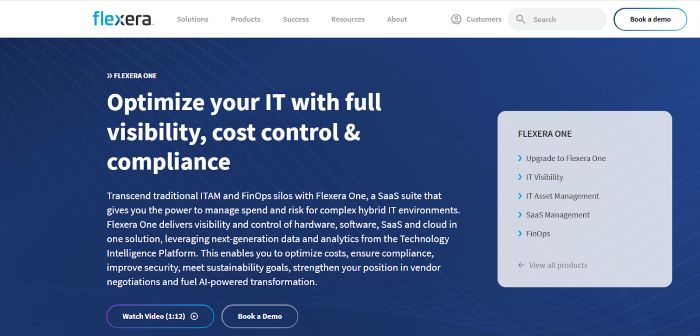
That precision carries a cost. Licenses can reach six figures for large estates, and implementation projects often span several months. Many organizations assign dedicated SAM analysts or hire Flexera consultants to keep data clean and reports actionable.
Choose Flexera One when software is your second-largest IT line item after payroll, and auditors visit regularly. For enterprises managing intricate license portfolios, it serves less as a tool and more as an insurance policy that pays for itself through avoided penalties and smarter renewals.
Zluri: Taming SaaS Sprawl with Surgical Precision
Ask any finance lead where the leaks are, and they will point to SaaS. Zluri closes those gaps by connecting to single sign-on logs, expense systems, and browser extensions, then surfacing every cloud app in use, approved or rogue. Within hours, you see total spend, license utilization, and overlapping tools that serve the same purpose.
Zluri’s focus is narrow by design. It will not track laptops or printers, and its price scales with employee headcount, so very small teams may find it costly. For organizations juggling hundreds of SaaS titles, however, the savings often dwarf the subscription fee.
If your shadow IT problem lives in the browser, not the server room, Zluri provides the spotlight you need. Pair it with a hardware-centric IT asset management suite and you finally see the whole estate, physical and virtual, in one clear view.
Conclusion
IT asset management in 2026 is no longer about keeping an inventory; it’s about controlling risk, cost, and complexity at scale. The right platform depends on your environment, maturity, and priorities. Use this comparison to match real-world needs to real capabilities and see how a client management interface can turn asset visibility into a lasting operational advantage.