
Somewhere in your downloads folder or in a forgotten browser tab, there’s a course with a progress bar stuck at 12%. A YouTube “watch later” playlist bookmarked with the best of intentions and never reopened. All because the format demands more time and focus than real life tends to offer. Micro-learning is built around that reality, and it raises a fair question: can brief daily lessons outperform a full-length course or a YouTube rabbit hole?
We checked our own team Slack last week and found 13 shared links to ‘must-watch’ productivity videos. When we asked who actually finished any of them? Silence.
So, we ran a small experiment: half the team took an hour-a-day communication course, the other half followed a micro-learning pass (RiseGuide’s Communication Mastery journey – one lesson a day for two weeks). By day ten, every person in the micro-learning group was still going. In the course group, only two out of six had made it past the halfway mark.
Below, we compare these formats and see where RiseGuide, an expert-powered self-improvement app (riseguide app), fits.
Key Takeaways
- Micro-learning offers brief daily lessons, promoting higher engagement and completion rates compared to traditional lengthy courses.
- Our experiment showed that every participant in the micro-learning group continued through the program while course attendees struggled to finish.
- Micro-learning breaks down complex topics into manageable chunks, making learning more accessible and easier to integrate into daily life.
- RiseGuide implements a daily micro-learning model, providing structured learning paths that increase consistency and success rates.
- In conclusion, micro-learning may lead to effective behavior change, especially for those struggling with time commitment and focus.
Table of contents
- What Counts as Self-Development Courses (and Why Completion Is Hard)
- What Micro-Learning Is (Daily Steps)
- Micro-Learning vs Courses (Pros/Cons)
- Micro-Learning vs YouTube (Pros/Cons)
- For Creators: Content Creation Courses vs Daily Journey Approach
- Where RiseGuide Fits (App Review)
- What Else We’ve Noticed During Testing
- FAQs
What Counts as Self-Development Courses (and Why Completion Is Hard)
Self-development courses guarantee transformation in exchange for hours of lectures, worksheets, and modules.
- On paper, the idea looks charming.
- In practice, completion rates for online self-improvement courses hover embarrassingly low, with some estimates under 15%.
We surveyed 50 people in our network. Forty-three had at least one unfinished course. Their most common excuse? ‘I’ll get back to it when I have time.’ Spoiler: they never do.
Most of that gap comes down to excessive difficulty: long sessions compete with jobs, commutes, and whatever energy remains at the end of a day.
What Micro-Learning Is (Daily Steps)
Micro-learning breaks big topics into focused lessons, delivered on a daily schedule. Each session pairs a single concept with an action prompt, something immediately applicable rather than theoretical. Where traditional courses require large time blocks upfront, micro-learning asks for minutes.
Behind this approach, there’s a simple principle: showing up regularly works better than pushing yourself too hard once in a while. Instead of packing a weekend workshop into memory, a daily routine of small wins gradually builds understanding.
Over weeks, that rhythm creates genuine behavior change. Because practicing a skill repeatedly wires it deeper than passively watching someone explain it ever could.
Micro-Learning vs Courses (Pros/Cons)
Undoubtedly, traditional courses win in depth. A twenty-hour deep-dive offers granularity that a fifteen-minute daily lesson can’t match in one sitting. But depth means nothing if nobody reaches the end, right?
Micro-learning trades some of that breadth for motion – each lesson feels achievable, which keeps engagement high over weeks.
One member of our team tried both formats side-by-side. Three weeks later: the longer course sat at 18% complete, while she’d finished 21 daily Riseguide lessons. Different completion rates, different results.
Where it falls short is layered content that genuinely requires long-form immersion. To master a complex certification, you may still call for a full course. While shifting a daily habit or mindset responds far better to structured, repeated micro-lessons delivered inside a consistent routine.
- Courses: deep coverage, but low completion rates and high time commitment.
- Micro-learning: consistent progress and higher follow-through, but less granular detail per session.
Micro-Learning vs YouTube (Pros/Cons)
For pure learning discovery, YouTube remains unmatched. A single search can surface a brilliant Stanford lecture or a creator dissecting negotiation tactics. What happens after that first video, though, is where things unravel: the algorithm queues another clip, then another, an hour passes without a clear takeaway.
It feels productive, yet the absence of structured review means retention drops fast. Self-improvement apps curate a path rather than offering a content buffet.
Structure replaces endless choice, information overload shrinks, and each lesson stays tied to a specific outcome instead of drifting wherever the algorithm leads.
- YouTube: great for discovery and variety, but no structure, and easy to lose focus.
- Micro-learning: clear direction and built-in accountability, but a narrower scope per lesson.
For Creators: Content Creation Courses vs Daily Journey Approach
We’ve seen a bunch of content creation courses that front-load theory: algorithm hacks, filming setups, editing workflows. Then leave creators alone when it’s time to actually hit publish.
A daily journey approach flips that order. A structured prompt arrives each day and pushes creators to produce and ship, no pressure to absorb all knowledge in the world before getting started.
For anyone who struggles with consistency more than knowledge, this format closes the gap between learning and doing – turning “I’ll start next week” into “done before lunch”.
Where RiseGuide Fits (App Review)
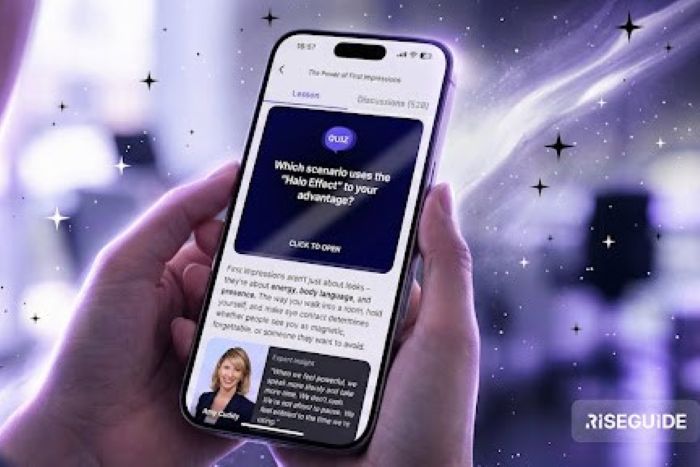
So what is RiseGuide? It’s a platform that applies the daily micro-learning model to self-development. Growth is organized into journeys – themed paths like:
- Intelligence Training,
- Communication Mastery,
- Content Creation.
Each path is broken into daily steps backed by expert frameworks. About fifteen minutes a day is all it takes, and built-in progress tracking removes the guesswork about whether that progress is real. What separates it from passive alternatives is the system. Each journey has a clear endpoint, which keeps completion rates meaningfully higher than an open-ended playlist.
How to Choose Your Best Format (Decision Checklist)
These four questions can help you clarify which format deserves attention.
- How much time is realistically available each day? If you got under twenty minutes, micro-learning fits better than a lengthy course.
- Consider accountability next: does learning stick better with an external schedule or self-paced freedom? Micro-learning apps bake accountability into the daily rhythm.
- Broad exploration or targeted change – which matters more? YouTube handles wandering curiosity, while apps handle deliberate growth.
- And is deep expertise needed immediately, or are compounding results over weeks the real goal?
What Else We’ve Noticed During Testing
Over the first three weeks of testing Rise guide alongside traditional courses and YouTube learning, a clear pattern has emerged:
- Courses: high drop-off after week one. Even the most motivated of us struggled to carve out 2-hour blocks.
- YouTube: high engagement, low retention. The team watched hours of content but couldn’t recall specifics days later.
- RiseGuide: lowest barrier to entry, highest consistency. Fifteen minutes fit into schedules that couldn’t accommodate hour-long sessions.
Final word: the format that works best isn’t the one with the most information. It’s the one people actually complete.
FAQs
Can micro-learning replace a full course?
For behavior and habit-based goals, yes. More technical certifications may still call for a full-length course. But the two formats aren’t mutually exclusive: daily micro-lessons handle consistency, while longer courses provide the depth.
Does RiseGuide work for real self-improvement?
From what we’ve seen, testing the platform and reading user feedback (riseguide reviews): yes, if you engage with the exercises. We watched users who just read through lessons get minimal results. Those who actually completed the daily prompts? Consistent improvement over weeks.
Does micro-learning lead to lasting change?
When paired with daily action prompts, evidence supports spaced repetition as one of the most effective learning methods. Every intelligence riseguide review we’ve seen echoes that point – consistency matters far more than session length.