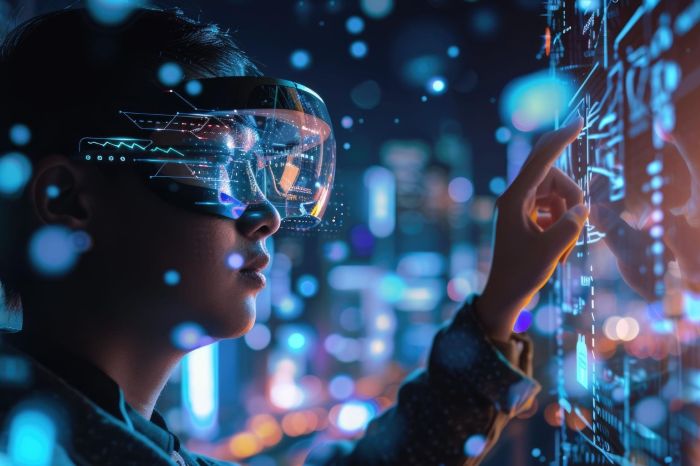
For generations, scientists, leaders, entrepreneurs, and everyday people have been interested in how far technology will take us in the future. The world is accelerating toward a time of unprecedented changes in human history. Breakthroughs that once seemed like impossible dreams are now happening in real-world fields. Quantum computing, biotechnology, artificial intelligence, and self-driving cars are realities that seemed impossible at the turn of the century. As we think about what will happen next, two questions come to mind. The first question is,” How will technology innovation change in the future? We also wonder, “What are the technological forces that will shape the next stage of digital evolution?”
The forces of exponential growth, like processing power and data streams, are merging to create a new reality. The following sections discuss the specific ways that this speedup is happening and the disruptions that will completely change how people interact, do business, and see themselves, illustrating the positive impact of technology.
Key Takeaways
- Technology innovation accelerates through the convergence of AI, quantum computing, and biotechnology, reshaping our future.
- AI will become a cognitive partner, enabling complex tasks and raising new ethical questions.
- Personalized digital experiences will transform industries, from healthcare to education, enhancing user interactions.
- Automation is set to revolutionize economies, creating self-sufficient factories and AI-driven logistics.
- The future will highlight the human aspect of technology, emphasizing new social norms, privacy, and digital identities.
Table of Contents
The Convergence Driving the Next Digital Evolution
Before we can make any guesses about what will happen in the next 20, 50, or even 100 years, we need to know why important technology is evolving so rapidly. The next stage of digital evolution will be fundamentally shaped by the convergence of these currently disparate fields. This convergence—where AI controls synthetic biology, quantum computing improves global logistics, and autonomous systems run hyper-personalized digital environments—will make the lines between the physical, biological, and digital worlds irrelevant.
One of the main forces that will drive change is the full integration of AI as a cognitive partner in all decision-making processes. We also will likely see the creation of a fully functional and secure global quantum internet (which internet transformation is currently underway). Additionally, the widespread use of CRISPR-like technologies to improve humans and agriculture will likely be on the horizon. This will force society to deal with new ethical and governance frameworks.
1. The Acceleration Principle Driving Future Technology Innovation
Technology innovation never slows down; it only accelerates. This caveat has been true of humans since we first stood upright. Every generation builds its discoveries and inventions on the ones that came before. For instance, AI went from simple machine-learning models to world-class reasoning systems in less than ten years, illustrating trends in information technology.
The question of “what is an ultimate goal for the computers of tomorrow?” is not hypothetical. We are living inside the answer.
Some important accelerators are:
- Computing power that grows exponentially (futuristic tech)
- Global connectivity (what internet transformation drives this)
- AI and automation
- Cross-disciplinary innovation
- Massive new data streams
These pillars influence diverse fields, from healthcare and manufacturing to national security and entertainment. The more they become intertwined across sectors of society, the faster evolving technology will change in the future.
2. What Will Technology Look Like in the Future?
To guess how technology will change in the future, you need to look at how it is changing now. Here are the changes that are most likely to transform society:
AI as a Cognitive Partner
AI will not only help with tasks but will also collaborate with people in increasingly complex ways. We will see AI systems that can:
- Autonomous decision-making
- Multi-step reasoning
- Creative generation
- Problem-solving on a large scale
This technology innovation will raise new questions about morality, human control, and the line between biological and synthetic intelligence, highlighting the positive effects of technology.
Hyper-Personalized Digital Worlds
Your digital world will be personal to you. Every screen, device, and platform will adapt in real-time to your needs. Think about:
- Individualized healthcare systems
- Tailored learning models (elite technology for classroom innovation)
- Personal AI agents
- Immersive virtual workplaces
This level of customization will redefine how people work, have fun, and interact with each other, demonstrating the positive impact of technology.
Big Breakthroughs in Quantum
Quantum computing is expected to move from theory to mainstream use. This could revolutionize:
- Drug discovery
- Encryption
- Climate modeling
- Materials engineering
Quantum supremacy is an inevitable technology innovation; it is only a matter of timing. Such breakthroughs are innovations in smart technology.
3. How Far Will Technology Take Us in the Future?
The real question isn’t whether technology will change society, but to what extent. This raises predictions for smart technology across multiple sectors.
Scenario 1: A Fully Automated Economy
Automation has already disrupted logistics, manufacturing, customer service, and finance. Changes in the future could move economies toward:
- Factories that run themselves
- Networks of self-driving cars
- Robotic medical systems
- Supply chains run by AI
Machines can do the work, freeing workers to be more creative and strategic, reflecting the technology landscape of tomorrow.
Scenario 2: Merging Biological and Digital Systems
Biotechnology and neural interfaces that work better may blur the line between people and machines. Some possible results are:
- Embedded neural chips
- Cognitive enhancement
- Regeneration of organs
- Personalized genetic medicine
Society will be forced to navigate moral issues about identity, consent, and the implications of emerging technologies in software and bio-integration.
Scenario 3: Intelligence on a Global Scale
As AI systems connect to each other, we may see the rise of a global computational layer, which is a smart digital infrastructure that learns and changes across all fields.
This could allow:
- Autonomous environmental monitoring
- Predictive cities
- Super-optimized logistics around the world
- Reducing risks to the planet
This interconnected digital infrastructure, sometimes called the “Global Brain” or “Datasphere,” exemplifies the future of technology innovation.
4. The Human Side of Technology in the Future
It’s easy to get lost in the machines, but the biggest changes in the future will be social. The next generation will experience:
- New rules for digital behavior and ethics
- New definitions of privacy
- Decentralized communication
- New forms of digital identity
- Changes in workforce structure (future trends in smart devices)
Technology will not only change what we do, but also who we are, how we connect with others, and how we see the world, showing the positive impact of technology.
5. Preparing for the Next Era of Technology Innovation
To thrive in a world shaped by rapid transformation and constant disruption, individuals and organizations must:
- Accept learning for life
- Think in an agile way
- Develop digital literacy (innovative micro technology)
- Build resilience in the face of adversity
- Keep up with new trends (innovation and technology)
The people who can change the fastest will own the future.
Conclusion: The Future Is Here Now
If we want to understand technology in 2030 and beyond, we need only look at the speed of progress around us. Every industry is adapting to changes in technology. The rapidly emerging technologies in software and the convergence of AI, quantum, and biotech mean the line between science fiction and reality is shrinking daily.
Changes in the future are happening faster than we dreamed they could. Technology innovation in the future will change everything about life, from work to society to who we are and even our intelligence. Futuristic tech will affect everything, reinforcing the need to embrace technological solutions that improve lives and society.