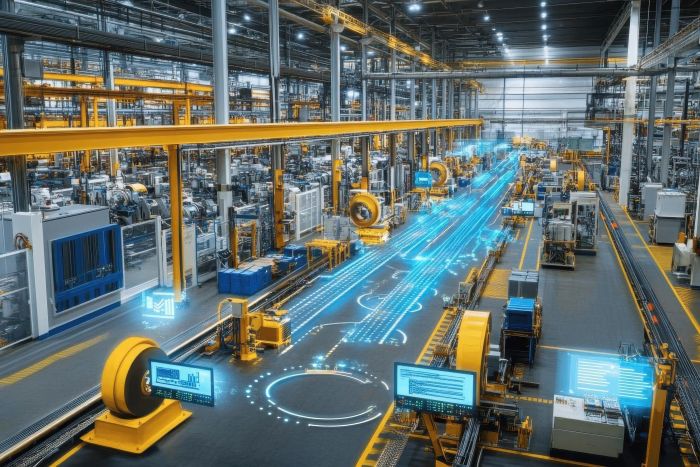
A modern plant floor now looks like a server room with conveyor belts. Sensors stream live data, robots handle repetitive work, and dashboards flag a drift in tolerance before a single part ships. The hardware caught up fast to smart factories. The people who read that data did not.
That gap is the quiet story behind the smart factory boom, and it shapes which startups scale and which stall. Tooling alone does not fix a defect rate. A trained engineer does, often by applying methods learned through structured programs like Excedify rather than by trial and error. The machines are ready; the talent pipeline is the part still under construction.
Key Takeaways
- Smart factories rely heavily on advanced automation, but the skills gap persists as many workers lack the necessary training.
- Automation has left behind roles that require human judgment, leading to projections of millions of unfilled jobs by 2030 in manufacturing.
- Essential skills for closing the gap include GD&T, Six Sigma, and other testing methods that allow teams to measure and prevent defects.
- Online training offers flexible, cost-effective solutions to upskill workers, enabling them to learn at their own pace and apply skills immediately.
- Finding a balance between hiring experienced leads and internal training often yields better results for filling the skills gap in smart factories.
Table of contents
Why Did the Skills Gap Grow Faster Than the Tech?
Automation removed the easy jobs first. What remains demands judgment that software cannot fake yet. Reading a control chart, sizing a tolerance, or tracing a recurring scrap problem still needs a human who knows the method.
Deloitte and the Manufacturing Institute have projected that the sector could leave about 2.1 million jobs unfilled by 2030. Many of those roles sit above the assembly line, in quality and process engineering. Demand for those skills climbed while training lagged.
The work also got more technical at every level. A line worker in 2010 rarely touched a statistical model. Today the same role may review yield data daily. Three forces drove that shift:
- Cheaper sensors put data on every station.
- Cloud tools made that data easy to store and query.
- Customers raised quality bars across automotive and aerospace.
The result is a mismatch that buying more machines cannot fix. A plant can install a 10-axis robot in a week. Training someone to spot why its output drifts takes far longer. That timing gap is where projects slip and budgets swell.
Which Skills Actually Close the Gap for Smart Factories?
Tools change every year, but the core engineering disciplines have held steady for decades. They turn raw output into decisions. A founder hiring for a first quality role should look for fluency in a short, dependable set of methods.
The most useful skills share one trait. Each gives a team a repeatable way to measure, predict, or prevent a defect:
- Clear rules for how parts must fit.
- Tested methods to cut variation.
- Risk checks that run before a launch.
Geometric Dimensioning and Tolerancing, or GD&T, is the language of precision parts. It defines exactly how a feature may vary and still work. The standard behind it, ASME Y14.5 and related codes, gives global teams one shared grammar for design intent.
Six Sigma sits next to it. The approach targets a defect rate near 3.4 errors per million chances, and its DMAIC framework is documented in ISO 13053-1. Three more methods round out the toolkit:
- Design of Experiments, to test many variables at once.
- FMEA, to rank failure risks before they reach a customer.
- APQP, to plan quality into a product from day one.
How Online Training Reset the Math for Smart Factories
Sending an engineer to a week-long seminar costs travel, fees, and lost shop time. For a 12-person startup, pulling one person off the floor for five days is a real hit. Self-paced courses changed that calculation.
A worker can now study GD&T at night and apply it the next morning. Progress is tracked, and a certificate proves the skill to an auditor or a customer. Founded in Germany in 2022, one such platform reports use by professionals at more than 150 companies across manufacturing, aerospace, and automotive.
Online formats also scale with a team. Onboarding three new hires costs the same effort as onboarding one. That flexibility matters when growth is uneven, much like the discipline that helps a startup build a reliable financial model before it scales headcount.
Is the Gap a Hiring Problem or a Training Problem?
Both, but the balance has shifted. Five years ago, firms tried to hire their way out. Now the pool is too thin for that to work at the pace tech demands.
Building skills inside an existing team is often faster than a 90-day search. It also keeps institutional knowledge in the building. The same logic that guides a careful fundraising strategy applies here: invest in what you already own before you chase something scarce and expensive.
A blended plan tends to work best. Hire one experienced lead, then train the surrounding team to support that person. The numbers favor it, with internal training often costing a fraction of a full senior hire.
Frequently Asked Questions
What Is the Engineering Skills Gap for Smart Factories?
The skills gap is the difference between the technical abilities a modern smart factory needs and the abilities its workforce actually holds. Smart factories generate large volumes of data, yet many teams lack engineers trained to act on it. The gap shows up most in quality and process roles. Industry groups estimate millions of positions could go unfilled this decade. Closing it relies on focused training, not just on buying more equipment.
Which Engineering Certifications Carry the Most Weight?
GD&T, Six Sigma, Design of Experiments, FMEA, and APQP are the most recognized across regulated industries. GD&T and Six Sigma tend to lead because they map to global standards auditors already accept. A certificate signals that a candidate can apply a method, not just describe it. For aerospace and automotive suppliers, these credentials often appear as a baseline contract requirement.
How Long Does It Take to Train an Engineer In These Methods?
A focused course in a single discipline, such as GD&T, often runs 8 to 20 hours of study over a few weeks. Six Sigma belt programs take longer, sometimes several months for the higher tiers. Self-paced formats let a working engineer fit study around shifts. Most teams see usable skills within the first month, then deepen them through real projects over the following year.
Can Small Startups Afford This Kind of Training?
Yes, and online programs are why. A single seat in a self-paced course costs far less than travel to an in-person seminar, with no lost shop days. Many platforms price per user, so a 5-person shop pays only for what it uses. Because the training is reusable, the cost per trained engineer drops with each new hire.