
Most engineering teams treat domain acquisition as a marketing decision, something handled by the brand team and finalized late in the build process. But in modern web architectures, where performance is measured in milliseconds and trust signals directly influence conversion, the domain name functions as infrastructure. That distinction is reflected in market behavior as well. In 2025, .com domains still accounted for roughly 40.1% of the global domain market, with about 4.6 million new registrations, reinforcing that trusted domains remain a structural layer of the web rather than a cosmetic branding choice.
Understanding a premium domain isn’t about branding; it’s about understanding the long-term technical and financial trade-offs that will shape your infrastructure decisions for years.
This article explores why domain strategy belongs in technical architecture discussions, how domain choices cascade through modern web systems, and what developers need to consider before their first commit.
Table of contents
- The Invisible Layer: How Domains Impact Performance
- The Security Tax of Cheap Domains
- Microservices, Subdomains, and Architectural Constraints
- The Hidden Costs of Domain Sprawl
- When Premium Domains Make Financial Sense (From a Technical Perspective)
- The Developer’s Role in Domain Strategy
- Building Domain Infrastructure into Your Stack
- Conclusion: Shifting Left on Domain Decisions
The Invisible Layer: How Domains Impact Performance
When you enter a URL in a browser, the Domain Name System is the first critical-path operation. Before any HTTP request or TLS handshake, DNS resolution must occur. For most applications, this happens in 20-120 milliseconds. That might seem negligible, but in distributed systems serving global traffic, it compounds.
Premium domains from established registries often come with better DNS infrastructure. They’re hosted on more robust name servers with better global distribution, lower TTL (time-to-live), and shorter propagation delays during updates. This matters when you’re running blue-green deployments, implementing failover strategies, or managing traffic during incidents.
Consider a real-world scenario: you’re running a SaaS application with microservices across AWS regions. You need to route traffic by geography to ensure GDPR compliance. Your domain needs to support:
- Multiple A/AAAA records for different regions
- CNAME flattening for apex domain performance
- Fast propagation during incidents
- DNSSEC for security
A poorly chosen domain on an unreliable registry can add 50-100ms to every cold-start request. For a conversion funnel, that’s measurable revenue loss. For a real-time application, that latency is unacceptable.
The Security Tax of Cheap Domains
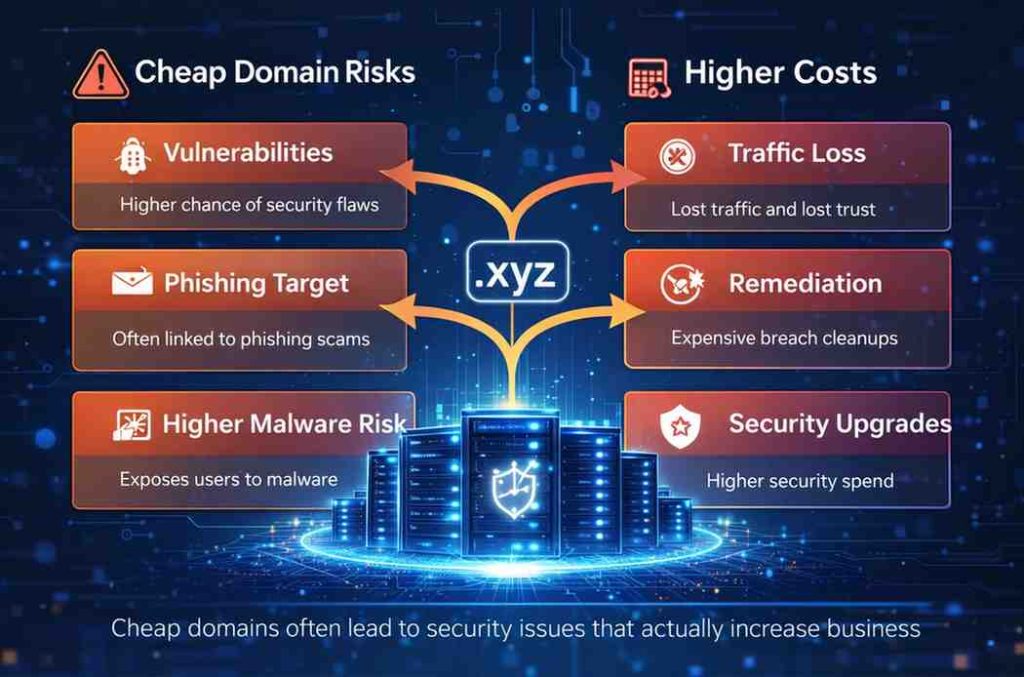
Security considerations rarely enter domain acquisition discussions, but they should. Certificate authorities, browser vendors, and security tools treat domains differently based on their reputation, age, and TLD.
Certain TLDs have higher premium domain pricing for phishing and malware. When you choose an obscure TLD because the .com was too expensive, you’re inheriting that reputation. Modern browsers implement sophisticated heuristics that flag new domains from suspicious TLDs more aggressively. Your perfectly legitimate application might face:
- More aggressive phishing warnings
- Slower SSL certificate issuance
- Higher scrutiny from payment processors
- Reduced trust scores from security tools
From an infrastructure perspective, this creates technical debt. You’ll spend engineering time debugging why your transactional emails are being flagged, why your API clients are seeing certificate warnings, or why enterprise customers can’t access your application behind corporate firewalls that blacklist entire TLD ranges.
DNSSEC implementation quality also varies by registry. Premium domains from established registries typically offer stronger DNSSEC support, more reliable key rollover, and better tooling for managing DS records. If you’re building infrastructure that handles sensitive data or needs to pass compliance audits, these aren’t nice-to-haves – they’re requirements.
Microservices, Subdomains, and Architectural Constraints
Modern web architectures rarely live on a single domain. You have:
- api.yourapp.com for backend services
- cdn.yourapp.com for static assets
- auth.yourapp.com for authentication services
- ws.yourapp.com for WebSocket connections
- admin.yourapp.com for internal tools
Each subdomain is a DNS lookup. Each lookup is a potential performance bottleneck. The quality of your domain’s DNS infrastructure scales multiplicatively with architectural complexity.
More critically, your domain structure encodes architectural decisions. Moving from a monolith to microservices often requires restructuring your domain topology. If you started with a cheap, fragmented domain strategy, you might face:
- Cookie sharing issues across subdomains (impacting authentication)
- CORS complexity from inconsistent domain patterns
- Certificate management overhead (especially with wildcard certs)
- Inconsistent caching behavior across CDN edges
Teams often discover these constraints only after architectural commitments are made. Changing your domain structure mid-flight is exponentially more expensive than getting it right initially.
The Hidden Costs of Domain Sprawl
Here’s a pattern I’ve seen repeatedly in fast-growing startups: early-stage teams grab whatever domain they can afford. As the product evolves, they add more domains:
- Different TLDs for different markets
- Alternative domains for testing or staging (that accidentally go public)
- Defensive registrations to prevent squatting
- New domains for new product lines
Within two years, they’re managing 15-20 domains across multiple registrars, with different renewal cycles, varying DNS configurations, and no centralized management. The engineering overhead becomes significant:
- Automated certificate renewal breaks when domains are spread across registrars
- Infrastructure-as-code configurations become fragmented
- Security audits require manual domain enumeration
- Compliance reporting requires tracking domain ownership across systems
This sprawl creates technical debt that costs developer time. Every sprint, someone is debugging a domain-related issue that could have been avoided with better upfront planning. The opportunity cost of this distraction compounds over time.
When Premium Domains Make Financial Sense (From a Technical Perspective)
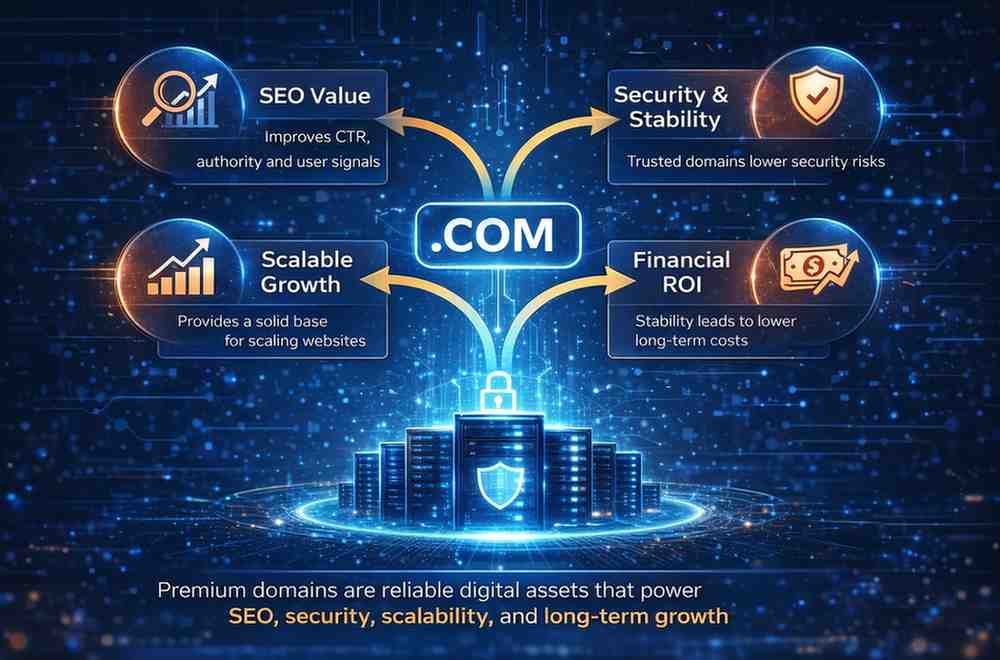
Premium domains cost more upfront. But from a technical perspective, the calculus isn’t straightforward.
Consider a SaaS startup targeting enterprise customers. A .com domain might cost $3,000-$10,000. Over five years, that’s $600 to $2,000 annually. Compare this to the engineering cost of:
- Debugging trust issues with enterprise firewalls (10-20 hours)
- Implementing workarounds for SSL certificate validation (5-10 hours)
- Managing domain sprawl and consolidation (20-40 hours)
- Performance optimization to compensate for DNS latency (10-20 hours)
At a fully-loaded engineering cost of $100-150/hour, you’re looking at $6,000-$12,000 in engineering time. The premium domain isn’t more expensive; it’s a way to prevent technical debt.
This calculation changes based on your architecture. If you’re building a consumer mobile app where users never see the domain, the branding value is minimal. But the infrastructure value remains: faster DNS resolution improves app responsiveness, better registry infrastructure means more reliable API uptime, and premium TLDs face less security scrutiny (reducing friction with platform approval processes).
The Developer’s Role in Domain Strategy
Domain decisions shouldn’t happen in isolation. When the marketing team selects a domain without technical input, they optimize for branding, which is important, but they miss critical technical considerations.
Developers should be involved early because they can evaluate:
- DNS infrastructure requirements for the planned architecture
- TLD reputation and its impact on security tooling
- Subdomain strategy based on service decomposition plans
- Certificate management complexity
- International deployment requirements (some TLDs have geographic restrictions)
- Long-term scalability (can this domain structure grow with our architecture?)
This doesn’t mean developers should make the final call. But they should provide technical requirements that constrain the decision space. Just as you wouldn’t choose a database without consulting the backend team, you shouldn’t choose a domain without understanding its technical implications.
In practice, this means including domain strategy in architecture design reviews. When you’re sketching microservices on a whiteboard, you should also be sketching the domain topology. You’re planning for scale, you should plan for domain infrastructure that scales with you.
Building Domain Infrastructure into Your Stack
Mature engineering organizations treat domains as managed infrastructure. This means:
- Domain configuration lives in infrastructure-as-code (Terraform, Pulumi, CloudFormation)
- DNS changes go through code review and CI/CD pipelines
- Domain renewals are automated and monitored
- SSL certificate management is automated (Let’s Encrypt, AWS ACM, etc.)
- Domain ownership is documented in runbooks and disaster recovery plans
When domains are managed this way, they become predictable infrastructure components rather than sources of operational chaos. You can version control your DNS configuration, test changes in staging environments, and roll back problematic updates.
This level of maturity requires starting with a domain structure that supports automation. Some registrars and TLDs have better API support than others. Some have better integration with popular infrastructure tools. These aren’t questions the marketing team can answer; they require technical evaluation.
Conclusion: Shifting Left on Domain Decisions
The software industry has embraced “shifting left,” moving quality, security, and operational concerns earlier in the development cycle. Domain strategy deserves the same treatment. By the time you’re managing DNS in production or explaining to your CEO why enterprise customers don’t trust your domain, you’ve already accumulated technical debt.
Domain selection isn’t a one-time procurement decision. It’s an architectural choice that influences performance, security, scalability, and operational complexity. Start treating domains as infrastructure: include them in architecture reviews, evaluate their technical properties alongside their branding value, and budget for quality domain infrastructure the same way you budget for quality cloud infrastructure.
The next time your team discusses domain options, don’t just ask “Does this domain sound good?” Ask, “Can this domain support our technical architecture for the next five years?” The answer will lead to better infrastructure decisions and fewer 3 AM pages about DNS propagation failures.