Crypto payment gateways are becoming increasingly visible, blurring the line between traditional finance and digital assets. Crypto processing enables businesses to accept crypto as easily as a bank card, without intermediaries and with much greater scalability.
The demand for such solutions is growing as companies seek faster payments, more predictable costs, and access to a global digital audience. This trend aligns with broader institutional adoption: while Gartner has not published a specific 2025 adoption percentage for crypto payments, earlier research indicated that 20% of large enterprises were expected to use digital currencies for payments, stored value, or collateral by 2024, signaling sustained momentum into 2025 and beyond. Providers building custom crypto payment infrastructure continue to observe this shift as enterprises modernize their payment architectures.
Table of contents
Crypto payment gateways: how it works
A crypto payment gateway is a software interface that accepts crypto from a customer and transfers it to the merchant in an agreed-upon format, either as a digital asset or as instantly convertible fiat currency. During payment, the system generates a unique address or QR code for the customer to send funds to. Once the transaction is confirmed on the blockchain, the gateway notifies the business of a successful payment and records it in the customer’s account.
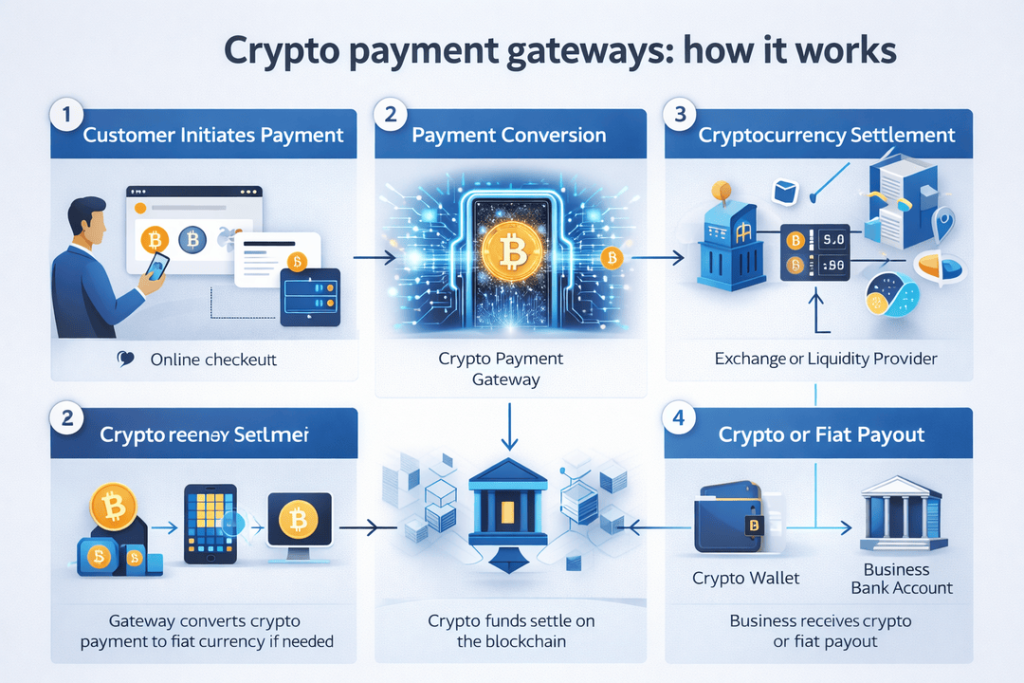
To minimize time delays, gateways work with blockchains, which provide high throughput and moderate fees. Some systems use internal mechanisms to accelerate verification, such as batching (grouping several individual transactions into a single transaction before sending them to the blockchain). Transaction aggregation (combining data from multiple transactions to enable compact recording and joint validation on the blockchain) may also be used. Additionally, the gateway verifies the amount, currency, and compliance of the payment parameters to prevent inaccuracies.
Importantly for businesses, there is no need to interact with crypto wallets or network settings yourself during the process. The gateway automatically processes the funds received, as well as:
- tracks status;
- creates accounting reports;
- ensures transparency of payment flow.
Such technology may be suitable even for companies that have never worked with digital assets. This enables rapid integration into the digital economy with minimal risk.
Integration with business processes
Cryptocurrency payment gateways are designed to integrate easily with existing company infrastructure, including custom crypto payment infrastructure development tailored to specific business needs. Online stores integrate them via CMS modules; corporate systems use APIs; and sales platforms rely on ready-made widgets that require no developer intervention. As a result, cryptocurrency payments can operate in parallel with traditional bank payment methods without disrupting internal fund acceptance workflows.
The gateway’s technical logic handles all blockchain operations. The business does not care about creating addresses, storing private keys, or signing transactions.
Most platforms automatically convert cryptocurrency amounts to the company’s chosen currency, avoiding exchange rate fluctuations. If a business wants to store crypto assets, the gateway allows you to receive payments without conversion by sending them to a corporate wallet.
Security is an important component of integration. Configured gateways use multi-layered protection:
- data encryption;
- access control;
- demarcation of rights;
- activity log;
- verification of automatic messages.
Such measures reduce the likelihood of manipulation or attempted interference. As a result, businesses receive a reliable level of payment protection without having to build their own cybersecurity systems.
Benefits for companies and their customers
Crypto payment gateways are attractive to businesses because they reduce their dependence on banks, payment aggregators, and international financial platforms. Crypto transaction processing fees are often lower and more predictable, and confirmation speeds are not tied to banking networks or time of day. This is very valuable for companies that work with foreign customers or sell across multiple continents.
For buyers, the advantage is simplicity. If the customer already has a crypto wallet, they can pay for the goods without additional checks, linking the card and the risk of blocking the payment due to the country of origin or bank restrictions. Payment does not require the transfer of confidential data, thereby increasing privacy.
For businesses, the interest also lies in the opportunity to work with a new category of buyers and users who actively pay with digital assets and choose companies that offer modern payment methods. Including crypto payments among payment options can increase conversion rates and reduce abandoned cart rates, especially in the international segment.
Things to remember: risks and ways to reduce them
Despite the obvious advantages, crypto payment gateways have certain features that require careful consideration. The first risk is volatility. Digital asset prices change rapidly. Unwanted fluctuations can affect a company if it accepts payments without conversion. To avoid this, most gateways offer the option to automatically convert crypto to fiat immediately upon receipt.
Crypto assets vary significantly across countries. Some jurisdictions view cryptocurrency as a commodity, others as a digital asset, and in some cases as a financial instrument. Therefore, companies should clarify reporting, taxation, and data retention requirements. Trusted gateways often provide documentation to facilitate this process and guidance on executing transactions.
There is also such a risk of unwanted transactions from addresses associated with illegal activities. High-quality gateways have built-in monitoring systems that use chain analysis to verify the sources of funds. If the system detects a risky address, the payment is blocked or sent for additional verification. Therefore, the business can operate transparently and avoid unwanted legal consequences.
Special attention needs to be paid to staff training. Employees responsible for financial transactions must understand the basic principles of working with digital assets and the procedures for handling disputes. This reduces the likelihood of errors and increases the efficiency of implementing a new payment method.
Why crypto payment gateways are becoming part of the future financial infrastructure
Crypto payment gateways not only complement existing payment methods but also introduce a new model of money flow: transactions are faster, easier, and subject to fewer restrictions. Businesses see this as an opportunity to deliver global services without barriers at every stage of payment acceptance. Instead of depending on regional banking regulations or lengthy international transfers, companies get a mechanism that works everywhere. This system requires only Internet access.
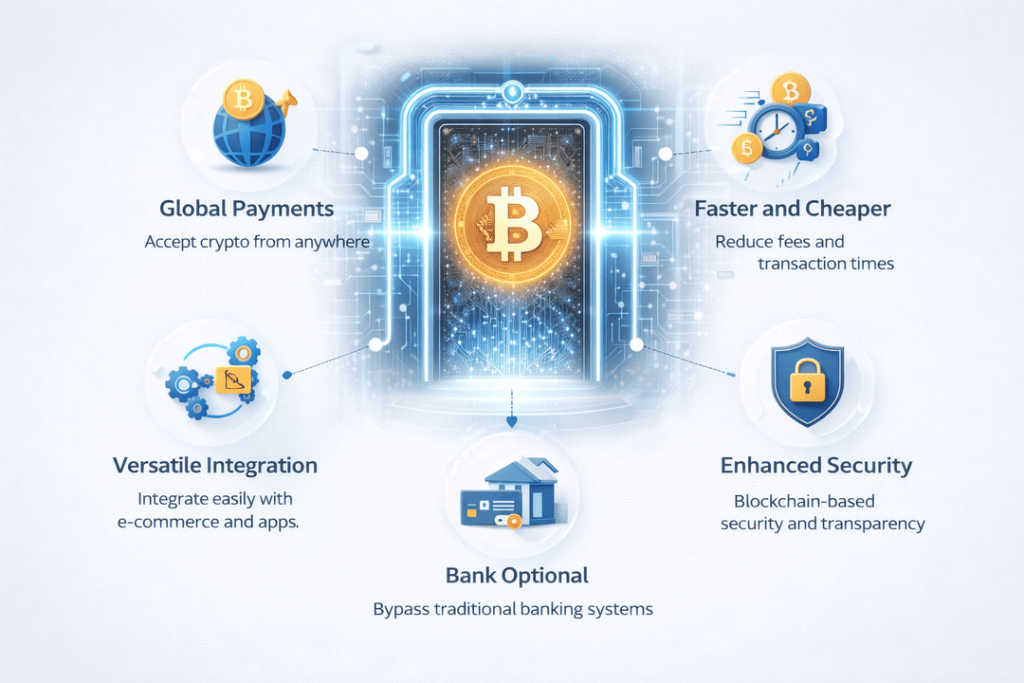
Crypto payment gateways are paving the way for a new era of e-commerce. Users are gaining greater freedom to choose their payment methods, and companies are gaining more room for growth. The implementation of such solutions is becoming less of a technical upgrade and more of a strategic move. A prominent real-world asset tokenization use case demonstrates how custom infrastructure can eliminate barriers, enabling instant liquidity and transparent ownership for traditionally illiquid markets.