Choosing the right tools from the start is one of the most important decisions you will make as a dropshipper. The wrong stack wastes money and creates blind spots. The right stack saves hours every week and-more importantly-gives you visibility into what you actually keep after every expense. This guide covers the essential dropshipping apps you need to launch and grow a profitable dropshipping business in 2026, organized by the job they do in your workflow.
| Before picking tools, commit to the Profit-first principle: every app you pay for should either save money, make money, or give you clarity on whether you are making money. If it does not, it is noise. |
Key Takeaways
- Choosing the right dropshipping apps is crucial for business visibility and profitability.
- Start with foundational tools like a store platform, supplier integration, and profit tracking to ensure viability.
- In 2026, customer acquisition costs and delivery expectations are higher, making margin management essential.
- Monitor all operational costs to prevent profit leakage and make informed scaling decisions.
- Use profit tracking tools from day one to maintain clarity and avoid losing money as you grow.
Table of contents
What Is Dropshipping & How Does it Work?
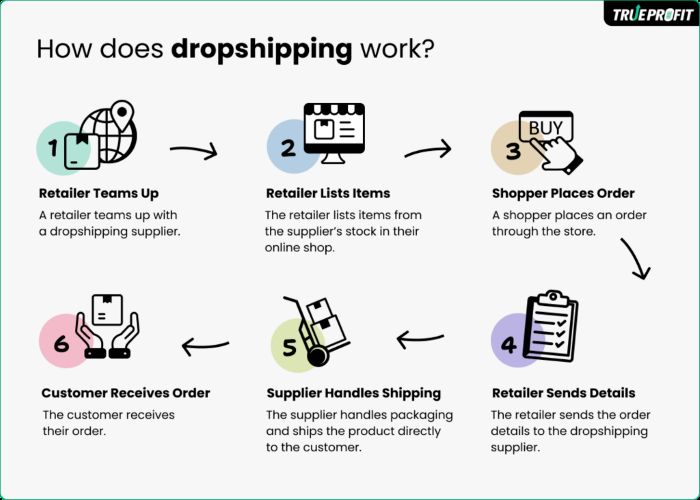
Dropshipping is a retail model where you sell products online without holding inventory. When a customer places an order, your supplier fulfills it and ships directly to them. You handle product selection, marketing, and customer experience. The supplier handles storage and shipping.
The appeal is real: lower upfront capital risk compared to buying stock in bulk, faster product testing, and the ability to run a lean operation from anywhere. Global ecommerce continues to grow, and low-barrier entry models like dropshipping continue to attract new sellers. But the landscape in 2026 is more demanding than it was a few years ago-and the sellers who thrive are the ones who approach it like a real business from day one.
How the process works, step by step:
- You market a product and drive traffic to your store via paid ads, organic content, or SEO.
- A customer places an order and pays you at your retail price.
- You pay the supplier the wholesale price and submit the order for fulfillment.
- The supplier ships directly to your customer, usually without branding.
- You keep the margin -the difference between what the customer paid and your total cost to deliver that order.
Three shifts define the market in 2026:
- Customer acquisition costs are higher and less predictable. Ad CPMs on Meta and TikTok have risen across most niches. A product that worked at a $15 CPA in 2023 may need $30+ today. Margin buffer is no longer optional-it is survival.
- Delivery expectations have tightened. Customers compare their experience to Amazon. Vague shipping timelines and inconsistent tracking drive up refund rates, even when the product itself is fine.
- Cost leakage is everywhere. Most sellers track product cost and ignore everything else: payment processing fees, currency conversion fees, dropshipping apps subscriptions, shipping charges, refunds, chargebacks, and taxes. That is how stores look busy while staying broke.
The Market Still Grows in 2026
Understanding the margin & income before you launch is the filter that separates products worth testing from ones that will quietly drain your budget.
According to TrueProfit’s data of typical dropshipping profit margins, many dropshippers aim for roughly 30-60% gross margin on the product economics, 60-70% gross margin and 15-25% net margin is often viewed as a strong benchmark when the niche allows it-because it gives you room for marketing, refunds, and operational surprises.
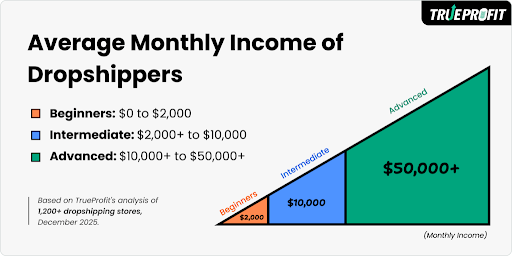
Based on TrueProfit’s report on December 2025, average monthly income typically falls into three bands:
- Beginners: $0 to $2,000/month
- Intermediate: $2,000+ to $10,000/month
- Advanced: $10,000+ to $50,000+/month
Essential Dropshipping Apps You Need to Start your Business in 2026
Store-Building Dropshipping Apps
Your store is your storefront, checkout, and first impression. In 2026, the bar for a credible store is higher-customers expect fast load times, clear policies, and trustworthy product pages.
1. Shopify
Shopify remains the default choice for dropshipping stores in 2026. Its ecosystem of dropshipping apps, straightforward checkout, and integrations with suppliers and profit-tracking tools make it the easiest platform to build on. Most dropshipping-specific tools are built Shopify-first.
Best for: Most dropshippers, especially beginners and those scaling to multiple products
Pricing: From $39/month (Basic). Higher tiers unlock better reporting and lower transaction fees-factor this into your unit economics.
2. WooCommerce
WooCommerce is a strong alternative if you want lower platform fees or need more customization. The trade-off is higher setup complexity and more maintenance. For dropshippers who already know WordPress, it can be cost-effective at scale.
Best for: Tech-comfortable sellers who want platform fee flexibility
Pricing: Free plugin; hosting typically $10-30/month. Costs scale with plugins needed.
Product Sourcing & Supplier Apps
Sourcing is where your margin is either protected or lost. Reliable fulfillment is not just a logistics issue-it is a profit issue. Late or inconsistent delivery drives refunds and chargebacks that quietly eat net profit. Prioritize suppliers who are predictable, not just cheap.
3. DSers
DSers is the official AliExpress dropshipping partner and the go-to tool for sourcing from Chinese suppliers. It handles bulk order processing, supplier mapping, and order tracking directly inside Shopify. Faster order processing reduces the gap between customer payment and fulfillment.
Best for: Dropshippers sourcing from AliExpress and wanting streamlined bulk ordering
Pricing: Free plan available. Paid plans from $19.90/month.
4. Spocket
Spocket focuses on US and EU suppliers, which means faster shipping times and fewer delivery complaints-a direct improvement to refund rates and customer satisfaction. Products cost more than AliExpress equivalents, but shorter shipping windows can improve conversion and reduce support overhead.
Best for: Dropshippers selling to US/EU customers who prioritize delivery speed
Pricing: From $39.99/month.
5. Zendrop
Zendrop offers a curated product catalog with faster shipping than standard AliExpress and private labeling options. It integrates directly with Shopify and simplifies the supplier relationship for sellers who want more control over brand presentation.
Best for: Sellers looking for faster shipping and branded packaging options
Pricing: Free plan available. Pro from $49/month.
Product Research Dropshipping Apps
Picking the wrong product is the fastest way to lose money in dropshipping. In 2026, the best products have clear demand, clear differentiation, and enough margin to survive normal acquisition cost fluctuations.
6. Minea
Minea tracks ads across Facebook, TikTok, Pinterest, and Snapchat to surface trending products and show what is actively being marketed. You can see which products are generating consistent ad spend-a signal of real demand rather than guesswork.
Best for: Dropshippers who want data-backed product selection before committing ad spend
Pricing: From $49/month. Starter plan available.
7. AutoDS
AutoDS combines product research with order automation, price monitoring, and inventory sync. For sellers managing multiple suppliers or large product catalogs, the automation reduces manual work and catches supplier price changes before they damage margin.
Best for: Sellers managing multiple SKUs or suppliers who need automation alongside research
Pricing: From $26.90/month depending on plan and store size.
Marketing & Traffic Apps
Marketing is where most of your cash will go. The goal is not high ROAS-it is profitable growth. A campaign can look great on ROAS and still be unprofitable once you factor in product costs, refunds, and payment fees.
8. Meta Ads (Facebook/Instagram)
Meta Ads remain the dominant paid channel for dropshippers in 2026. The targeting options and visual ad formats work well for demonstrating physical products. CPAs have risen, so margin buffer matters more than ever before you scale a campaign.
Best for: Visual products with broad consumer appeal; stores with enough margin to absorb CPM fluctuations
Pricing: Variable ad spend. Budget at least $500-1,000/month for meaningful test data.
9. TikTok Ads
TikTok Ads continue to offer lower CPMs than Meta in many niches, especially for younger audiences and trend-driven products. Native-looking video content significantly outperforms polished ad formats on this platform.
Best for: Trend-driven products; sellers comfortable with video creative production
Pricing: Variable ad spend. TikTok recommends a minimum of $50/day per ad group for testing.
10. Klaviyo
Klaviyo handles email and SMS flows that recover abandoned carts, re-engage past buyers, and build repeat purchase behavior. Post-purchase flows reduce one-time buyer dependency and improve customer lifetime value-a key driver of long-term profitability.
Best for: Stores with meaningful traffic volume ready to build retention revenue
Pricing: Free up to 250 contacts. Scales with list size from ~$20/month.
Conversion & Trust Dropshipping Apps
Traffic means nothing without conversion. In dropshipping, trust is a conversion lever-customers cannot physically inspect your product, so your store has to build confidence instead.
11. Loox
Loox collects and displays photo and video reviews from real customers. Visual reviews are the highest-trust form of social proof for physical products-they show the product in real-world use and reduce purchase hesitation. Automated review request emails handle collection without manual effort.
Best for: Any store selling physical products where buyer uncertainty is high
Pricing: From $9.99/month.
12. GemPages
GemPages lets you create product-specific landing pages with benefit-focused layouts, comparison sections, and stronger calls to action-without a developer. Dedicated landing pages consistently outperform default Shopify product pages for paid traffic campaigns.
Best for: Sellers running paid traffic who want higher conversion rates from existing ad spend
Pricing: From $29/month.
Operations & Customer Service Apps
Operational costs are where profit leaks quietly. Refunds, chargebacks, and support time all have a direct cost-even if they do not show up in your ads dashboard.
13. Gorgias
Gorgias centralizes customer support across email, live chat, and social into one dashboard, with Shopify order data surfaced directly alongside each ticket. Faster resolution reduces chargeback risk and repeat contacts-both of which carry a real cost for dropshipping stores.
Best for: Stores with growing support volume or chargeback exposure
Pricing: From $10/month (Starter). Scales with ticket volume.
14. AfterShip
AfterShip sends automated shipping updates to customers, dramatically reducing ‘Where is my order?’ support tickets. Proactive tracking updates manage expectations and reduce refund requests caused by buyer anxiety rather than actual delivery failure.
Best for: All dropshipping stores-especially those with longer fulfillment timelines
Pricing: Free plan for basic tracking. Paid from $11/month.
Profit Tracking & Financial Visibility Apps
This is the category most dropshippers underinvest in-and the one that determines whether you can scale confidently or keep guessing. Revenue screenshots are not profit. The costs that kill dropshipping businesses are the ones that stack quietly: payment processing fees, currency conversion fees, Shopify app subscriptions, shipping charges, refunds, ad spend, and taxes. Without one place that tracks all of these, your profit number is fiction.
15. TrueProfit
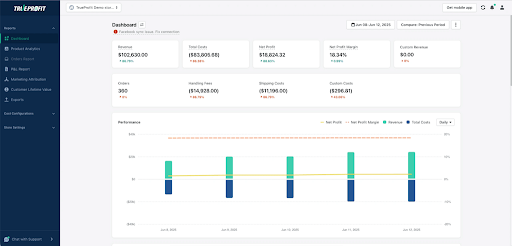
TrueProfit is a Net Profit Analytics platform built specifically for Shopify merchants-including dropshippers and print-on-demand sellers-who want a profit-first view of their business. Instead of piecing together data from Shopify reports, your ad platform, and spreadsheets, TrueProfit gives you a real-time profit view that accounts for every cost category.
Core capabilities:
- Real-time profit dashboard – product, ad channel, and store level in one view
- Accurate cost tracking – COGS, shipping, payment fees, currency conversion, refunds, taxes, and custom costs
- Ad spend sync – pulls ad costs directly from Meta, TikTok, Google, and other platforms
- P&L reporting – clear income statement view by day, week, or month
- Customer value insights – LTV and CAC trends to inform scaling decisions
- Mobile monitoring & all-store view – track profit across multiple stores from anywhere
Shopify’s built-in reports do not capture ad spend or most operational costs. Spreadsheets break at scale. TrueProfit fills that gap so every decision-which product to push, which channel to increase budget on, which cost to cut-is based on what you actually keep.
Best for: Dropshipping stores with stable revenue, or those who want to track all expenses from day one
Pricing: From $35/month with free trial available
Why Profit Tracking Belongs in your Stack from Day One
| Most sellers add a profit tracking tool after they have already lost money. The better move is to install it before you scale. Knowing your real unit economics early-before you double ad spend-is what separates stores that grow confidently from stores that stay busy while staying broke. |
Quick Reference: Essential Dropshipping Apps in 2026
| Category | App | Starting Price |
| Store Platform | Shopify | $39/mo |
| Store Platform | WooCommerce | Free (+ hosting) |
| Supplier / Sourcing | DSers | Free / $19.90+ |
| Supplier / Sourcing | Spocket | $39.99/mo |
| Supplier / Sourcing | Zendrop | Free / $49+ |
| Product Research | Minea | $49/mo |
| Product Research | AutoDS | $26.90/mo |
| Paid Acquisition | Meta Ads | Variable |
| Paid Acquisition | TikTok Ads | Variable |
| Email / SMS | Klaviyo | Free / ~$20+ |
| Social Proof | Loox | $9.99/mo |
| Landing Pages | GemPages | $29/mo |
| Customer Support | Gorgias | $10/mo |
| Order Tracking | AfterShip | Free / $11+ |
| Profit Analytics | TrueProfit | $35/mo (free trial) |
How to Think About Your Dropshipping Apps Stack
Not all dropshipping apps in this guide is essential from day one. The priority order matters.
- Start with the foundation: a store platform, a supplier integration, and a profit tracking tool. These three determine whether your business is viable.
- Add when you have traffic: marketing tools, landing page builders, and email flows become valuable once there is volume to optimize.
- Add when you have scale: customer support platforms and advanced research tools justify their cost when the volume is there.
The stores that fail in dropshipping usually do not fail because they used the wrong ad platform. They fail because they never had visibility into their real profit-and scaled something that was losing money without knowing it. Build your stack around clarity first. Revenue is easy to see. Net profit is what you keep.