MLA style is one of the most popular styles of the humanities. In 2026, when writing an essay, research paper, or other assignment, you will know how to implement the MLA heading and the MLA header so that you may have a professional structure and avoid the typical errors. Such formatting rules will help you write good and tidy papers that will fulfill your academic needs.
Although the two terms are similar, MLA heading and MLA header have different usage in an academic paper. In this blog, we’ll walk you through both, explain where to place them, how they differ, and how they fit into MLA format essay heading and MLA format paper heading requirements in 2026. By the end, you’ll know exactly how to apply MLA style headings and MLA style headers in your essays.
Key Takeaways
- MLA style is crucial for humanities papers, ensuring proper structure and professionalism.
- The MLA heading appears only on the first page, containing your name, instructor, course, and date.
- The MLA header includes your last name and page number, appearing on every page to maintain organization.
- Following MLA format requires double spacing, 1-inch margins, and a readable font like Times New Roman.
- Understanding the differences between the MLA heading and MLA header helps avoid common formatting errors.
Table of Contents
What Is MLA Format?
The Modern Language Association is referred to as MLA. It is a writing style mostly applied in the study of the humanities, e.g., literature, language, and cultural studies. One of the most significant parts of this format is the MLA paper heading, which allows your instructor to identify your work and preserve the format.
Key formatting basics include:
- 1‑inch margins on all sides
- Double spacing throughout
- 12 pt readable font, such as Times New Roman
- Page numbers in the running MLA formatting header
- Left‑aligned text for body paragraphs.
Now we’ll break down exactly what an MLA heading and MLA header mean in this context.
What Is an MLA Heading?
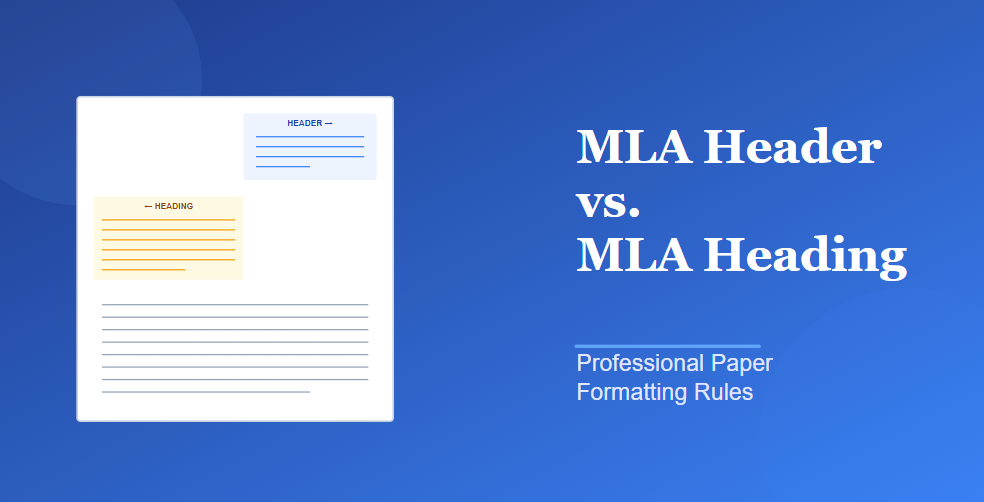
An MLA heading format is the text at the top of the first page of your essay or research paper. This is also referred to as the MLA essay heading or MLA paper heading. The MLA heading contains the details about you, your instructor, and the assignment. It is printed on the first or title page of your paper.
Here’s what the proper MLA format heading usually includes, in order:
- Your full name
- Your instructor’s or professor’s name
- The course name or number
- Date (in Day Month Year format)
This part is different from a title page. Most MLA papers do not use a separate title page unless your teacher specifically requires it. Rather, you write this MLA format essay heading on the very first page.
One aspect that should not be neglected is that an MLA heading is presented only once on the first page. It is not repeated on each page of your paper.
MLA format heading example:
- Numan Ijaz
- Professor Khalid Ahmed
- ENG 202
- 24 January 2026
After that, you center your title. Then start your essay text below the title, indented properly.
What Is an MLA Header?
The MLA header format is not the same as the heading. A header appears in the header section (the top margin area) of every page of your paper.
In the MLA style header, you include:
- Your last name
- A space
- The page number
This header appears on the upper right-hand side of every page, including the first one. It is one-half inch above the top; it is level at the right; and in the same type with the rest of your paper.
MLA header example
Ijaz 1
Then the second page will be:
Ijaz 2
…and so on.
This header for MLA format helps your reader know whose work they’re reading and what page they’re on. It’s especially useful when printing or transferring multiple pages digitally.
MLA Format Heading Paper Rules
Here’s a checklist you should follow when formatting your MLA format paper heading on the first page:
- Double-space the entire page
- Use a readable font (e.g., Times New Roman, 12 pt).
- Margins should be set to 1 inch on all sides.
- Don’t use bold, italics, or underline in your heading.
- Use title case for your essay title (capitalize main words).
- Keep your heading left-aligned before the title and text.
After the heading on the MLA paper, add your essay title centered on its own line, then start your first paragraph. This is the standard MLA format paper heading structure instructors expect in 2026.
MLA Format Header Rules
For the MLA format paper header that appears on every page:
- Move to the header section of your document.
- Right-align your text.
- Enter your last name followed by a space and the page number.
- Page numbers should be Arabic numerals (1, 2, 3…).
- Keep the font and size the same as the rest of your paper.
This proper MLA paper header adds an important element to ensure your instructor never loses track of your pages.
Why Do Both MLA Heading and MLA Header Matter?
The MLA format heading and header serve separate but complementary purposes:
- The MLA heading format provides your instructor with all the identifying information for your assignment and is used only on the first page.
- The MLA header format (name + page number) also helps keep pages in order, easy to locate, and readable for readers and graders.
All these make your paper look professional and easy to follow part of what instructors want when they demand an MLA format paper heading and header for MLA format.
Key Differences Between MLA Header and MLA Heading
Here’s a side-by-side comparison to clarify the difference between the MLA paper heading format and the MLA header format:
| Feature | MLA Heading | MLA Header (Running Header) |
|---|---|---|
| Placement | First page only | Every page |
| Purpose | Identifies the writer and assignment | Pagination and organization |
| Content | Name, Instructor, Course, Date | Last name + page number |
| Alignment | Left-aligned | Right-aligned |
| Required | Yes (unless title page is used) | Yes |
| Example | Numan IjazProf. SmithEnglish 10124 January 2026 | Ijaz 1 |
| Appears in MLA Paper | Yes (only on the first page) | Yes (on every page) |
This comparison should make clear how MLA style headings and MLA style headers serve different functions in your formatting structure.
What About Section Headings and Subheadings?
In addition to the main MLA heading for the essay and the MLA header for the paper pages, your essay might have section headings to organize content, especially in longer academic work.
Unlike APA, MLA doesn’t have strict rules for how many levels of MLA format headings you can use, but the general expectations are:
- Level 1 Headings: Bold, flush left
- Level 2 Headings: Regular text, flush left
- Level 3 Headings: Italic, flush left
Keep headings consistent in style throughout the paper. These internal headings are optional, depending on the length and complexity of your paper. Many essays don’t need them, but research papers with multiple sections often do.
Title Page vs. MLA Heading
There’s a difference between a title page and an MLA heading in an MLA format paper. MLA does not usually require a title page unless your instructor specifically asks for one. A title page is a separate cover page that shows your title, author information, course, and date.
Most MLA papers do not require a separate title page unless your instructor specifically asks for one. Generally, you use the MLA heading on the first page instead.
Title Page (when required):
- Appears before the first page of text
- Contains the title, your name, course info, instructor, date, and sometimes the institution
- It is centered, double‑spaced, and stands alone
MLA Heading (standard):
- Appears on the first page of your essay
- Includes your name, instructor, course, and date at the top left
- Your centered title comes right below this information
- The main text begins under the title.
Unless your instructor directs otherwise, use the MLA heading instead of a title page.
Common Mistakes in MLA Heading and Header
Students often make the same errors with the header MLA format and heading MLA format. Here’s what to watch out for:
- For MLA essay header:
- Forgetting to include it on every page
- Including the full name instead of just the last name
- Misaligning it (should be right-aligned)
- For MLA headings:
- Placing heading text in the header section instead of the body
- Forgetting double spacing
- Skipping elements like the instructor’s name or date
Centering the heading (only the title should be centered)
Step-by-Step Setup for MLA Heading and Header
To make the correct MLA format heading and MLA formatted header in Word or Google Docs:
- Set page margins to 1 inch on all sides.
- Choose a readable font (e.g., Times New Roman, 12 pt).
- Insert proper MLA format heading on page 1 (left-aligned).
- Center your title directly below your heading.
- Add MLA-formatted header (last name and page number) in the top right corner of every page.
- Double-space all text throughout the paper.
Conclusion
In conclusion, the distinction between the MLA header and MLA heading is the key to the correct formatting of your academic papers in 2026. The MLA headings give important information about your paper, e.g., your name and course, and date, which is only displayed on the first page. On the contrary, the MLA header will be at the bottom of each page, and there will be your last name and the page number, making it easy to organize your work.
Using the correct MLA formatting of the heading as well as the header, you guarantee that your paper is presented in the form that is required by academia, and therefore, your professor can read and even grade it much more easily. It is important to remember that although certain papers might need a title page, others will be written using the standard MLA heading format. Thus, a clear understanding of these aspects will ensure that your paper is overseen by MLA standards and thus more expert and readable.
FAQs
No, you do not need a title page in MLA format unless your instructors request it. Instead, the title page is the essay title as it appears on the first page.
Yes, MLA requires both a heading and a header. The heading appears on the first page with your name, instructor, course, and date, while the header (last name + page number) appears on every page of the paper.
The first page of an MLA heading must include your full name, the name of your instructor, the name of your course/number, and the date in Day Month Year form.
No, there are no MLA headings and subheadings, but they may be applied in longer papers to make it clearer. They must be used in a consistent formatting (with title case) of headings.
No, the MLA heading is only presented on the first page. The MLA header containing the last name and page number is placed on each page.