Introduction
In 2026, when we talk about marketing, it is no longer just about running ads and posting content. Incredibly, it is about using technology wisely to gain a complete understanding of people. Over the last few years, artificial intelligence has been used across almost every field of marketing, including writing captions, creating engaging videos, and predicting customer behavior. According to McKinsey’s 2024 Global Survey on AI, 65% of organizations now regularly use generative AI in at least one business function, with marketing and sales leading adoption. This shows that AI is no longer experimental; it has become a mainstream tool shaping modern business decisions.
As part of the broader Marketing Trends 2026, we are observing something surprising: human creativity has become rare, while artificial intelligence has become common. Customers and audiences are now far smarter. They can easily sense whether the content is automated, lacks emotions, or is generic. Moreover, changes in algorithms, privacy concerns, and new search behaviors are prompting marketers to reshape their tactics. Owners of different brands, bloggers, and market experts agree that 2026 is all about maintaining balance, blending authenticity with automation, emotion with data, and strategy with speed. Below are some of the most fundamental and powerful trends experts expect to redefine this year.
Table of contents
- Introduction
- Human-Generated Content Becomes a Powerful Asset
- Short Videos Dominate The Buying Decisions of Customers
- Transitioning from Channels to Systems in Performance Marketing
- AI Becomes Common, But Tactics Become The Main Power
- Generative Engine Optimization (GEO) Replaces Old SEO Thinking
- Human-Led Content
- Deep Personalization and Community-Driven Marketing
- Conclusion
Human-Generated Content Becomes a Powerful Asset
With the help of Artificial Intelligence, business owners can now write blogs, generate video scripts, and design graphics. As a result, content created by humans is valued more than ever. In 2026, the year of advancement, those brands that have created their real identities, real stories, and experiences will stand out in the competitive market. Rather than idealized enhanced marketing messages, audiences place greater importance on relatability and honesty.
Significantly, in the background videos, stories, founder and customer testimonials, and opinions that are not filtered, trust builds more quickly than robotic perfection. Brands that blend wise marketing automation with original storytelling will gain more attention and loyalty in 2026.
Short Videos Dominate The Buying Decisions of Customers
In 2026, one of the best strategies that truly defines marketing is creating short videos. There are various social media platforms, such as Instagram, TikTok, and YouTube, where reels and short videos posted by people are no longer just apps for entertainment. But they are now considered useful search engines and platforms for hassle-free shopping. Significantly, most customers now discover products through a 30-second video before making a purchase. Businesses can expect most customer purchases to be made through short video content this year.
It is essential to create useful, engaging, and clear content videos that resolve customer issues, rather than just creating random clips. In addition, in-video shopping is another astonishing marketing trend in 2026. Customers can watch a video, click on a product, and purchase it directly from the video.
Transitioning from Channels to Systems in Performance Marketing
“This year, marketing will shift its focus from channel optimization to system optimization,” says Wyatt Mayham, Founder of Northwest AI Consulting.
High-performing teams will ask, “How fast does data move from signal to decision?” rather than, “What’s working on LinkedIn or Google?” By integrating audience segmentation, lifecycle messaging, creative testing, and attribution into ongoing feedback loops, AI is enabling this. Feedback velocity is the competitive advantage, not tool availability. Teams that can monitor behavior, adjust messaging, and redeploy spend in real time will perform better than teams still using static campaigns. Additionally, there will be more living systems, always-on testing, modular creative, and adaptive funnels, instead of one-time launches.
Marketing executives will begin to resemble operators, creating workflows that enhance learning. In this context, efficiency is about bridging the gap between insight and action rather than reducing expenditure.
AI Becomes Common, But Tactics Become The Main Power
In the past years, individuals felt innovative by simply using AI, but in 2026, it is essential to use AI wisely. Businesses use AI tools for customer service, email customization, content drafting, data analysis, and campaign optimization. When discussing AI in marketing 2026, professionals suggest that the main difference between successful and average brands lies not in AI itself but in strategic thinking.
As it is obvious that all businesses have easy access to the same AI tools, clarity and creativity become the deciding elements. AI can generate ideas, but it cannot fully understand a brand’s emotional and cultural values or its long-term vision. Therefore, marketers need to focus keenly on asking better questions, defining their goals clearly, and building strong brand identities.
Generative Engine Optimization (GEO) Replaces Old SEO Thinking
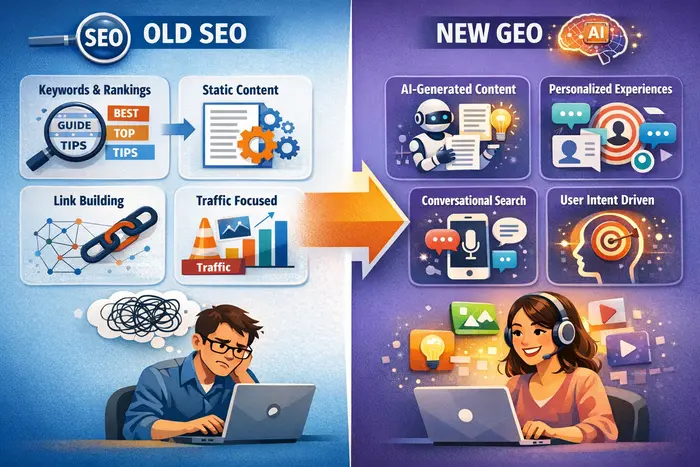
Over time, search engine behavior is changing rapidly. Rather than browsing links and searching for keywords in Google, most users now ask AI for summarized answers to their queries. As a result, professional marketers predict a rise in GEO.
Generative Engine Optimization focuses on creating content that is easy for AI systems to understand, analyze, summarize, and suggest. It means writing answers in clear words, using properly structured headings, providing authentic information, and building powerful authority. Thus, in 2026, marketers were directed to optimize both humans and AI systems simultaneously.
Human-Led Content
The content economy has changed dramatically because of the rise of AI. Human judgment is now the key factor, as anyone can quickly create blogs, ads, and social media posts, says Sari Honkala, Digital Marketer & Co-Founder at Glow Digital. This year, brands will focus on unique ideas, firsthand knowledge, and distinct viewpoints instead of generic, “optimized” content. While AI won’t be the author, it will remain a strong tool for speeding up processes. Mass-produced content will fall short compared to content that shows real knowledge, such as case studies, personal insights, behind-the-scenes processes, and firsthand accounts. Both audiences and search engines are getting better at spotting sameness. At Glow Digital, we have already seen higher engagement when experts share client stories, founder voices, and nuanced viewpoints instead of focusing on volume. In a world full of content, credibility is valuable. The brands that succeed will publish with purpose rather than just produce more.
Deep Personalization and Community-Driven Marketing
“Today, ordinary marketing messages are losing their grace and power. Customers’ expectations become higher now. They want more personalized services across all social media platforms. Customization is not limited to using the customer’s first name in the email. It involves suggestions for useful products based on behavior, personalized experiences on websites, and targeted content that should be a true reflection of the customer’s interests,” says Dr. Nick Oberheiden, Founder at Oberheiden P.C.
Moreover, AI helps make it possible, but building trust should be the priority. Brands need to be transparent about data collection and its use. In addition, influencer marketing is not only powerful; community marketing is also fundamental. Rather than relying solely on big names and celebrities, brands should build small, trustworthy, and loyal communities through newsletters, private groups, and interactive live sessions.
Conclusion
Thus, in 2026, it is not about picking one between humanity and technology. But it is all about using both wisely. Artificial intelligence plays a key role in transforming workflows, enhancing efficiency, and accelerating effective decision-making. Short videos can define inventions. GEO will help change how brands appear in search results. Customization and building community will shape loyalty. But above all, authenticity is a powerful currency. Audiences are fed up with noise; they place greater importance on value, clarity, and honesty. Those brands will succeed in 2026 who use technology as a supporting tool while keeping humans’ emotions at the center of every message and communication.