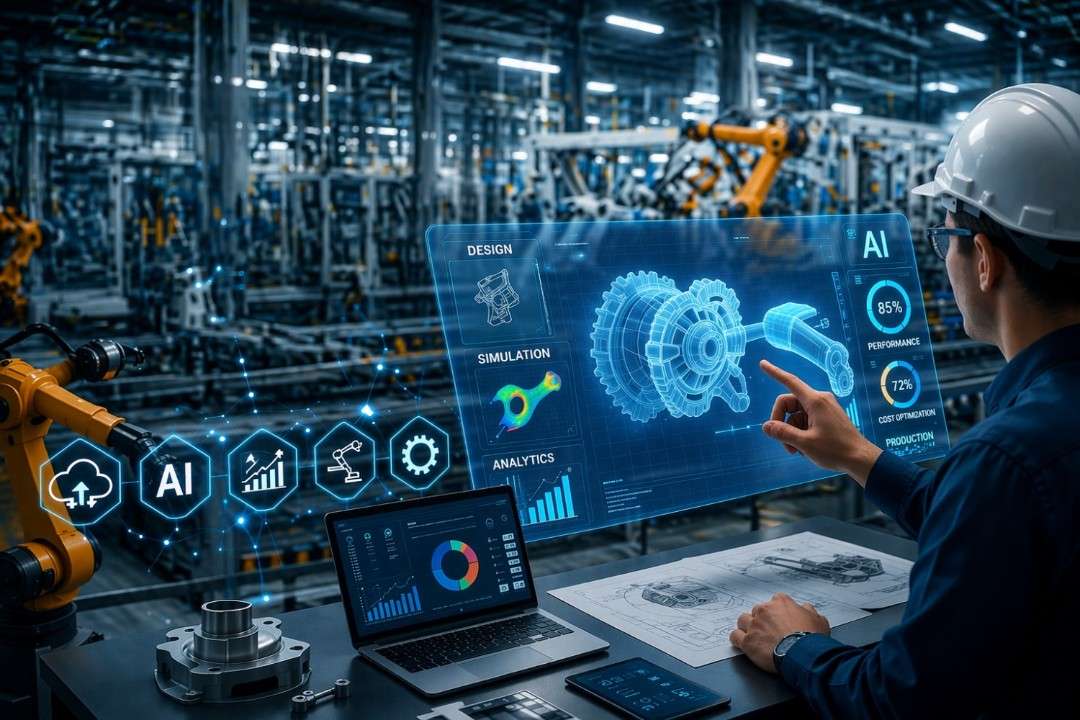
Manufacturing executives face a paradox. Their companies operate some of the world’s most sophisticated equipment, yet many still rely on spreadsheets, email chains, and disconnected tools to manage product development. The gap between operational capability and development process efficiency has never been wider, and it’s costing them real money.
Digital transformation in manufacturing product development isn’t a future trend. It’s happening now, reshaping how teams collaborate, iterate, and bring products to market. The companies winning this race share something in common: they’ve fundamentally changed how information flows through their development processes.
Table of contents
- The Hidden Costs of Disconnected Development
- What Digital Transformation Actually Means for Product Development
- The Rise of AI-Driven Intelligence in Manufacturing Development
- Establishing Product Lifecycle Management as Your Digital Foundation
- Practical Digital Transformation: From Strategy to Execution
- Release Management and Launch Excellence
- Building an Innovation Culture with Digital Tools
- Comparison: Traditional vs. Digital Product Development
- The ROI of Digital Transformation in Product Development
- The Reality Check: Transformation Takes Time
- Conclusion: The Transformation Imperative
- Frequently Asked Questions
The Hidden Costs of Disconnected Development
Most manufacturing organizations inherited their product development workflows from the pre-cloud era. A typical process looks like this: engineering creates designs in CAD, component data lives in spreadsheets, procurement uses separate systems, supply chain has its own tools, and manufacturing planning references printed documents. Information gets copied, pasted, and retyped across platforms. Versions multiply. The single source of truth becomes a myth.
The costs are substantial but often hidden. A mid-sized automotive supplier discovered they were maintaining the same component information across seven different systems. Engineers spent 15-20% of their time finding correct data rather than using it. When a supplier change occurred, updating all seven systems took weeks instead of hours.
This fragmentation creates more than operational friction. It introduces quality risks. When component specifications exist in multiple places and diverge, manufacturing may build products that don’t match design intent. Supply chain commits to timelines based on outdated information. Product launches slip. Costs overrun.
The spreadsheet problem deserves special attention. Excel is powerful for analysis, but it was never designed for collaborative product development. It lacks version control beyond crude “v2” and “v2_FINAL” naming conventions. There’s no audit trail showing who changed what and when. Multiple people editing the same sheet creates conflicts.
Yet thousands of manufacturing companies run critical product data this way, treating spreadsheets as their system of record.
What Digital Transformation Actually Means for Product Development
Digital transformation in manufacturing isn’t about buying technology for its own sake. It’s about restructuring how information flows and how teams interact with that information.
For manufacturing product development, transformation typically involves several key shifts:
- From sequential to collaborative workflows: Traditional product development moved linearly: engineering completes designs, hands them off to procurement, then to manufacturing planning, then to the supply chain. Each handoff creates delays and information loss. Cloud-based platforms enable parallel work. Engineering, procurement, and manufacturing can access the same product data simultaneously, flag conflicts in real time, and resolve them without formal meetings or email chains.
- From static documents to living data: A PDF design document is a snapshot. It becomes outdated the moment someone changes the design. Cloud systems treat product information as living data that updates everywhere simultaneously. When an engineer modifies a component specification, everyone who depends on that data sees the change instantly. There’s a single version of truth, not dozens of conflicting copies.
- From manual data entry to automated integration: Digital transformation eliminates rework. Rather than manually copying specifications from CAD into spreadsheets, systems integrate. When a designer adds a new component in the product structure, that component automatically appears in the bill of materials, triggering procurement workflows, manufacturing cost calculations, and supply chain planning. Humans make decisions. Machines handle data transfer.
- From delayed feedback to real-time visibility: In traditional workflows, discovering manufacturing constraints happens late, during detailed planning. Digital systems provide real-time feedback. As engineers design, they immediately consider supply availability, cost implications, and manufacturing feasibility. They make smarter trade-offs earlier, when changes are cheap.
The Rise of AI-Driven Intelligence in Manufacturing Development
Artificial intelligence is accelerating these transformations. AI doesn’t replace human judgment in product development, but it dramatically amplifies it.
Consider design optimization. Traditional approach: engineers design a component, manufacturing calculates cost, procurement checks supply availability, and analysis takes days or weeks. Modern approach: AI systems process multiple design options simultaneously, modeling cost, manufacturability, supply risk, and performance implications in hours. Engineers evaluate far more alternatives before committing to one.
Supply chain risk prediction is another area where AI adds enormous value. Manufacturing product development depends on suppliers. But which suppliers are at risk? Which components face supply vulnerability? Which markets are experiencing shortages? AI systems monitor supplier financial health, geopolitical factors, demand signals, and historical disruption patterns to flag risks early. Product teams can redesign around vulnerable supply chains before problems impact production.
Bill of materials (BOM) management is traditionally tedious and error-prone. AI-driven systems can analyze BOMs to identify cost-reduction opportunities, suggest standard parts to reduce the number of suppliers, flag components with long lead times, and highlight single-source dependencies.
Establishing Product Lifecycle Management as Your Digital Foundation
Effective digital transformation requires a capable product lifecycle management system as the backbone. The right product lifecycle management platform serves as the central nervous system for product development, managing the complete product from conception through launch and beyond.
A strong PLM platform manages the bill of materials, tracks engineering changes, maintains revision history, controls access to sensitive product data, and integrates with downstream systems like ERP and manufacturing execution systems. Most importantly, PLM creates a single source of truth for all product information.
For manufacturing organizations, modern PLM platforms eliminate the chaos of disconnected data. They provide the foundation for collaboration, enable compliance with quality and regulatory requirements, and create the traceability that manufacturing demands. When product lifecycle information lives in a single system rather than scattered across spreadsheets and email, teams can see real-time status, spot conflicts early, and coordinate work seamlessly.
Practical Digital Transformation: From Strategy to Execution
Digital transformation fails when companies treat it as an IT project. It succeeds when treated as a business transformation with technology as the enabler.
- Start with process clarity: Most manufacturing companies have never documented their actual product development process. Engineers follow implicit workflows, making individual decisions about how to collaborate. Digital transformation requires making these processes explicit. Map the current state: where does product information originate, how does it flow between teams, where do decisions happen, and where do errors creep in. Understanding the current process reveals where digital tools will have the most impact.
- Choose platforms that support collaboration, not silos: This is crucial. Many companies select tools that automate their existing broken processes. They digitize spreadsheet workflows into systems that still operate like spreadsheets: isolated, hard to integrate, requiring manual handoffs. Look for platforms designed for collaborative product development that enable seamless data flow between design, engineering, procurement, manufacturing, and the supply chain.
- Invest in data governance: Digital systems create opportunities for real-time visibility only if data quality is high. That means establishing clear standards: who can create or modify product information, when changes are locked or visible, how versions are managed, what information is required before something becomes official. Good data governance may seem like bureaucracy, but it actually reduces work by eliminating confusion about what’s current and correct.
- Build integration architecture: Rarely will a single platform handle every function. You’ll need CAD tools, ERP systems, PLM systems, and specialized applications. Integration matters more than any individual platform. Design your system architecture so information flows between tools automatically, not manually.
Release Management and Launch Excellence
One often-overlooked aspect of digital transformation is release management. Traditional approaches to product launches are fragile: engineering freezes the design and hands it off to manufacturing, which must scramble to understand the intent and determine production feasibility. Late discoveries trigger delays and expensive rework.
Digital transformation restructures this completely. Product release readiness becomes a continuous process, not a sudden event. As design approaches completion, manufacturing can see updated BOMs, procurement can validate supplier readiness, supply chain can confirm material availability, and quality teams can review specifications. By the time the official release date arrives, everyone is already prepared.
Following product release process best practices means establishing clear gates, ensuring all functions sign off electronically, maintaining audit trails, and treating the release process as a managed transition rather than a chaotic hand-off. When you structure the release process this way, you capture handoff documentation, track decisions, and eliminate the scramble that characterizes traditional product launches.
Digital systems make this governance possible and visible to all stakeholders. Manufacturing can see the complete lifecycle journey of each product: design decisions, engineering approvals, supplier confirmations, and quality sign-offs. That visibility translates directly to execution reliability.
Building an Innovation Culture with Digital Tools
Digital transformation enables more than efficiency. It enables innovation velocity.
When information flows seamlessly, when teams can see the same data simultaneously, when AI-driven analysis surfaces insights quickly, engineers can experiment more. They try more design options. They explore more material alternatives. They model more manufacturing approaches. They fail faster with low-cost digital prototypes before committing to expensive physical prototypes.
Companies that excel at this shift from “design-and-release” mentality to “design-test-iterate-release” mentality. Digital tools make iteration cheap and fast. That’s powerful.
Comparison: Traditional vs. Digital Product Development
| Aspect | Traditional Approach | Digital Transformation |
| Data storage | Spreadsheets, local files, email | Cloud-based single source of truth |
| Version control | Manual naming (“v2_FINAL”) | Automatic revision tracking with audit trail |
| Team collaboration | Sequential handoffs, email chains | Real-time parallel access for all teams |
| Design-to-manufacturing | Weeks of manual data transfer | Automated BOM sync from CAD to production |
| Change management | Email notifications, manual updates | Formal approval workflows with full traceability |
| Supply chain visibility | Delayed, fragmented reporting | Real-time dashboards and AI-driven risk alerts |
| Product release | Chaotic hand-off, late discoveries | Continuous readiness with electronic sign-offs |
The ROI of Digital Transformation in Product Development
| Metric | Typical Improvement |
| Product development cycle time | 30-40% reduction |
| Design errors caught before production | 60-80% increase in early detection |
| Time to market | 25-35% faster |
| Engineering change processing | 50-70% faster approval cycles |
| BOM-related production errors | 70-85% reduction |
| Cross-team collaboration efficiency | 2-3x improvement |
The Reality Check: Transformation Takes Time
Digital transformation in manufacturing doesn’t happen overnight. Companies starting from spreadsheets and disconnected tools often need 12-18 months to fully transform. That’s normal and expected. The journey involves change management, training, process redesign, and often cultural shifts.
But the payoff justifies the investment. The metrics above represent real improvements reported by companies that have completed their transformation journey.
More importantly, transformed companies can respond to market changes faster. They can pivot product strategies without massive rework. They can accommodate supplier disruptions by quickly redesigning around alternatives. They can launch variants and extensions without treating each as a massive undertaking.
Conclusion: The Transformation Imperative
Manufacturing executives no longer have the luxury of waiting. Digital transformation in manufacturing isn’t a nice-to-have initiative. It’s becoming table stakes for competitive companies.
The good news: technology exists today. Cloud platforms, AI systems, integration frameworks, and collaborative tools are mature and proven. The limiting factor isn’t capability. Its execution.
Start with process clarity. Choose platforms that enable collaboration. Build governance disciplines. Integrate systems thoughtfully. Measure relentlessly. Build your organization’s capability step by step.
The companies leading manufacturing today aren’t better at hardware. They’re better at information flow and decision-making speed. Digital transformation makes information flow seamless and decisions fast. That’s the competitive advantage worth pursuing.
Frequently Asked Questions
What is digital transformation in manufacturing?
Digital transformation in manufacturing is the process of using technology to fundamentally restructure how organizations develop, produce, and deliver products. Rather than automating existing broken processes, true digital transformation in manufacturing reimagines how information flows, how teams collaborate, and how decisions are made. It shifts from disconnected legacy systems and manual workflows to integrated cloud-based platforms where teams work on the same real-time data.
How does PLM software support product development?
Product Lifecycle Management software serves as the central hub for all product-related information. PLM systems manage bills of materials, track engineering changes and revisions, control who can access sensitive product data, maintain audit trails of all modifications, and integrate with manufacturing and supply chain systems. This creates a single source of truth that enables teams to collaborate in real time, catch conflicts early, and ensure products are built according to current design intent rather than outdated spreadsheets.
What are the biggest challenges in manufacturing digital transformation?
The primary challenges are organizational rather than technical. Change management often tops the list: helping teams unlearn old spreadsheet-based workflows and embrace collaborative systems takes time and training. Data governance is another major hurdle: establishing standards for how product information is created, modified, and approved requires discipline. Legacy system integration can also complicate transformation, as companies often must maintain connections to older ERP or CAD systems while adopting new PLM platforms.
How does AI improve manufacturing product development?
AI accelerates decision-making and dramatically reduces analysis time. In design optimization, AI can evaluate dozens of design options simultaneously for cost, manufacturability, supply risk, and performance, work that used to take weeks. AI also predicts supply chain risks by analyzing supplier financial health, geopolitical factors, and historical disruption patterns. For BOM management, AI identifies cost reduction opportunities, flags components with long lead times, and highlights single-source dependencies. The result is engineers making better-informed decisions faster, with lower cost and lower risk.
What is the difference between traditional and cloud-based PLM?
Traditional PLM often operates on-premises with limited real-time collaboration. Cloud-based PLM enables simultaneous access to product data from anywhere, automatic synchronization across teams and locations, seamless integration with other cloud tools, and built-in security and compliance features. Cloud systems also scale more easily, cost less to maintain, receive continuous updates and improvements, and support the distributed teams that characterize modern manufacturing organizations.