
Surely, if you take a few seconds to look at most companies today, you’ll find more than one contradiction, especially between how they talk about AI and the spreadsheets still quietly running their day-to-day operations. This is especially true of executives, who never stop talking about Artificial Intelligence, as if it had already completely transformed their business: nearly automated work, approved budgets, and satisfied shareholders.
However, if you dig a little deeper into the operations side, much of that business is still supported solely by spreadsheets, email chains, and shared folders (understandable only to those who originally created them). This is why we say there’s a huge gap between what companies say and what they actually do (at least when it comes to AI). This may well be the biggest problem in the world of corporate technology today.
Table of contents
The Readiness Gap
If we look at this 2026 survey of more than 1,500 executives involved in the world of AI, conducted by Publicis Sapient, we’ll see that the gap we’re talking about is represented by a stark statistic. 71% of respondents (in the U.S.) expect multiple significant advancements within 1 or 2 years thanks to AI. Only 20% of respondents say their company can implement these changes right now. These figures reflect an optimism that is by no means grounded in reality.
The most important insight we can glean from this report is the reason for the lack of a foundation. The answer isn’t a lack of talent or shortcomings in AI models, but rather that most of the systems and workflows used since before the implementation of AI were never intended to be modernized. You can have the latest AI agent on the market, but if the data you work with every day is scattered across multiple outdated spreadsheets (which no one trusts), there’s nothing this agent can do to fix that.
Why the Spreadsheet Earned Its Place
But let’s be fair to spreadsheets: they’ve earned their place. For decades, they were, without a doubt, the best tool available. Flexible, accessible, inexpensive, requiring no procurement processes, and above all, requiring no programmer or developer. For example, a company’s operations manager could put together a basic, functional tracker without having to mobilize the entire IT department. A finance manager could create a proper budget model before the lunch break, and the list goes on. These are, of course, real advantages, and also the reason why these spreadsheets ended up becoming the core of operations for a wide variety of companies.
So, what’s the problem? Well, mainly, it’s when this tool, originally intended for individual calculations, ends up handling collective, ongoing work. Version control becomes a system of trust that no one takes responsibility for; whether the tracker reflects the latest changes depends on whether someone remembers to update it; permission to access files becomes a matter of life and death; and so on.
None of the above is entirely the spreadsheet’s fault, of course, because it wasn’t originally designed to handle all that. And this breakdown does occur, albeit slowly enough that most companies don’t notice it until it’s already too late.
What Actually Changed
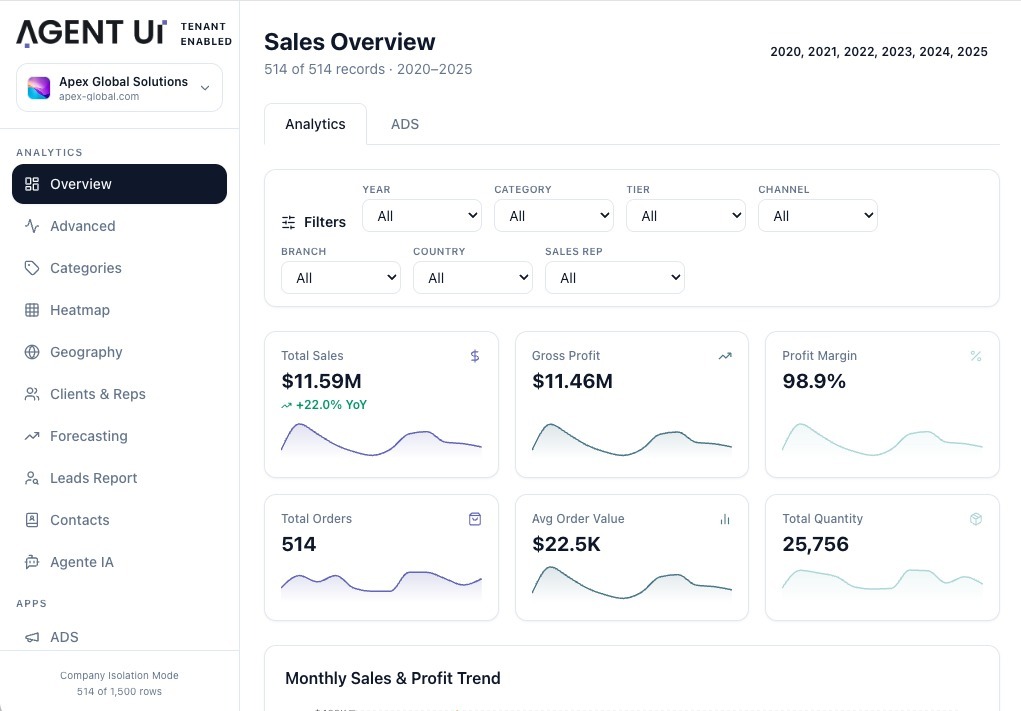
For more than two decades, the most logical alternative to using a spreadsheet was to commission the development of software from scratch, which required developers, time, and, above all, money. This alternative almost always stood a poor chance of success, not because it was a bad idea, but because it was both too slow and too expensive, so it was never even considered.
In today’s market, this has changed. AI-powered “no-code” platforms allow a team or user to describe the desired process in simple language and have a system up and running in no time. Gartner projects that 70% of new applications built by enterprises will use low-code or no-code technology by the end of this year, up from less than 25% just three years ago, which gives a sense of how quickly this shift has actually been happening.
AgentUI is a clear example of this: teams simply describe the internal tool they need, and it is built based on that description, without the need for developers or an IT team.
Pricing typically varies based on team size and intended use, replacing the typical upfront fixed cost of traditional software projects, so trying it out doesn’t mean betting your entire budget on a single decision.
With this in mind, there’s no longer a technical barrier.
The Part That Doesn’t Make the Shareholder Report
Virtually every survey on enterprise AI reveals the same pattern: companies are making more progress in adopting multiple AI tools than in fixing the operational problems on which those tools depend. An AI assistant, no matter how good it is, will summarize those three disconnected spreadsheets just as haphazardly as the mess it’s summarizing.
These AI agents, designed to automate an approval process, need actual processes to connect to, not just scattered PDFs and a chat group.
No one writes “we finally connected the order tracker to the inventory system” in a report to shareholders. It doesn’t sound like innovation. But it’s often the real difference between an AI project that changes how a company operates and one that remains a nice demo that no one uses after the second month.
What This Looks Like Once It’s Fixed
Allowing ourselves to move beyond spreadsheet-based operations doesn’t mean eliminating them, but rather placing those parts of our business that depend on shared, up-to-date data onto a system built to handle all this workload. All employees will be using the same up-to-date file, so there’s no need to worry about that. Data will move between systems on its own, rather than someone having to manually enter it, one by one. As for access, it can be truly restricted, so a client can view their project, a contractor can see the tasks to be performed, and the budget remains visible only to those who actually need to see it.
None of the above requires a company-wide deployment to start seeing results. Organizations that derive real value tend to start small: a single process, a small team, an obvious pain point, and, above all, testing before rolling it out everywhere. It is also, quite rightly, the best way to begin closing the readiness gap measured by Publicis Sapient. No one is going to modernize their entire operating model in a single sprint, but rather workflow by workflow, until the “that’s just how we do things here” mindset disappears.
The Question Worth Actually Asking
In most companies, the question of whether AI has a place in their business has become a practically settled debate. What remains is another question that’s even harder to answer: will our operational infrastructure really hold up, or is it still running on the same spreadsheets that were never designed to handle such a heavy load? Companies that ask themselves these questions are often the ones that turn AI implementation into a real advantage rather than just another initiative.
The Pattern Repeats Across Industries
Change the details, and the story remains almost the same. A distributor that has to juggle its warehouse inventory in a shared spreadsheet hits the same wall as a service firm that manages all its clients’ work in the same way. The same thing happens to a logistics company handling shipments and purchase orders manually. The industries may vary, but the problem remains the same: data becomes out of sync, no one is sure which is the latest version, and the people doing the actual work end up spending more time maintaining the tracking system than doing the work that the system itself is supposed to support.
What’s different today is the cost to a company of waiting. Competitors who have already automated their operations naturally move faster under the same circumstances and can detect problems before they become catastrophic.
In today’s market, where AI-driven efficiency is more of a requirement than a nice-to-have, relying on spreadsheets isn’t just slower. It often becomes the real reason why a company’s ambitions and its reality are so far apart, and why moving beyond spreadsheet-based operations stops being optional the moment a business is actually serious about AI.