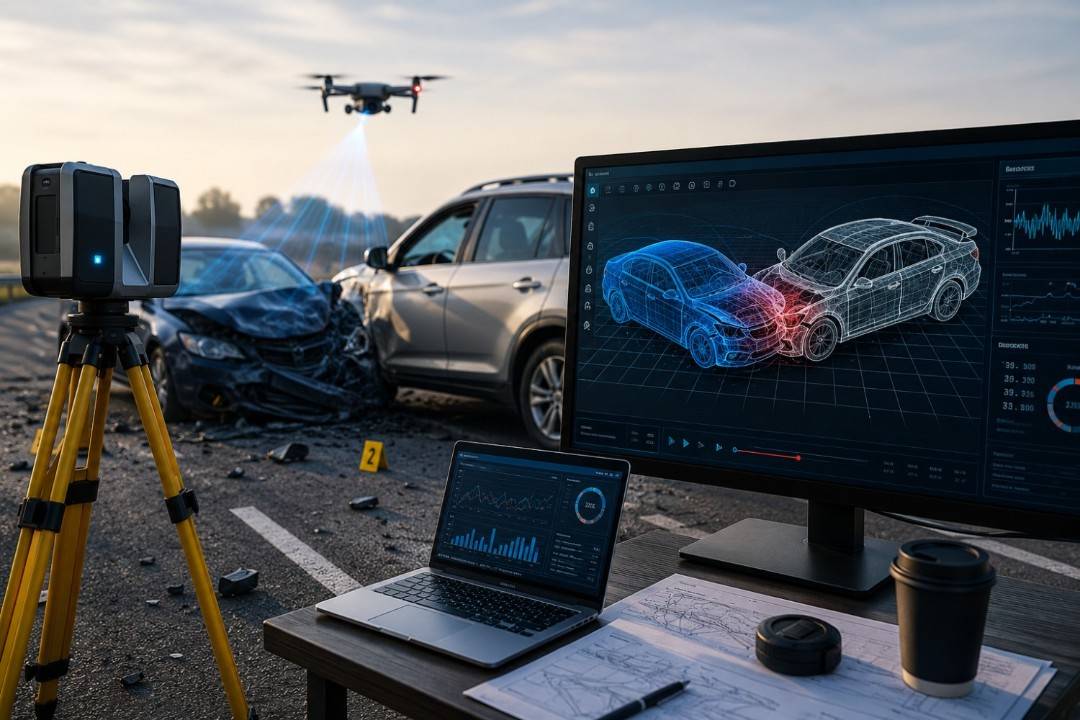
Crash reconstruction has become a data-intensive discipline. The physical evidence that investigators once relied on exclusively, tire marks, vehicle deformation, and road surface traces, now shares the analysis stage with electronic logging device outputs, vehicle black box data, LiDAR mapping, and AI-assisted trajectory modeling.
The quality of a personal injury claim involving a serious vehicle crash increasingly depends on how effectively this data is collected, processed, and presented. Unlike a typical passenger vehicle collision, a truck crash may involve multiple sources of electronic evidence, federal safety records, commercial maintenance logs, driver qualification files, and several potentially liable parties. As a result, truck accident cases are harder, take longer to complete, and require coordination between accident reconstruction experts, engineers, and industry specialists.
In Texas, where the Texas Department of Transportation documented 14,893 serious injury crashes in 2024 across a highway network that includes some of the most freight-dense corridors in North America, the intersection of technology and legal liability is producing new standards for how crash investigations are conducted.
Table of Contents
Event Data Recorders and What They Capture
Every passenger vehicle produced in the United States since 2014 carries an event data recorder, commonly called a black box, under a National Highway Traffic Safety Administration mandate. Commercial trucks carry similar systems that feed directly into the electronic logging device network.
In the five seconds before a crash, a vehicle’s event data recorder captures speed, engine throttle position, brake application, seatbelt status, and steering input at a sampling rate of one reading per second for most systems and up to 10 readings per second for newer models. In crashes where the airbag deploys, the recorder locks its data and cannot overwrite it, preserving the pre-crash record automatically.
Commercial truck black boxes capture a longer horizon of data. GPS position logs, idle time records, speed variation over routes, and hard-braking events are all recorded continuously. The Federal Motor Carrier Safety Administration requires carriers to retain this data for six months. An attorney who sends a spoliation letter to a carrier within days of a crash puts the company on legal notice that the data must be preserved beyond the standard retention period.
For this reason, attorneys handling serious truck accident cases often send preservation, or spoliation, letters shortly after a crash and, when necessary, seek court orders to prevent the destruction of electronic evidence. Attorneys at Sutliff & Stout use these preservation tools as part of their investigation when electronic data may play an important role in establishing how a collision occurred.
LiDAR and Photogrammetry in Scene Documentation
Light Detection and Ranging systems, called LiDAR, use laser pulses to generate three-dimensional maps of a physical space with millimeter-level accuracy. Law enforcement agencies in Harris County and across major Texas jurisdictions have adopted LiDAR scanning for crash scene documentation, creating complete digital records of the scene that can be revisited virtually months or years later in litigation.
Photogrammetry extracts three-dimensional measurements from photographs. When LiDAR scanning is not available or is deployed after some evidence has been cleared, a reconstruction specialist can use photographs taken by first responders, witnesses, or traffic cameras to generate measurement-accurate spatial models of the scene.
Both technologies reduce the dependency on the physical preservation of the crash site. A Houston vehicle accident attorney working with a reconstruction specialist who used LiDAR at the scene can present a digital model to a jury that shows precisely where each vehicle was, how fast it was traveling, and what the geometry of the collision looked like, without relying solely on witness testimony that varies with memory. For victims seeking legal guidance after a collision, a Houston Car Accident Lawyer can also help explain how this type of reconstruction evidence may support their case.
Telematics Data and the Commercial Carrier’s Digital Trail
Commercial vehicles operating in the United States generate telematics data continuously. The onboard computer system records fuel consumption, engine temperature, transmission shift patterns, and diagnostic fault codes alongside position and speed data. Fleet management platforms used by major carriers aggregate this data in real time for dispatch and efficiency monitoring.
In a crash investigation, telematics data provides context that the event data recorder alone cannot. If a truck’s engine computer recorded a recurring brake fault code in the weeks before a crash, that record becomes evidence that the carrier had knowledge of a mechanical problem and failed to address it. If the telematics system recorded that the driver had exceeded hours-of-service limits on previous days in the same week as the crash, that pattern becomes evidence of systemic compliance failure rather than an isolated driver error.
Discovery requests in commercial truck accident cases now routinely include demands for telematics data, carrier fleet management platform records, and any maintenance work orders generated in response to fault codes. Carriers that delete or allow this data to expire after a crash face spoliation arguments in Harris County courts.
AI-Assisted Trajectory Modeling and Its Evidentiary Limits
AI tools are now used to generate trajectory models from incomplete data sets. When dashcam footage captures only a partial view of the vehicles before impact, and event data recorders from only one vehicle are available, AI reconstruction software uses the available inputs to generate probabilistic models of the vehicles’ positions and speeds.
These models carry significant persuasive weight in front of a jury that is not technically trained. They also carry significant vulnerability to legal challenge. Texas courts apply the Daubert reliability standard to expert evidence under Texas Rule of Evidence 702, which requires that a methodology be tested, subject to peer review, and carry a known error rate. AI reconstruction tools that are proprietary and not subject to independent peer review face challenges to admissibility that traditional physics-based reconstruction methods do not.
An attorney presenting AI-generated trajectory evidence in a Harris County District Court should be prepared to explain the algorithm, its training data, its validation history, and its error rate in terms that a trial judge can evaluate without a technical background.
What This Means for the Injured Party
The technology available to crash reconstruction experts has made it harder for trucking companies and their insurers to contest well-documented crashes. It has also made it easier for those same companies to challenge claims where the documentation is incomplete.
A crash victim who does not preserve evidence at the scene, who declines a medical evaluation before symptoms fully develop, and who waits months to consult an attorney may find that the best available reconstruction tools cannot compensate for the absence of the data that would have supported their claim.
Sutliff & Stout is a Houston personal injury law firm that has recovered over $1 billion for injured Texans. The firm coordinates with licensed accident reconstruction specialists who use current technology to document crashes in Harris County and across the Texas highway system.
The technology serves whoever moves first.