
Sudoku puzzles have long fascinated math enthusiasts and problem solvers. Machine learning has changed how we create and solve these number challenges. Now, computers can make complex sudoku puzzles with great creativity and precision. Modern artificial intelligence brings a new way to understand and solve sudoku puzzles. Advanced algorithms can make unique puzzles and solve them faster than most people. These systems analyze patterns, recognize logical structures, and solve puzzles like humans do.
The mix of computer intelligence and puzzle design is exciting. Neural networks and advanced algorithms can make puzzles for all skill levels. AI shows great potential in understanding and mimicking human logic.
This exploration will show how technology changes sudoku puzzles. We’ll see how artificial intelligence tackles these challenges, mixing math, computer science, and creative problem-solving.
Key Takeaways
- Machine learning has transformed how we create and solve sudoku puzzles, enabling computers to generate complex challenges with precision.
- AI uses advanced algorithms and neural networks to recognize patterns and solve sudoku puzzles faster than humans.
- Hybrid methods combine traditional techniques with machine learning, enhancing the effectiveness of solving sudoku puzzles.
- Neural networks, including convolutional and recurrent types, learn from large datasets to improve their ability to solve complex puzzles.
- The future of solving sudoku puzzles with AI promises innovation, pushing the boundaries of creativity and problem-solving.
Table of contents
The Intersection of Artificial Intelligence and Sudoku Puzzles
Sudoku puzzles are a big deal for artificial intelligence researchers. These 9×9 grids are more than just fun—they’re complex problems for AI. Neural networks can solve them by checking thousands of number combinations at once.
Pattern recognition is key for AI solving these puzzles. Unlike humans, who use logic, AI uses fast algorithms. Sudoku is perfect for testing AI because it has clear rules and goals.
Solving sudoku is not just for fun. It helps improve AI’s problem-solving skills in many areas. By using neural networks, researchers create smart algorithms that find the right numbers fast.
Sudoku has turned into a big challenge for AI learning. It shows how AI tackles problems in a unique way. This mix of AI and puzzles keeps pushing the limits of machine learning.
Machine Learning Algorithms for Generating Sudoku Puzzles
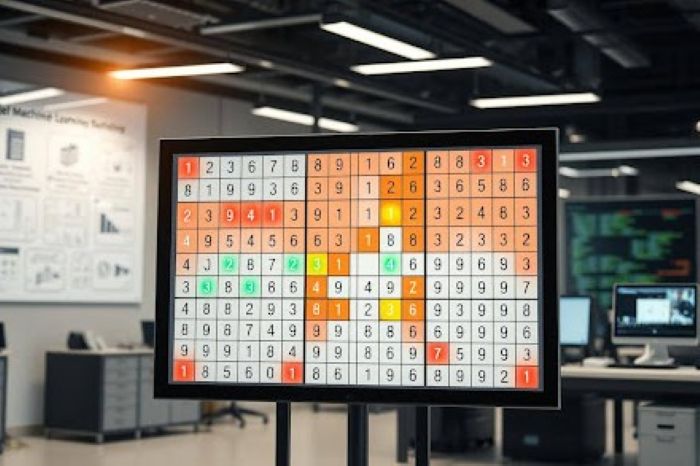
Creating sudoku puzzles needs smart computer methods. Sudoku solver algorithms are key in making puzzles that are fun and hard. They use advanced ways to make grids that test players but can be solved perfectly.
Constraint satisfaction is vital in making puzzles. These algorithms remove numbers from a full grid. This makes sure each puzzle has only one answer. Machine learning looks at many puzzles to learn about patterns and how hard they are.
Backtracking algorithms are a strong way to make puzzles. They fill the grid carefully, trying different ways to make puzzles with certain features. Genetic algorithms go further, treating puzzle parts like traits to be improved.
It’s hard to make puzzles that are both challenging and solvable. But, advanced machine learning can now make puzzles with the right level of difficulty. This lets puzzle apps and websites keep offering new puzzles for players.
These computer methods change how solving sudoku puzzles is approached. They move it from a manual task to a smart, data-based process, keeping players interested and engaged while making the experience more fun.
How Neural Networks are Solving Sudoku Puzzles and Challenges
Deep learning has changed how we solve puzzles, especially complex ones like Sudoku. Neural networks can recognize patterns in these number grids like never before. They use AI to learn and solve Sudoku puzzles in new ways.
Convolutional neural networks see Sudoku puzzles as visual patterns. They look at how numbers relate in rows, columns, and boxes. Starting with little knowledge, these AI systems learn from thousands of puzzles. They get better at solving them by adjusting their own rules.
Recurrent neural networks are great at making decisions step by step. They fill in Sudoku cells with great accuracy. These AI models break down puzzles into smaller steps, solving even the toughest ones. They can spot patterns that humans might miss.
Researchers are always finding new ways to use neural networks for puzzles. Even though it’s hard to use lots of computers, the idea of solving puzzles in new ways is very exciting.
Comparing Traditional Methods to AI-Powered Approaches
Solving Sudoku puzzles has changed a lot with new computer methods. Old ways like backtracking algorithms are still used. They check all possible answers, removing ones that don’t fit the puzzle.
Constraint satisfaction is another old but effective method. It uses logic to figure out where numbers can go. This makes solving puzzles faster by cutting down on possibilities.
Now, machine learning sudoku solvers bring a new way to solve puzzles. Neural networks find patterns and learn from solving puzzles. This means they can find new ways to solve puzzles that humans might not think of.
Hybrid methods are the latest innovation. They mix old algorithms with new machine learning. This mix uses the best of both worlds to solve puzzles faster and more accurately.
When comparing, traditional methods are good for simple puzzles. But, machine learning is better for harder ones. Each method has its own strengths. The choice depends on the puzzle and the tools you have.
Conclusion
Machine learning has changed how we are solving sudoku puzzles. AI can now create and solve sudoku puzzles faster than ever before. This shows how AI and math can work together in amazing ways.
AI uses neural networks and algorithms to solve puzzles that humans find hard. These tools don’t just solve puzzles; they show AI’s power in solving complex problems. The skills used in sudoku help in many areas, like planning and logical thinking.
The story of sudoku and AI is one of constant improvement. AI gets better at solving puzzles, but the real challenge is making puzzles that are even harder. Everyone is looking forward to seeing what new AI strategies will come next.
The future of sudoku and AI looks bright and full of surprises. The mix of human creativity and AI keeps leading to new ways to solve problems. It shows that even simple puzzles can lead to big tech breakthroughs.