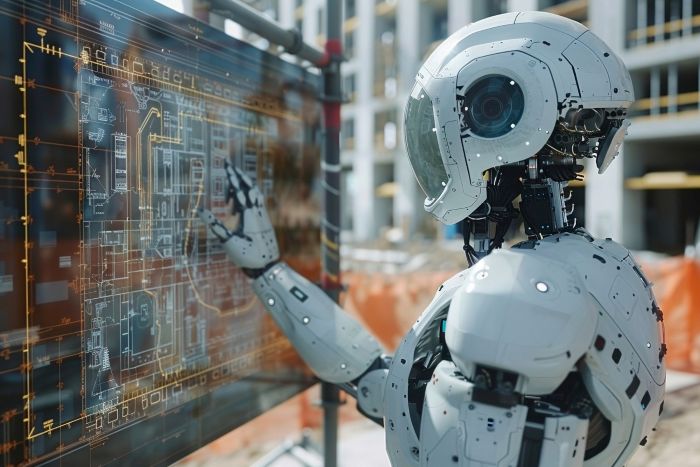
In today’s age, we are moving towards an era when robotics, cloud computing, and artificial intelligence (AI) are no longer separate innovations. Instead, they are merging to redefine the way companies operate. From powering next-generation data centers to choreographing complex supply chains, convergence is posing as the foundation of world scalability and resilience during the modern surge of global innovation.
With experience in both cloud infrastructure and robotics-driven systems, I’ve seen firsthand how organizations can unlock massive efficiencies, cost reductions, and reliability improvements. These occur when these technologies are strategically combined.
Key Takeaways
- Robotics, AI, and cloud computing are merging to redefine how companies operate, enhancing scalability and resilience for global innovation.
- Cloud infrastructure enables robotics to communicate across regions, improving efficiency, uptime, and reducing operational costs.
- AI algorithms enhance robotics by enabling predictive maintenance and workload balancing, driving dynamic optimization.
- Automation and standardization in deployments help companies maintain compliance and reduce time-to-market for new technology rollouts.
- Industry 4.0 is approaching, promising real-time optimization, resilient supply chains, and greener operations powered by this convergence.
Table of Contents
Robotics and Cloud: A Global Transformation
Advanced robotics solutions in manufacturing, logistics, and mechatronics are producing huge amounts of data and need millisecond-level decision-making. Previously, data was processed locally on secluded systems, which was a constraint in scalability.
Using cloud infrastructure, companies program robots to communicate with multiple regions at the same time by relying on standardized systems and centralized data analysis. As a result, it makes possible global innovation with:
- Cross-region scalability: Systems can be deployed across multiple regions with no interruption.
- Resilience: Cloud-backed robotics can failover instantly, with downtime minimized.
- Efficiency: Pipeline centralization reduces redundancies and accelerates optimization.
The result is smarter factories, optimized logistics, and more sustainable operations. These operations are powered by a blend of cloud-native systems and robotics.
Lessons from Multi-Region Deployments
In the technology industry, we see companies rolling out robotics and cloud infrastructure to emerging geographic territories. They have demonstrated how business success is driven by strategic infrastructure.
- Up to 40% latency savings are realized when end users see workloads processed nearby, eliminating cross-continent bottlenecks.
- 99.99% uptime reliability is now standard, thanks to cloud-native failover and distributed redundancy.
- Operational cost savings are provided through automated scaling, energy-efficient data centers, and shared resource patterns.
- Adoption rates grow exponentially in emerging markets when there is localized infrastructure available. This highlights the cause-and-effect correlation between technology performance and business growth.
These findings point to a key reality: the union of robotics and cloud is not so much about technology. However, it’s about creating a sustainable, global competitive edge.
AI as the Bridge Between Robotics and the Cloud
While there is a great combination of robotics and scalable cloud infrastructure, we also need to keep in mind the layer of intelligence. This intelligence is what neural networks and Artificial Intelligence (AI) can bring to bridge the two.
Examples in this today include:
- Using Predictive maintenance through AI algorithms on cloud platforms to detect anomalies in robotic arms before they fail, reducing downtime.
- Algorithms can balance workloads across several facilities so robotics systems operate at optimal capacity to help with dynamic optimization
- Human enhancement: AI-driven robotics frees up routine work from engineers so that they can focus on strategic innovation.
These capabilities are not science fiction. In fact, industries from aerospace to health care to green manufacturing are already leveraging them.
Building Resilience for Global Innovation Through Standardization
One of the biggest issues with global technology rollout is maintaining consistency. This is particularly challenging in areas with differences in terms of regulatory, environmental, and operational conditions.
By automating robotic and cloud deployments, organizations can:
- Ensure security compliance across numerous jurisdictions.
- Reuse automation infrastructure to drive new region rollouts (shortening time-to-market by up to 50%).
- Retire technical debt via standardized architectures and clean codebases.
This approach has become a blueprint for industry best practices. It has impacted technology businesses as well as finance, healthcare, and government businesses.
Industry 4.0: The Road Ahead
We are on the cusp of Industry 4.0, when cyber-physical systems, robotics with AI capabilities, and cloud-native architecture are transforming industries. They are reshaping industries in their entirety.
- Smart factories will optimize themselves in real-time with sensor and cloud feedback.
- Global logistics networks will adapt dynamically to disruptions, and supply chains will become resilient.
- Operations will become green as robotics and cloud reduce waste, energy consumption, and overhead of operations.
For companies, the decision is not if and when to go big with robotics and cloud. Instead, it is about how soon they can transform to remain competitive.
Conclusion
The convergence of robotics, AI, and cloud infrastructure represents the most significant leap in industrial innovation since the digital revolution. By scaling these technologies globally, organizations can unlock unprecedented efficiency, resilience, and innovation.
As someone who has led both large-scale cloud expansion projects and infrastructure automation in robotics environments, my takeaway is simple. Those who invest in this convergence today are not just future-proofing their organizations. They are defining the future of global innovation itself.