
As AI-controlled products gain popularity, natural-language interfaces are becoming ubiquitous across every sector. Designers must develop conversations that understand users. Products must provide clear responses that guide users to their destination without friction. According to research, about half of customers report using AI‑powered chatbots for standard services such as scheduling, placing orders, reporting issues, or seeking product support.
Industry experts have found that great conversation design is not about AI mimicking humans. Instead, it is about creating straightforward, predictable interactions that align user intent with AI model capabilities. This article explores the core principles of AI conversation design and provides practical examples and actionable advice for UI/UX designers, product managers, and digital teams building AI-powered products.
Key Takeaways
- AI-powered products require effective conversation design that prioritizes user intent over literal input.
- Design should maintain clarity about what the product can and cannot do, guiding users appropriately.
- Conversations must be goal-oriented, context-aware, and capable of managing unhappy paths efficiently.
- Personality and tone play a crucial role in humanizing AI interactions, ensuring they align with brand values.
- Adhering to these principles enhances usability and strengthens user engagement with AI-powered products.
Table of Contents
What is Conversation Design in AI-Powered Products?
In Wavespace, conversation design guides how users interact with the system through language rather than buttons or menus. A user might provide an incomplete or ambiguous request, and the system must respond to clarify intent and support the user, regardless of their level of expertise.
The conversation design sits at the intersection of:
- User experience design
- Linguistics and patterns of communication
- System logic and automation
- Business and product conditions
An effective conversation design allows users to accomplish tasks productively and assuredly. A poorly constructed one causes friction, confusion, or doubt.
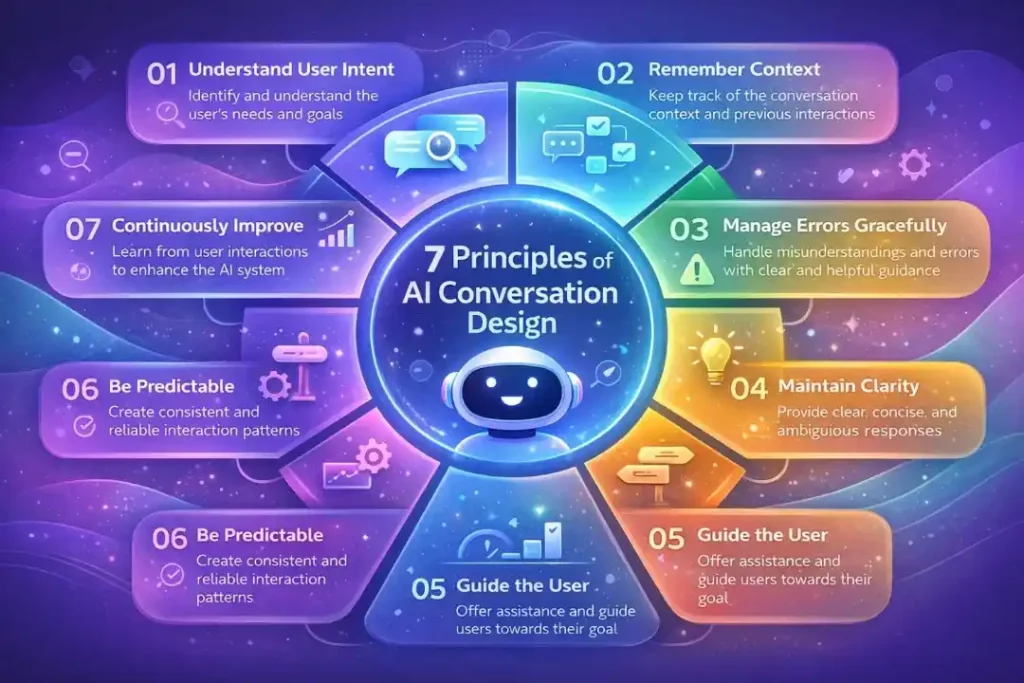
7 Principles of AI Conversation Design
Prioritize User Intent Over Literal Input
Average users often fail to provide precise prompts or commands. They vaguely talk about their goals, problems, or requirements. Conversation design must concentrate on understanding user intent rather than reacting to literal input.
As an example:
- “I can’t access my account” may mean a forgotten password, account suspension, or a system outage.
- “Give me last month’s data.” This could mean viewing, exporting, or generating a report.
Good product design understands users. Enables clarity of intent and provides follow-ups to the user without overwhelming them.
Practical insight: Map out primary, secondary, and edge-case intents during discovery. Design flexible conversational paths that adapt to variations in language and context.
Set Clear Capabilities and Boundaries
Users form a mental expectation. When a system promises more than it can deliver, users are disappointed. The conversation design must communicate straightforwardly. It helps the user to have a clear perspective about the AI-Powered product.
Keep your product transparent to users, tell them:
- What your product can do
- What your product cannot do
- When human help is needed
As an example, A financial AI assistant should clarify whether it can execute transactions or only generate reports.
Practical insight: The AI’s capabilities should be outlined from the start. Make it clear with onboarding messages, and reinforce boundaries contextually during the discussion.
Keep Conversations Goal-Oriented
An AI product is designed to complete tasks; there is no time for small talk. Robust design eliminates unnecessary communication and helps guide the user to the finish. It must avoid wordy or sugar-coated answers.
As an example, A customer service chatbot should not focus on conversation friendliness. It should focus on problem-solving.
Practical Insight: Assess every response. Does it make the user closer to their intent?
Design for Context Awareness
AI Conversations are efficient and intelligent because of context. AI can find and perform tasks correctly given the proper context. To provide the correct answers, your AI model should remember relevant information from the sessions.
Remembering relevant information within a session reduces repetition and improves flow.
Examples of practical context:
- Retaining Selections: Remember the categories or preferences the user chose earlier.
- Thread Continuity: Remember previous questions and instructions within the same task.
- Localization: Maintain the user’s language or formatting preferences.
However, over-contextualization can lead to mistakes. Designers must specify what is remembered when the context is acquired.
Practical Insight: Have clear and explicit context rules. Let your users know when context expires and resets.
Progressive Disclosure
Users differ in experience and intent. Some want speed and accuracy, others wish for a step-by-step breakdown of information. UX design must support both in terms of progressive disclosure.
Provide brief overviews in your AI product. Ask question to users a question, “Would you like more details?” This approach prevents information overload while still supporting advanced users.
Practical Insight: Design and organize the responses in layers. Summary → Explanation → Deep dive for more knowledge.
Designing for the Unhappy Path
Examples of unhappy path scenarios:
- Misunderstood inputs
- Unsupported requests
- System failures
- Lack of complete information
Handle these unhappy paths without a generic response; use transparency and guidance to guide users. For example: “I did not understand, please tell me more.” or “I can assist in the X or accessing Y, Which one are you looking for?” This approach reassures users while moving the conversation forward and avoids dead ends.
Practical insight: Take unhappy paths with the same seriousness as ideal paths. Pre-define recovery strategies, clarifying questions, and escalation options in advance
Personality and Tone (Persona Design)
Any AI product expresses a personality either unintentionally or by design. Persona design humanizes the product, bridging the gap between user and machine. It is a perfect fit between brand values, expectations, behavior, and language.
Persona key elements:
- Role: Assistant, tutor, coach, analyst, companion, agent, etc.
- Tone: Authoritative, friendly, humorous, serious, or neutral.
- Voice: Formal and conversational.
- Language complexity: Simple and technical.
- Emotional stability: Stoic vs. expressive.
- Communication style: Short and detailed.
For example, an enterprise analytics assistant will prefer a professional tone that is calm and accurate. On the other hand, a consumer app can be much more relaxed. However, personality must never be detrimental to clarity or truth.
Practical insight: Develop a persona guide specifying the rules of tone, choice of vocabulary, and length of response to various situations.
Conclusion
The development of AI-based products requires a shift from visual to conversational thinking. Systems become truly natural and assistive when they are designed around user intent, retain context across interactions, and carefully manage errors to prevent frustration. Natural language is emerging as the primary interface, allowing users to communicate with products in ways that feel intuitive and human-centred. Natural language interfaces (NLIs), such as chatbots and voice assistants, can reduce customer response times by an average of 77%, thereby improving service efficiency. About half of customers report using AI-powered chatbots for standard services such as scheduling, placing orders, reporting issues, or seeking product support.
Effective conversational design also involves anticipating user needs, providing proactive guidance, and maintaining clarity even when the AI’s understanding is limited. By aligning the dialogue with the AI model’s capabilities, designers can create interactions that are predictable yet flexible, reducing friction and building trust. Adherence to these seven principles not only enhances usability but also ensures that AI-driven products deliver measurable value, strengthen user engagement, and support scalable, efficient digital experiences across industries.