
**This post is sponsored by Semrush. When you purchase through links in this article, we may earn an affiliate commission from Semrush.**
If your audience is already turning to AI tools for answers, then your brand’s AI search visibility depends on whether it shows up in those conversations. That shift is already happening, and it is changing how people discover, compare, and decide.
Key Takeaways
- AI is transforming how users discover and interact with information, making visibility crucial for brands.
- Semrush MCP integrates real data into AI tools, enhancing the accuracy of answers about keywords and competitors.
- This integration helps streamline workflows by providing immediate, data-backed insights without switching tools.
- Operating within existing tools, Semrush MCP is easy to adopt since it’s built into Semrush One and the SEO Toolkit.
- As AI shapes decisions earlier, brands need to ensure they are present in AI-generated answers to stay relevant.
Table of contents
The Shift from Traditional Search
If you want to keep up with that change and start using real data inside the tools people rely on every day, you can take a closer look here.
Search is no longer something users visit. It is something that follows them. It happens inside chat interfaces, inside workflows, and often before they ever land on a website. In many cases, the answer they get from AI is enough to shape their next step.
Why Visibility Now Happens Inside Answers
That creates a different kind of challenge. Visibility is no longer just about ranking on a results page. It is about being present in the answers themselves. If your brand is not included, it is easy to be overlooked without even realizing it.
This is where Semrush One Solution starts to feel more relevant in a practical sense. It is not just a platform for looking at data after the fact. It is a way to bring that data into the environments where decisions are actually being made.
Bringing Real Data Into AI Tools
A big part of this shift comes from Semrush MCP. While it might sound like a technical feature, the idea behind it is straightforward. It allows AI tools like ChatGPT, Claude, Cursor, and VS Code to access real Semrush data while you are using them.
That means when you ask questions about keywords, competitors, or website performance, the answers are no longer based on general assumptions. They are grounded in actual data, which directly supports stronger AI search visibility.
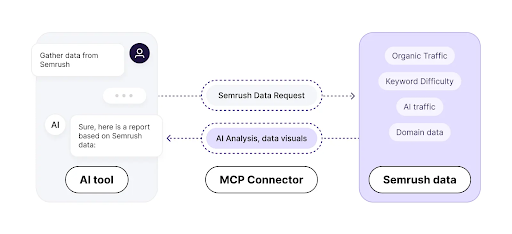
For anyone who already uses AI tools regularly, this solves a familiar problem. AI is fast, but it can also be vague. It can sound confident while still missing important context. That gap between speed and accuracy is where things often fall apart.
Improving Everyday SEO Workflows
By connecting Semrush data directly into those conversations, that gap becomes much smaller. You are no longer switching between tools to verify what you are seeing. The information is already part of the interaction.
In everyday work, that changes how things feel. Instead of opening multiple tabs to check keyword movements, you can ask and get a clear answer. Instead of manually tracking competitors, you can get updates when something shifts. Reporting, which usually takes time to pull together, can be generated more easily with the help of AI working from real data.
It is not about doing more. It is about making the work you already do less fragmented.
This is why it makes sense to think of Semrush MCP as a workflow upgrade rather than a technical integration. It fits into the tools people are already using instead of asking them to adopt something entirely new.
Why AI Search Visibility Matters Now
Another reason it feels accessible is that access to the Semrush MCP server is already included in Semrush One and the SEO Toolkit. There is no separate setup or extra layer to manage. It is built in, which makes it easier to start using right away.
The timing of this matters. AI is shaping decisions earlier in the process than traditional search ever did. People are asking questions, comparing options, and forming opinions before they click on anything.
That means discovery has changed. Visibility needs to catch up.

If your brand is not part of those AI generated answers, it is missing a growing share of attention. And as more users rely on AI as their starting point, that gap becomes harder to ignore.
Having reliable data inside AI tools helps address that. It makes sure that the insights guiding decisions are accurate and current. It also makes it easier to act on those insights without slowing down your workflow.
To see how this works in practice, here is a quick tutorial on setting up Semrush MCP with OpenAI tools: Video Tutorial Link
You can also include screenshots here to walk through the setup process step by step, along with examples of how responses inside AI tools change once Semrush data is connected. This gives a clearer picture of how the experience improves from general answers to data backed insights.
At this point, the shift toward AI driven discovery is already underway. The brands that show up in AI answers are the ones that will shape what users see and trust.
If you want to bring your data into that space and make AI a more reliable part of your workflow, you can explore Semrush One here.
Because as search becomes something that happens everywhere, maintaining strong AI search visibility should not depend on switching between tools. It should be part of the conversation from the start.