
AI data collection pipelines fail more often due to unstable access and noisy outputs than to weak scrapers. The proxy layer decides whether runs stay repeatable under load, whether localization stays consistent across rechecks, and whether long flows finish without session breaks. According to Mordor Intelligence (2025), the web scraping market was valued at USD 1.03 billion in 2025, which shows how quickly data collection has become an infrastructure layer rather than a niche task.
This list focuses on providers that support real AI collection workflows, including training corpora, RAG refresh, evaluation datasets, and continuous monitoring.
Table of contents
- What Are the Main AI Data Collection Failure Points in 2026?
- Why Does Residential Proxy Routing Matter Early in AI Pipeline Design?
- What Should Be Checked Before Buying?
- Which Proxy Providers Are the Best for AI Data Collection in 2026?
- What Are AI Data Collection Proxy Use Cases?
- What About Ethics and Compliance?
- How to Integrate Proxies into AI Pipelines?
- Conclusion
What Are the Main AI Data Collection Failure Points in 2026?
The biggest AI data collection failures come from WAF pressure under real traffic load. They also come from broken identity and sessions in multi-step flows, geo drift that changes local pages, and quiet partial extraction when templates shift.
- WAF pressure under concurrency: As request volume grows, traffic-pattern scoring triggers more throttles and blocks.
- Identity and session breaks: Mid-run identity changes break login flows, pagination chains, and step-by-step navigation.
- Geo drift over time: Inconsistent location resolution mixes currencies, languages, taxes, and availability signals.
- Silent partial extraction: Pipelines may return incomplete pages or missing fields without obvious hard failures.
Why Does Residential Proxy Routing Matter Early in AI Pipeline Design?
A residential proxy matters early because it directly affects success rate, geo consistency, and session continuity before scraper logic is tuned. On defended targets, residential routing usually keeps access more stable than speed-first networks and reduces challenge-heavy noise in collected data. This makes downstream validation cleaner and helps teams benchmark real pipeline limits before scaling.
Direct Impact on Failure Points
Residential routing lowers friction where identity changes break pagination or login-bound steps. It also improves localization consistency across reruns, which reduces mixed-language, mixed-currency, and mixed-availability contamination. When these issues are controlled early, teams spend less time debugging failures in the training and evaluation stages.
Practical Use Before Provider Selection
Teams can treat residential traffic as a baseline for hard targets, then compare other network types against that baseline. This approach makes provider testing more objective because performance is measured by valid records, not raw request counts. It also prevents underestimating WAF pressure during early pilot runs.
What Should Be Checked Before Buying?
Before buying, run a test matrix on normal and hard targets across geos and concurrency, then validate real page markers and key fields. Log failure types separately, measure retry budget per success, and calculate usable output cost per valid record instead of cost per GB or request.
- Test Matrix: Run 3 normal targets plus 1 hard target across 2 geos and 2 concurrency levels.
- Validity Checks: Verify page markers and key fields rather than relying on status codes.
- Failure Taxonomy: Log challenge pages, empty fields, locale mismatches, and timeouts separately.
- Retry Budget: Track retries per success so cost does not spike silently under stress.
- Usable Output Cost: Estimate cost per valid record, not cost per GB or per request alone.
Which Proxy Providers Are the Best for AI Data Collection in 2026?
A reliable provider match comes from workload fit, not headline pool size. The most useful options combine repeatable session control, stable routing, and pricing that stays predictable as traffic grows.
| Provider | Ideal Use Case | Key Features | Strengths | Trade-Offs |
| Live Proxies | Stateful runs and stable reruns | Sticky sessions up to 24 hours, session IDs, rotating residential + mobile residential | Stable multi-step continuity and cleaner reruns | Requires routing profiles to avoid wasted retries |
| Oxylabs | Enterprise-scale collection | Enterprise suite and APIs | Strong infrastructure for high concurrency and hard targets | Higher cost profile at scale |
| Decodo | Cost-aware scaling | Dashboard, docs, pricing tiers | Broad coverage with SOCKS5 support on residential | Tier-dependent controls |
| SOAX | Geo-sensitive datasets | Targeting controls and plans | Location tooling and bundled plans | Needs forecasting to avoid unused volume |
| IPRoyal | Pilots and smaller runs | Simple dashboard | Clear entry pricing and simple operations | Less enterprise orchestration |
| Webshare | Lean teams, predictable spend | Simple panel | Public pricing and quick ramp-up | Fewer advanced workflow layers |
| ProxyEmpire | Mixed workloads | Docs + pricing matrix | Protocol flexibility and broad plan matrix | Capabilities vary by plan |
| Infatica | PAYG and steady scaling | Pricing tiers + trial flow | PAYG pricing and clear tier ladder | Costs can rise with high retry rates |
1. Live Proxies
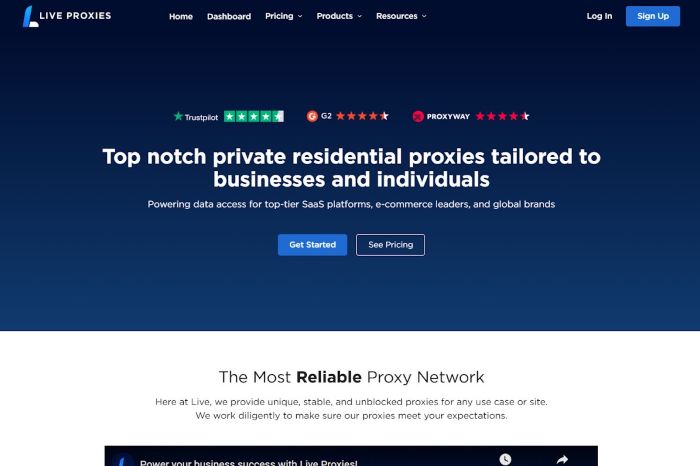
Live Proxies fits AI data collection workflows that need stable reruns, session continuity, and cleaner output under sustained load. It supports sticky sessions up to 24 hours via session IDs, so login flows, pagination, extraction, and follow-up requests can stay on one identity before controlled rotation. This reduces session breaks and improves repeatability across multi-step pipelines. For high-volume workloads, teams can also choose a proxy with unlimited bandwidth on eligible plans.
- Proxy Types: Rotating residential proxies, rotating mobile proxies.
- Features: Session IDs for stickiness, private IP allocation by target set, rotating and sticky session formats, separate rotating/sticky display for B2B dashboards, 24/7 support, and high-uptime infrastructure (99.9% uptime on rotating residential).
- Protocols: HTTP, SOCKS5.
2. IPRoyal
IPRoyal works well for pilots and smaller monitoring runs where teams need clear entry tiers and a setup process that does not require heavy engineering effort at launch. Its residential pricing is published as volume-based GB tiers, so teams can map expected traffic to cost from the start and avoid budget surprises during early testing. This makes it practical for validating workflows and scaling gradually after performance is confirmed.
- Proxy Types: Residential, Mobile, ISP, Datacenter.
- Features: Volume-based residential pricing, tiered plans, and simple onboarding for smaller teams.
- Protocols: HTTP(S), SOCKS5.
3. Webshare
Webshare fits lean teams that need fast setup, clear costs, and simple day-to-day operations without a heavy technical rollout. The platform is удобный for pilot monitoring tasks, регулярные checks, and small-to-mid scale data collection where teams want to start quickly and scale in controlled steps. Transparent tiering helps plan spend in advance, while the self-serve flow reduces launch friction for new projects.
- Proxy Types: Static Residential Proxy, Dedicated Static Residential, Rotating Residential Proxy, Private Static Residential.
- Features: Self-serve onboarding, transparent pricing tiers, straightforward dashboard controls, and quick ramp-up for small teams.
- Protocols: HTTP(S), SOCKS5.
4. Oxylabs
Oxylabs is built for enterprise data collection. It stays steady when concurrency stays high. It fits teams that run large pipelines across many targets. When things break, recovery speed matters. Routing control matters too. Output quality has to stay consistent. The product lineup supports both broad and more focused proxy setups. That helps teams match the proxy strategy to each workload.
- Proxy Types: Residential, Mobile, Datacenter ISP, Dedicated Datacenter Proxies, Dedicated ISP Proxies.
- Features: Automatic rotation (notably on residential products), enterprise positioning for high-scale workloads, and broad product coverage for different routing models.
- Protocols: HTTP, HTTPS, SOCKS5.
5. Decodo (formerly Smartproxy)
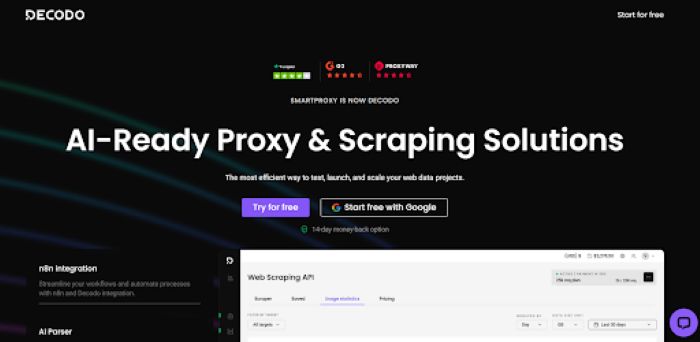
Decodo fits teams that need a straightforward scaling path with clear pricing and broad protocol support. It works well for pilot stages and growing workloads where teams want to start quickly, control spend with transparent tiers, and expand usage without changing tooling. The service is practical for mixed use cases, because teams can run different traffic patterns across one vendor while keeping operations simple.
- Proxy Types: Residential, Mobile, ISP, Datacenter.
- Features: Tiered residential pricing by GB, self-serve setup, and product coverage for multiple routing models.
- Protocols: HTTP(S), SOCKS5.
6. ProxyEmpire

ProxyEmpire fits mixed workloads that need protocol flexibility and a clear product matrix across residential, mobile, and datacenter routing models. It works well when one team runs different task types in parallel and wants both rotating and session-stable options under one vendor. This setup helps teams assign the right proxy type to each workload instead of forcing one routing strategy across all tasks.
- Proxy Types: Rotating Residential Proxies, Unlimited Residential Proxies, Static Residential Proxies, Rotating Mobile Proxies, Dedicated Mobile Proxies, Rotating Datacenter Proxies.
- Features: Plan/product matrix for workload segmentation, sticky and rotating behavior options, and traffic models that support both throughput-oriented and session-sensitive runs.
- Protocols: HTTP, HTTPS, SOCKS5, and UDP protocols.
7. SOAX
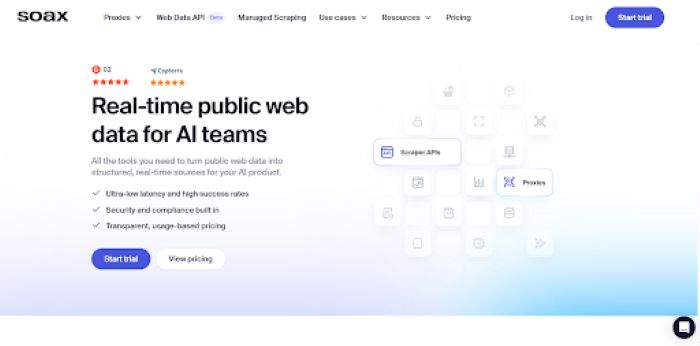
SOAX fits location-sensitive collection where geo accuracy and routing consistency must stay stable across repeated runs. It works well for teams that need granular targeting and predictable behavior in recurring workflows, with bundled access that keeps setup and scaling manageable. It is useful for projects that require frequent country, region, city, or ISP-level adjustments without rebuilding the workflow each time.
- Proxy Types: Residential, US Datacenter, Mobile.
- Features: Bundled plans (access to proxy products in one plan), location targeting (country/region/city/ISP), sticky and rotating sessions, and configurable IP refresh options.
- Protocols: HTTP(S), SOCKS5.
8. Infatica
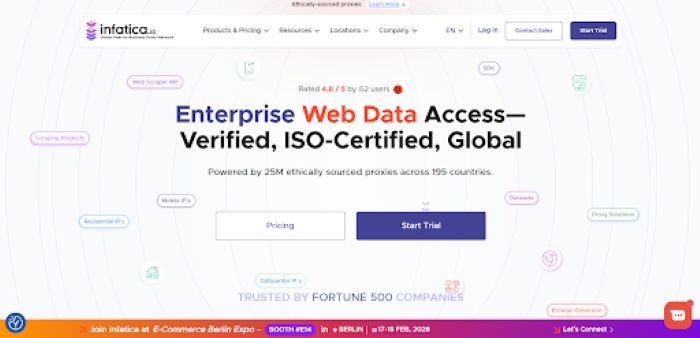
Infatica fits teams that want PAYG economics with a clear tier ladder and predictable scaling from pilot traffic to larger monthly volumes. It works well for mixed scraping workloads where teams need to balance budget control, geo coverage, and routing flexibility without switching vendors between growth stages. Its pricing model is practical for teams that start small, validate performance, and then expand usage with clearer cost visibility.
- Proxy Types: Residential IPs, Premium IPv6 Residential IPs, Static ISP IPs, Datacenter IPs, Mobile IPs.
- Features: PAYG + tier-based plans, volume discounts, and multi-product coverage for different workload types.
- Protocols: HTTP, HTTPS, SOCKS5.
What Are AI Data Collection Proxy Use Cases?
AI data collection proxy use cases include stabilizing training and RAG refresh runs, keeping geo routing consistent for monitoring, and maintaining repeatable conditions for evaluation. They also support e-commerce localization, social session continuity, and resilience to news template drift and stricter cybersecurity defenses.
Model Training Corpora and RAG Index Refresh
Stable access keeps refresh jobs from skipping sources or falling into gaps when defenses trigger throttles. It also reduces drift in what gets collected between runs, which helps maintain a steadier distribution of domains, languages, and page templates inside the corpus.
Competitive Monitoring, Pricing, and Trend Analysis
Geo-stable routing keeps the same markets resolving to the same localized versions over time. That prevents silent contamination from mixed currencies, taxes, language variants, and availability rules, which otherwise makes trend lines look like “market change” when it is really routing noise.
Evaluation Datasets and Safety or Quality Checks
Repeatable conditions keep evaluation deltas tied to model changes rather than pipeline instability. When identity, location, and access behavior stay consistent, regressions and improvements reflect the model, not random challenge pages or shifted locale outputs.
Domain Examples That Stress Different Qualities
E-commerce targets stress localization and page-variant consistency around pricing and inventory. Social workflows stress identity continuity and stable sessions in multi-step navigation. News targets stress template drift and partial extraction as layouts change, while cybersecurity targets stress routing discipline and reliability under stricter defenses.
What About Ethics and Compliance?
Ethics and compliance mean defining allowed sources and endpoints before scaling, respecting robots and rate limits while collecting only necessary data, filtering sensitive or personal fields before storage, and enforcing internal rules with approvals, logging, and dataset documentation.
- Legal considerations and terms of service boundaries: Define allowed sources and endpoints before scale.
- Respecting robots, rate limits, and data minimization: Reduce load and collect only what the workflow needs.
- Handling personal data and sensitive categories: Filter or avoid sensitive fields early, before storage.
- Building internal guidelines: Use approvals, logging, and dataset documentation so collection stays defensible.
How to Integrate Proxies into AI Pipelines?
Integrate proxies through scraper workers, a proxy manager, storage, and the training or evaluation stack, with routing profiles versioned like code. Cap and classify retries, monitor valid-page rate, tail latency, challenge rate, and cost per usable record, and switch or mix networks when baseline success drops and tuning cannot restore stability.
Typical Integration Architecture
A practical architecture routes traffic through a dedicated proxy layer before data reaches storage and model workflows. A common path is: scraper workers → proxy manager → storage → training or evaluation stack. Routing profiles should be versioned like code so teams can reproduce runs and roll back after changes.
Retry, Backoff, and Error Handling
Retry strategy should be strict and bounded. Teams typically cap retries, classify failure types, and separate transient network errors from challenge-related failures. Timeouts, blocked responses, and invalid content need different handling paths. Retry loops waste budget and reduce output.
Monitoring Success Rate, Latency, and Cost
Core monitoring should track valid-page rate, tail latency, challenge rate, and cost per usable record. These metrics show both data quality and operational efficiency, not just request volume. Alert thresholds should be defined in advance so teams can act before degradation affects downstream training and evaluation results.
Switching Providers and Mixing Networks
A provider change should happen when the baseline success rate stays below target after routing and retry tuning. Teams can also mix networks when one proxy type performs well on some targets but fails on others. The decision should follow measured performance and cost-per-usable-record trends, not one-off outcomes.
Conclusion
AI data collection in 2026 becomes easier to scale when proxy selection follows workload fit instead of headline IP counts. The strongest pipelines pair the right proxy type with strict validity checks, stable geo rules, and retry budgets that protect both cost and data quality. Providers differ most in session continuity, protocol coverage, and how reliably they support repeatable reruns, which is the real requirement for training, RAG refresh, and evaluation datasets.