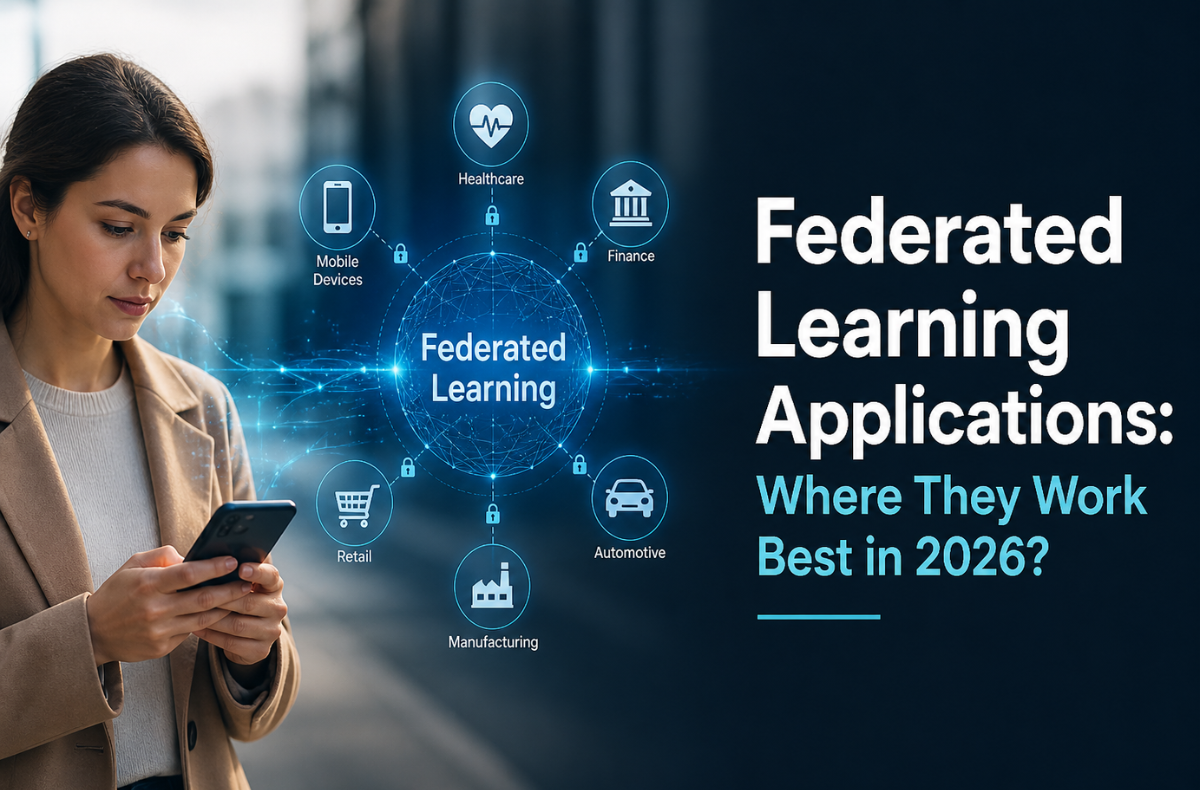
Data has become one of the most securely controlled assets in the digital economy, while machine learning systems continue to demand more of it. This tension has pushed federated learning from an academic concept into a core privacy-preserving AI technique used in real-world production systems. Federated Learning Applications are emerging rapidly as organizations seek ways to maintain privacy while harnessing valuable distributed data. Instead of centralizing data, it brings the model to where the data lives, trains locally, and shares only model updates with a central server.
By 2026, federated learning will be firmly established beyond experimentation. It is now widely used in healthcare, finance, telecommunications, and the IoT, where sensitive data cannot be transferred or exchanged. This post discusses the most effective federated learning applications, the industries in which they deliver quantifiable value, and the strategic change that has led to their adoption across regulated industries.
Key Takeaways
- Federated Learning Applications enable AI model training without centralizing sensitive data, enhancing privacy and compliance.
- This technique is increasingly adopted in healthcare, finance, IoT, and cybersecurity due to regulatory pressures.
- The process involves training local models, sharing only encrypted updates, and keeping data on devices.
- Key benefits include reduced risk of breaches, improved collaboration, and faster regulatory approvals.
- However, federated learning is not a one-size-fits-all solution; it’s most effective where data sensitivity and distribution are critical.
Table of Contents
- What Is Federated Learning and Why It Matters in 2026
- How Federated Learning Works Step by Step
- Federated Learning vs Centralized Machine Learning
- Blessings of Federated Learning for Enterprises
- The Main Federated Learning Applications in 2026
- Other Industries Using Federated Learning in 2026
- Privacy-Preserving Machine Learning Techniques That Pair With It
- Federated Learning Frameworks and Tools
- Federated Learning Challenges and Limitations
- Real World Applications Worth Studying
- Conclusion
- FAQs
What Is Federated Learning and Why It Matters in 2026
In federated machine learning, a shared model is trained across multiple machines or institutional servers that hold local data, without exchanging any data. Only model updates, such as gradients or weights, are exchanged.
Its fundamental value lies in enabling high-performance model training on data that cannot be centralized due to legal, ethical, or operational reasons, including clinical records, financial transactions, biometric data, and industrial telemetry. Any serious review of applications in federated learning consistently returns to this same point.
A federated learning, a comprehensive overview of methods and applications generally divides the technology into three architectures:
- Horizontal federated learning: shared feature space across different user populations.
- Vertical federated learning: shared user base with different feature sets.
- Federated transfer learning: knowledge transfer across both differing users and features.
Each variant addresses specific industry constraints, which explains the widespread adoption of federated machine learning across sectors.
How Federated Learning Works Step by Step
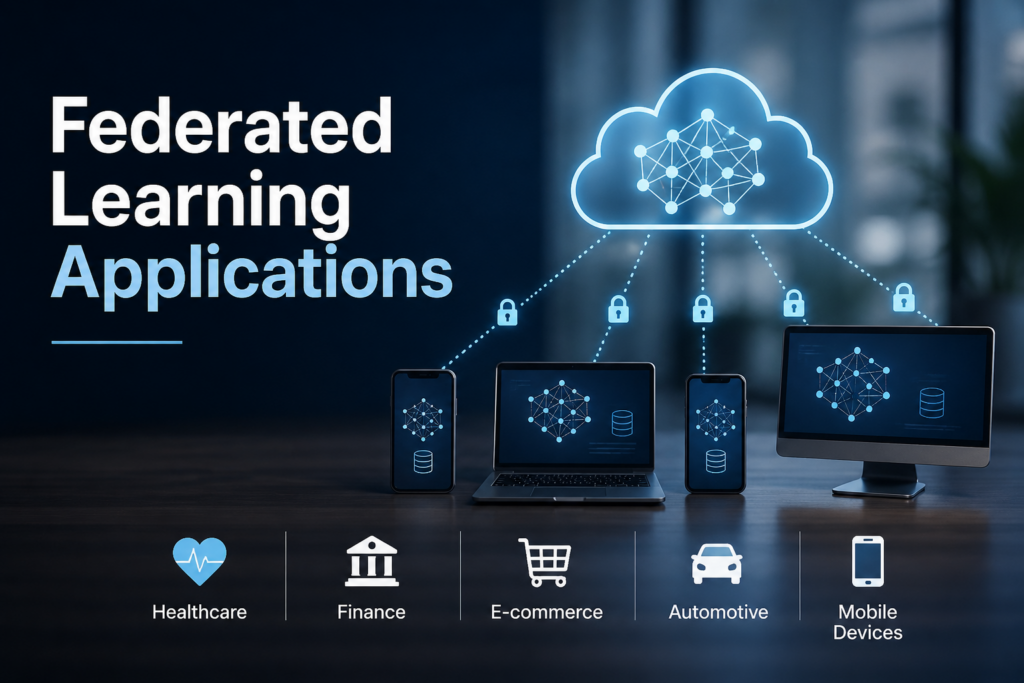
Understanding how federated learning works step by step is essential before deployment. Most production federated learning applications today follow a workflow structured as follows:
- Initialization: A central server loads an initial base model and sends it to selected client nodes, such as mobile devices, hospital servers, or edge gateways.
- Local Training: Each client trains the model on its proprietary dataset for a set number of epochs. The data remains entirely on-device.
- Update Transmission: Clients return only encrypted model updates. No raw records or personal identifiers are sent.
- Secure Aggregation: The server combines updates using algorithms like Federated Averaging (FedAvg), weighted aggregation, or secure multi-party computation.
- Global Model Distribution: The refined global model is redistributed, and the cycle repeats until convergence.
Production deployments usually layer on differential privacy, homomorphic encryption, or trusted execution environments to further fortify the pipeline.
Federated Learning vs Centralized Machine Learning
Centralized machine learning gathers data in one place and trains on it. It is efficient when centralization is allowed, but often not feasible due to practical or regulatory limits.
Federated learning distributes training across multiple devices or systems. Although coordination becomes more complex and training slows, this approach allows you to learn from data you cannot relocate. The section below provides a quick comparison of the two approaches.
| Factor | Centralized ML | Federated Learning |
|---|---|---|
| Data location | Pooled in one server or cloud | Stays on the local device or node |
| Privacy risk | High, single point of breach | Significantly lower |
| Regulatory fit (GDPR, HIPAA, DPDP) | Difficult, often blocking | Designed for compliance |
| Bandwidth use | Heavy data transfers | Light, only model updates |
| Personalization | Generic global model | Supports local fine-tuning |
| Ideal data type | Public or non-sensitive | Sensitive, distributed, regulated |
This is why discussions around federated machine learning applications consistently return to one key theme: it is the solution when centralization is not feasible.
Blessings of Federated Learning for Enterprises
The benefits of federated learning applications for enterprises in 2026 are genuinely compelling:
- Compliance by design. GDPR, HIPAA, PCI DSS, and emerging AI acts favor architectures where raw data does not move.
- Bigger effective datasets. Models trained collaboratively almost always outperform single-institution models on rare events.
- Reduced breach surface. No central honeypot of sensitive records means a breach at one node does not sink the whole project.
- Faster legal approvals. Data-sharing agreements that once took 18 months now sometimes close in weeks.
- Edge intelligence. Federated learning for sensitive data analysis pushes inference closer to decision points, reducing latency.
Where centralization is legally or commercially impossible, federated learning is increasingly the only viable path to competitive AI.
The Main Federated Learning Applications in 2026
Below are the federated learning applications that have shown the most significant impact in real-world deployments.
1. Federated Learning Applications in Healthcare
Healthcare is a leading example for clear reasons. HIPAA in the US and GDPR in Europe protect patient records, making centralized ML across hospitals nearly impossible. As a result, federated learning applications in healthcare have moved quickly from labs into clinical workflows.
Typical federated learning use cases in healthcare involve:
- Training diagnostic models in hospitals where patient files are not shared.
- Using multi-clinic data to predict disease progression.
- Enhancing pharma collaboration in drug discovery pipelines.
- Personalizing treatment plans while keeping records inside hospital firewalls.
Federated learning medical imaging applications are especially powerful. Radiology departments can train models on chest X-rays, MRIs, and CT scans across dozens of hospitals without a single image leaving the building. Diverse populations improve federated learning in medical applications by enabling better generalization and more accurate results.
2. Federated Learning in Finance and Banking
Banks hold vast amounts of valuable data that they cannot share. Since fraud networks span multiple institutions, direct data sharing is not feasible. Federated learning applications in finance and banking address this by enabling collaborative model training without exposing customer transactions.
Federated learning examples in finance include:
- Cross-bank fraud detection models that catch patterns one bank alone could not see.
- Anti-money-laundering systems are trained across regulators and institutions.
- Credit scoring that combines insights from multiple lenders.
- Trading anomaly detection that respects strict compliance rules.
What makes finance such a strong fit is the combination of high-stakes data, heavy regulation, and the obvious business value of cooperation. Competitors can collaborate on threat detection without becoming partners.
3. Federated Learning IoT Applications and Edge Computing
The Internet of Things generates very large volumes of data, which is too large to transfer to a cloud in real time. Federated learning for IoT devices addresses bandwidth and privacy issues, which is why it has become one of the fastest-growing deployment types.
The Federated learning applications for IoT now include:
- Smart home devices that learn user habits without uploading audio or video.
- Industrial sensors predicting equipment failure across factory floors.
- Connected vehicles that share driving insights without sharing location history.
- Wearables that enhance health tracking without exposing biometric data.
Federated learning in edge computing environments is especially interesting because the model runs on the device itself, resulting in lower latency, reduced cloud costs, and far better privacy.
4. Federated Learning Applications in Cybersecurity
Security is another natural application area. Threats evolve faster than any single organization can keep track of, and sharing threat intelligence has traditionally been difficult because logs often contain sensitive customer data.
Federated learning cybersecurity applications include:
- Cross-organization malware detection without exposing internal logs.
- Phishing model training across email providers.
- Network intrusion detection across distributed enterprises.
- Endpoint protection that learns from every device without uploading sensitive activity.
Security teams describe federated learning in cybersecurity applications as “collective immunity.” The more participants, the smarter the shared defense, but no one exposes how their internal systems work.
5. Smart Devices, Personalization, and Mobile AI
This is where most users have already encountered federated learning without realizing it. As your phone keyboard guesses the next word or your camera recognizes your dog, federated learning is often the engine behind it.
Examples include:
- Predictive typing on smartphones and autocorrect.
- Voice assistants that do not require uploading voice clips.
- On-device recommendation systems for music and shopping apps.
- Personalized fitness coaching that respects body data.
These are some of the clearest examples of federated learning applications for everyday consumers and have helped push the technology into the mainstream conversation.

Other Industries Using Federated Learning in 2026
The list of industries using federated learning in 2026 continues to grow. The areas below have moved from pilot testing to full production use, expanding the broader landscape of machine learning federal applications.
| Industry | Application | Why Federated Wins |
|---|---|---|
| Telecom | Network optimization, churn prediction | Customer data privacy laws |
| Retail | Personalized recommendations across chains | Competitor data sensitivity |
| Agriculture | Crop disease detection from farmer phones | Bandwidth limits in rural areas |
| Education | Adaptive learning across school districts | Student data protection |
| Government | Public health surveillance | Inter-agency data restrictions |
| Energy | Smart grid load prediction | Critical infrastructure security |
Privacy-Preserving Machine Learning Techniques That Pair With It
Federated learning rarely works alone. To make it bulletproof, engineers combine it with other privacy-preserving machine learning techniques:
- Differential privacy adds mathematical noise so individual data points cannot be reverse-engineered.
- Secure multi-party computation allows parties to compute results together without revealing their inputs.
- Homomorphic encryption allows calculations on encrypted data without decrypting it.
- Trusted execution environments create hardware-level secure zones for model training.
Together, these techniques and federated learning applications enable secure data sharing without centralization, the holy grail for any company handling sensitive information.
Federated Learning Frameworks and Tools
Practitioners today have a far more mature toolkit than two years ago. The federated learning frameworks and tools most commonly adopted include:
- TensorFlow Federated (TFF): Google’s open-source project, strong in research and simulation.
- PySyft: Built by OpenMined, a Python-first option emphasizing differential privacy.
- Flower: Framework-agnostic and production-friendly. The default for many startups.
- NVIDIA FLARE: A favorite in healthcare consortia, strong on medical imaging workflows.
- OpenFL: Intel’s cross-industry framework, widely used in clinical research.
- FATE: WeBank’s mature platform, popular in finance and Asian enterprise deployments.
- IBM Federated Learning: Enterprise-grade option for regulated industries.
The right tool for federated learning applications depends on your tech stack, scale, and whether you are using horizontal, vertical, or transfer learning.
Federated Learning Challenges and Limitations
Federated learning applications still face real engineering challenges. However, a survey on federated learning, challenges, and applications identifies the recurring obstacles below, which together define the current set of federated learning challenges and limitations:
- Statistical Heterogeneity: Customers are rarely jointly distributed, so data that do exist are rarely independent or identically distributed (IID).
- Communication Overhead: Since compressed model updates transmitted between millions of participating devices are often shared, they incur high communication overhead.
- System Heterogeneity: The devices involved vary widely in computational power, memory, and network connectivity.
- Residual Privacy Risk: If differential privacy or secure aggregation is not properly applied, gradient updates can reveal sensitive information.
- Incentive Architecture: Coordinating honest participation among competing organizations requires sophisticated governance frameworks.
- Diagnostic Complexity: Centralized dataset inspection is unavailable, complicating debugging and root-cause analysis.
In fact, these constraints are tractable, but they explain why a single federated learning application is not a universal substitute for every ML pipeline.
Real World Applications Worth Studying
The implementations below provide a reference map of current real-world federated learning applications in production:
- Owkin’s MELLODDY consortium: Multiple major pharmaceutical companies collaborate to train drug-discovery models without sharing sensitive research data.
- NVIDIA Clara: Deployed in hospitals like Mass General and King’s College London for privacy-preserving medical imaging and diagnostics.
- Apple’s on-device intelligence stack: Used across iPhones (iOS 18+) to improve features like keyboard predictions while keeping user data private.
- WeBank’s FATE system: One of the largest production federated learning systems in finance, widely used for fraud detection and risk modeling.
- Google Gboard: A pioneering consumer example where federated learning improves typing predictions without uploading personal text.
Additionally, these real-world federated learning examples show that secure, privacy-preserving AI is already in active use, not a theoretical concept.
Conclusion
Federated learning applications in 2026 are delivering real value across healthcare, finance, IoT, and cybersecurity. They allow organizations to train AI models without centralizing sensitive data, improving privacy while reducing compliance and security risks. They also unlock insights from previously inaccessible distributed data.
However, federated learning is not a complete replacement for centralized machine learning. It works best where data is distributed, sensitive, and subject to regulatory or business boundaries. The future of AI will combine both models, using each where it fits. For organizations, success depends on knowing when to use federated learning and applying it strategically.
FAQs
Federated learning trains models on local devices or servers rather than on a central system. It improves privacy by keeping raw data on-device and sharing only encrypted updates.
Yes, federated learning generally offers stronger privacy than traditional ML because it keeps raw data on local devices instead of centralizing it. However, it is not completely risk-free, so organizations often use encryption and differential privacy to further enhance security.
Financial institutions use privacy-preserving machine learning techniques to detect fraud, prevent money laundering, and improve credit scoring without sharing customer data. These techniques help them collaborate securely while remaining compliant with strict regulatory requirements.
Healthcare, finance, IoT, cybersecurity, and mobile apps use Federated Learning for diagnostics, fraud detection, and personalization. It suits sensitive, distributed data where privacy and compliance matter.
For most general tasks, you don’t need it. Centralized training works faster and keeps things simpler when you can share data. Federated learning proves useful when you cannot or should not centralize data.