
A massive gap exists between the infrastructure people need and the money available to build it. Global estimates indicate a $15 trillion infrastructure funding gap by 2040. Governments and organizations cannot fund every proposed project. That’s why having a priority infrastructure plan is fundamental; we need a reliable strategy to identify which projects deliver the best returns.
A priority infrastructure plan gives us that method. It connects high-level goals to concrete project execution. Without it, money is wasted, and critical deadlines are missed. Data from the Project Management Institute shows that organizations waste 11.4% of their investment due to poor project performance. Furthermore, only 56% of strategic initiatives actually meet their original goals.
Key Takeaways
- The priority infrastructure plan helps organizations allocate resources effectively amid a $15 trillion funding gap.
- It connects high-level goals to project execution while preventing reactive spending and ensuring accountability.
- Key components include identifying Priority Infrastructure Areas (PIAs) and applying frameworks such as the Infrastructure Prioritization Framework (IPF) to support effective project selection.
- Data-driven scoring models, such as WSJF, help prioritize projects based on value and urgency.
- Regular updates to the plan keep it aligned with new data and project outcomes, ensuring sustainable investment.
Table of Contents
- Core Principles of a Priority Infrastructure Plan
- Critical Components of Priority Infrastructure Plan
- Prioritizing Projects Effectively with Priority Infrastructure Plan
- Global Perspectives on Priority Infrastructure Plan Implementation
- Resource Allocation and Optimization
- Building Next Strategy with Priority Infrastructure Plan
- FAQs
Core Principles of a Priority Infrastructure Plan
A priority infrastructure plan dictates how to sequence and fund major physical assets. It prevents reactive spending. It stops departments from competing for the same resources.
The objective of a priority infrastructure plan is simple. It enables us to build the right project at the right time. A strong plan displays specific characteristics. It relies on data rather than political favor and uses clear infrastructure performance metrics to measure success. It aligns closely with the capital improvement planning process to secure funds.
Successful execution requires a solid infrastructure planning framework. Here, you start with an infrastructure needs assessment. You identify current gaps in your services. Then you establish a long-term vision for infrastructure planning.
A robust priority infrastructure plan needs strong institutional backing. An effective infrastructure governance framework ensures accountability. A priority infrastructure plan should be updated regularly to reflect new data and lessons learned. You can also link your plan directly to your infrastructure delivery strategy to ensure that actual construction follows it.
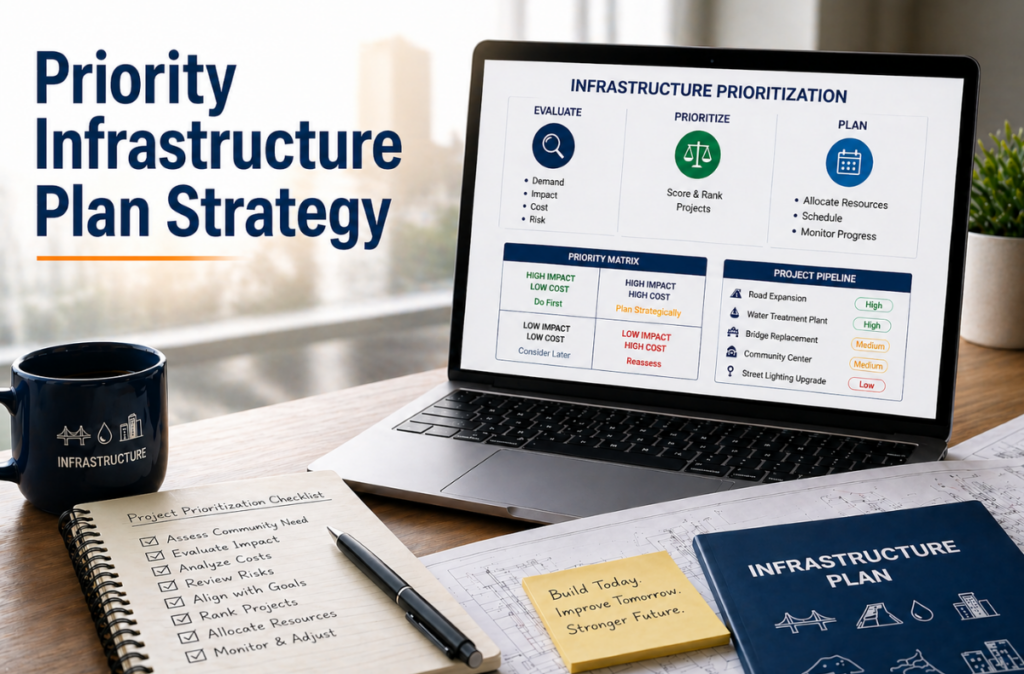
Critical Components of Priority Infrastructure Plan
Priority Infrastructure Areas (PIAs)
In this part, you must define exactly where growth will happen. For example, in regions like Queensland, Australia, planners use a Priority Infrastructure Area (PIA) to map urban infrastructure. A PIA accommodates 10 to 15 years of anticipated growth. It shows exactly where you will provide trunk infrastructure, such as water, sewer, transport, and parks.
You can map a PIA on a cadastral ground. This means you align the boundaries with actual property lines for total clarity. The PIA does not have to be one continuous zone. It can include non-contiguous areas or rural residential land, provided you have a focus plan to service those areas with trunk infrastructure. Establishing these zones directly supports the priority infrastructure plan for growth management.
The World Economic Forum Framework
The World Economic Forum provides a specific strategic infrastructure planning model. It grades readiness across four pillars to shape infrastructure policy development:
- Infrastructure Quality: Assess the reliability of existing transport, energy, and water grids.
- Government Readiness: Measure the rule of law and the track record of past projects.
- Societal Readiness: Gauge public willingness to pay and general civil maturity.
- Market Readiness: Evaluate the construction supply chain and access to finance.
Prioritizing Projects Effectively with Priority Infrastructure Plan
Project selection requires rigorous prioritization of infrastructure projects. Not every project can be treated as an emergency. You must rank projects using clear criteria based on the priority infrastructure plan.
Scoring Models and Matrices
Use data-driven approaches to prioritize infrastructure investments. Just establish weighting systems that should reflect the regional infrastructure strategy.
The World Bank developed the Infrastructure Prioritization Framework (IPF). They piloted this tool in Vietnam and Panama. The IPF scores projects on two distinct indices: the Social-Environmental Index (SEI) and the Financial-Economic Index (FEI). Plot these scores on a Cartesian plane and overlay the budget constraint. This creates four quadrants.
| Quadrant | Location on Matrix | Priority Level | Action Required |
|---|---|---|---|
| Quadrant A | High SEI, High FEI | High Priority | Fund these projects immediately. |
| Quadrant B | High SEI, Low FEI | Medium Priority | Review for social impact funding. |
| Quadrant C | Low SEI, High FEI | Medium Priority | Review for economic impact funding. |
| Quadrant D | Low SEI, Low FEI | Low Priority | Reject or redesign these projects. |
Weighted Shortest Job First (WSJF)
Agile methodologies offer another tool. You can use Weighted Shortest Job First (WSJF) to score projects. The WSJF can be calculated by adding business value, time criticality, and risk reduction, then dividing that sum by the job size. Projects with the highest WSJF score are placed at the top of the priority infrastructure plan. This approach improves the infrastructure lifecycle management.
Global Perspectives on Priority Infrastructure Plan Implementation
Different countries apply unique infrastructure planning best practices. We can learn from their approaches to infrastructure development guidelines.
United Kingdom
The UK constantly refines its municipal infrastructure planning. Historically, they split duties between the National Infrastructure Commission (NIC) and the Infrastructure and Projects Authority (IPA). To improve delivery, the UK merged these bodies into the National Infrastructure and Service Transformation Authority (NISTA) in 2025. This move streamlines the execution of their priority infrastructure plan.
Japan
Japan uses a structured five-year cycle. The 5th Priority Plan for Infrastructure Development covers FY2021 to FY2025. It targets four specific pillars:
- National Resilience: You invest heavily in disaster prevention and mitigation.
- Maintenance and Renewal: You focus on strict infrastructure asset management for aging structures.
- Digital Transformation (DX): You improve construction safety through digital technology.
- Regional Revitalization: You support local economies through targeted life-support services.

Resource Allocation and Optimization
The priority infrastructure plan must align with available resources. Resource management remains a top challenge for planners. Use infrastructure feasibility analysis to confirm you have the staff and materials to finish the job.
We can break large initiatives into manageable tasks and dependencies. Practice resource leveling to smooth out demand peaks. Constantly monitor infrastructure funding models to ensure cash flows align with execution schedules. Conduct a thorough infrastructure risk assessment before committing funds to prevent cost overruns. Proper resource tracking ensures that sustainable infrastructure planning stays on budget.
Building Next Strategy with Priority Infrastructure Plan
A priority infrastructure plan removes the guesswork from public spending. Stop wasting money on low-impact builds. Just follow infrastructure planning regulations to protect acquisitions. Design a priority infrastructure plan with strict boundaries, apply proven scoring frameworks, and carefully assign available resources.
Review your current project list today. Identify the projects that sit in Quadrant A. Allocate the budget to the projects that deliver the highest value. By properly following a reliable priority infrastructure plan, we can make our next move with confidence.
FAQs
A priority infrastructure plan is a strategic document that identifies and sequences essential public works projects over a specific timeframe, typically 10 to 15 years. It ensures you fund the most critical projects first.
You map Priority Infrastructure Areas on a cadastral basis. You identify zones where you can efficiently provide trunk infrastructure, such as water, sewer, and transport, to accommodate projected urban growth.
The World Bank developed the Infrastructure Prioritization Framework. It evaluates projects using a Social-Environmental Index and a Financial-Economic Index, helping you visually plot and select high-value projects.
Projects fail due to poor resource management and a lack of strategic alignment. Without a priority infrastructure plan, you risk funding low-value projects while ignoring critical needs.
The Weighted Shortest Job First model divides the cost of delay by the job size. You prioritize projects that deliver high value quickly and require the least amount of effort to complete.