Meta description: Running a Shopify dropshipping store in 2026? Here are the tools that actually move the needle, from finding winning products to knowing your real profit after every sale.
Your app stack can quietly make or break your store. Too many tools and you are bleeding money on subscriptions that do not pay off. Too few and you are flying blind, making decisions without the data you need. This guide focuses specifically on Shopify-compatible apps that earn their place in a lean, profit-aware dropshipping operation.
One rule worth keeping: If an app does not help you earn more, spend less, or understand your numbers better, cut it.
Table of contents
What Dropshipping Apps Do Shopify Merchants Actually Need?
Shopify takes care of the storefront. What it does not do is source your products, validate demand, recover abandoned carts, collect reviews, handle support tickets, or tell you whether your last campaign made or lost money. That is where apps come in.
Dropshipping on Shopify follows a straightforward sequence: you drive traffic to your store, a customer buys, you forward the order to a supplier, the supplier ships directly to your customer, and you keep the margin after all costs. Simple in theory. In practice, each stage in that chain has its own failure points. Nearly half of online shoppers abandon their carts due to unexpected additional costs like shipping, taxes, and fees (47%), which makes checkout one of the most critical leak points in the entire funnel. The right app at each stage is what keeps those failure points from becoming profit leaks.
The apps in this guide map directly onto that chain:
- Before the sale: sourcing and research tools help you stock the right products at margins worth defending.
- During the sale: marketing platforms bring in traffic, while review apps and landing page builders convert it.
- After the sale: email flows retain customers, support tools handle issues, and shipping apps keep buyers informed.
- Across every stage: profit tracking ties it all together so you know whether the whole operation is actually making money.
Get the stack right, and each part of the process reinforces the next. Get it wrong and you end up with a store that looks busy but bleeds money at every handoff
The Gap Between Merchants Who Get It Right and Those Who Don’t
Two Shopify dropshippers can target the same niche, run the same type of ads, and source from the same supplier category, and end up with completely different financial outcomes. The difference is rarely the product. It is the tools they use to manage margin, retain customers, and track what is actually happening in their business.
Merchants running without the right apps tend to underestimate their true cost per order, overestimate their margin, and scale spend into a business that was never as profitable as it looked on paper. The ones using a well-chosen stack know their numbers at every level and can make decisions accordingly.
According to TrueProfit’s data, the benchmarks are clear: 30-60% gross margin on product economics is the baseline, with 60-70% gross margin and 15-25% net margin representing what a well-run operation can sustain. And based on TrueProfit’s report on average dropshipping income, merchants who reach those margin levels typically fall into these income bands:
- Beginners: $0 to $2,000/month
- Intermediate: $2,000+ to $10,000/month
- Advanced: $10,000+ to $50,000+/month
Those numbers are achievable. But they assume the merchant has visibility into their actual profit, not just their revenue. That visibility comes from the right tools, starting with how you source, how you market, and how you measure.
Best Dropshipping Apps for Shopify Merchants in 2026
Product Sourcing and Supplier Apps
Your supplier relationship sets the ceiling on your margin and the floor on your customer experience. A cheap supplier with unpredictable fulfillment will cost you far more in refunds and support than you save on unit cost. Focus on apps that connect you with reliable suppliers and sync cleanly with Shopify.
1. DSers
As the officially recommended AliExpress app for Shopify, DSers handles the operational side of sourcing from Chinese suppliers at volume. You can map multiple suppliers to a single product, process bulk orders in seconds, and track order status without switching between platforms. The core value is speed: less time on manual order processing means faster fulfillment and fewer mistakes under pressure.
Best for: Shopify merchants sourcing from AliExpress who want to process high order volumes without the manual workload
Pricing: Free plan available. Paid plans from $19.90/month.
2. Spocket
Spocket connects Shopify merchants with vetted suppliers based primarily in the US and EU. The result is shipping times measured in days rather than weeks. If your target customers are in North America or Europe and delivery speed matters to your positioning, the higher per-unit cost is often justified. Fewer late delivery complaints means less support pressure and a lower refund rate over time.
Best for: Shopify stores targeting Western markets where fast shipping is a core part of the customer promise
Pricing: From $39.99/month.
3. Zendrop
Zendrop sits between the low-cost AliExpress ecosystem and a premium supplier network. It offers a curated product catalog with shorter shipping windows than standard AliExpress and gives sellers the option to add custom packaging and branding. For merchants who want to build a recognizable brand rather than run a generic dropshipping operation, Zendrop provides the infrastructure to start doing that without needing to negotiate directly with manufacturers.
Best for: Shopify sellers who want faster-than-AliExpress shipping paired with basic brand-building options
Pricing: Free plan available. Pro from $49/month.
Product Research Apps
A bad product choice is an expensive lesson. You spend money building a product page, run ad tests, and then discover the margin is too thin, or demand was never really there. Good research tools help you validate a product before committing real budget, not after.
4. Minea
Minea monitors live ad campaigns across Facebook, TikTok, Pinterest, and Snapchat, then surfaces products that are receiving sustained spend from multiple advertisers over time. That pattern of ongoing spend is a meaningful proxy for proven demand. Rather than guessing what might work, you get visibility into what is already working in the market right now.
Best for: Shopify dropshippers who want to validate demand through ad intelligence before running their own tests
Pricing: From $49/month. Starter plan available.
5. AutoDS
AutoDS is designed for stores managing real complexity: multiple suppliers, large SKU counts, and pricing that needs to stay competitive. It combines product discovery with automated order processing, supplier price monitoring, and inventory syncing. When a supplier raises a price or runs out of stock, AutoDS responds automatically. For merchants scaling past the point where manual management is viable, automation prevents margin bleed and stockout issues that are easy to miss otherwise.
Best for: Shopify sellers with growing catalogs who need product research and operational automation in the same tool
Pricing: From $26.90/month, depending on plan and store size.
Marketing and Traffic Apps
Spending on traffic without a clear picture of your unit economics is one of the fastest ways to lose money at scale. A strong ROAS number can coexist with an unprofitable business once you account for all the costs happening downstream of the click. Use these tools, but always pair them with accurate profit data.
6. Meta Ads (Facebook and Instagram)
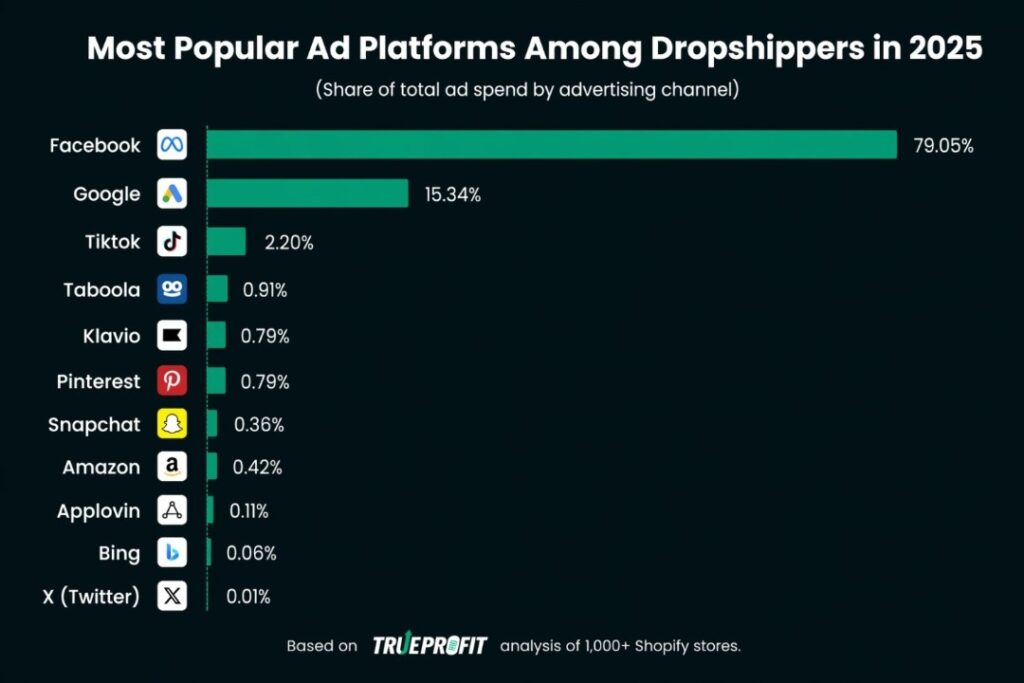
Meta remains the primary paid acquisition channel for most Shopify dropshippers in 2026. Its targeting depth, visual format options, and audience scale make it particularly well-suited to physical products with broad appeal. The cost of running effective campaigns has increased substantially over the past two years, making margin discipline more important than ever before when scaling spend.
Best for: Shopify stores selling visually appealing physical products to wide consumer audiences
Pricing: Variable. Budget at least $500 to $1,000/month to collect enough data to make informed decisions.
7. TikTok Ads
TikTok delivers lower CPMs than Meta across many niches, particularly for products targeting younger demographics or riding current trends. The platform favors content that feels native and unscripted over anything that looks like a traditional advertisement. Shopify merchants who can produce short-form video consistently will find TikTok a cost-effective complement or alternative to Meta.
Best for: Shopify merchants with trend-driven products and access to short-form video content production
Pricing: Variable. TikTok recommends at least $50/day per ad group during the algorithm’s learning phase.
8. Klaviyo
Every customer who completes a purchase is a future revenue opportunity that most Shopify stores underuse. Klaviyo lets you build automated email and SMS sequences that work in the background: recovering abandoned carts, following up after a purchase, re-engaging customers who have gone quiet, and promoting relevant products based on past behavior. Acquired customers cost significantly less to convert again, and Klaviyo is the engine that turns that efficiency into recurring revenue.
Best for: Shopify stores with steady traffic that want to generate more revenue from their existing customer list
Pricing: Free up to 250 contacts. Paid plans scale with list size from around $20/month.
Conversion and Trust Apps
Driving traffic to your Shopify store is only half the equation. Converting that traffic into paying customers is where most stores leave money on the table. In dropshipping, shoppers often have no prior relationship with your brand, which means trust signals and product page quality carry more weight than they would for an established retailer.
9. Loox
Loox is a review platform built around visual content. Photo and video reviews from real customers carry more persuasive weight than text alone because they answer the unspoken question every shopper has: does this product actually look and work the way the listing claims? Loox sends automated post-purchase emails to collect this content from buyers, so your review library grows proportionally with your order volume without requiring hands-on management.
Best for: Shopify stores where product appearance and real-world performance are key factors in the purchase decision
Pricing: From $9.99/month.
10. Ali Reviews
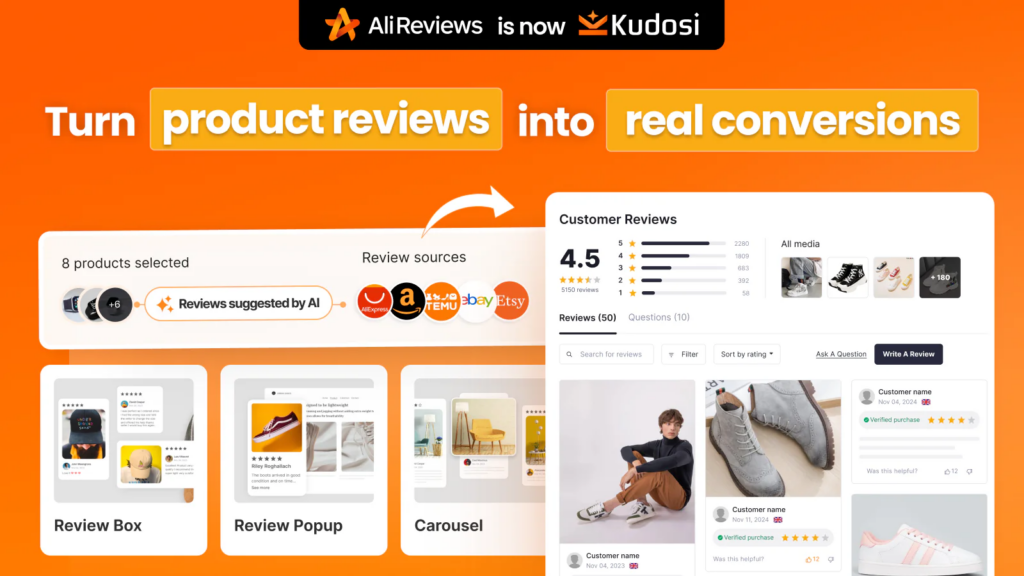
Ali Reviews, built by OneCommerce, addresses a practical problem unique to AliExpress dropshippers: how do you show credible social proof before you have processed a single order? The app imports reviews from the original AliExpress product listing directly to your Shopify store, complete with star ratings, reviewer text, and photos. Once your store is generating its own orders, it handles follow-up review collection from your actual customers through automated emails. The widgets are built to blend naturally into Shopify themes rather than looking like an obvious import.
Best for: Shopify dropshippers sourcing from AliExpress who want to establish social proof from the moment they launch
Pricing: Free plan available. Paid plans from $9.90/month.
11. Judge me
Judge.me has become one of the most widely used review apps on the Shopify App Store, largely because of what the free plan includes. Unlimited review request emails, unlimited review imports, and support for photo and video reviews are all available at no cost. It also outputs structured review data that enables star ratings to appear directly in Google search results, giving product pages better visibility in organic search. For merchants who want a reliable, full-featured review system without a recurring cost, Judge.me is the obvious starting point.
Best for: Shopify merchants who want a complete review system at low or no cost, particularly in the early stages of a store
Pricing: Free plan available. Awesome plan at $15/month.
12. GemPages
Shopify’s default product pages are built for general use, not for conversion optimization. GemPages gives merchants a drag-and-drop page builder to create dedicated landing pages with layouts designed around what actually drives purchases: clear benefit statements, comparison sections, trust indicators, and prominent calls to action. Sending paid traffic to a well-constructed landing page consistently outperforms sending it to a standard product page, often without any change to the ad itself.
Best for: Shopify sellers running paid traffic who want to improve conversion rates without needing development resources
Pricing: From $29/month.
Operations and Customer Service Apps
Post-purchase operations are a profit leak that rarely appears in marketing reports. Every preventable support ticket, every chargeback, and every refund that could have been avoided with better communication represents real money leaving the business. These apps reduce that friction.
13. Gorgias
Gorgias consolidates customer support channels, including email, live chat, and social media into a single workspace. What makes it particularly useful for Shopify merchants is that your order data surfaces directly inside each support conversation, so your team can see exactly what a customer purchased, when it shipped, and what the current status is without navigating away. That context speeds up resolution times and reduces the escalations that tend to turn into chargebacks.
Best for: Shopify stores where support volume has grown to the point that managing separate inboxes is creating delays and errors
Pricing: From $10/month (Starter). Scales based on ticket volume.
14. AfterShip
The majority of inbound support contacts in dropshipping come from customers who simply do not know where their order is. AfterShip eliminates most of those tickets by sending automated tracking updates at each stage of the shipping journey, so customers stay informed without needing to reach out. The reduction in “where is my package” messages frees up your support team for issues that actually need human attention, and it reduces the refund requests that happen when customers assume a package is lost.
Best for: All Shopify dropshipping stores, and especially those working with suppliers who have shipping timelines longer than a week
Pricing: Free plan for basic tracking. Paid from $11/month.
Profit Tracking and Financial Visibility Apps
This is the category most Shopify dropshippers skip or delay, and it is the one that ultimately determines whether growth makes you more profitable or just more exposed. Knowing your revenue is easy. Knowing what you actually keep after every fee, refund, ad cost, and subscription is what tells you whether the business is working.
15. TrueProfit
TrueProfit is a net profit analytics platform built for Shopify merchants who need an accurate, real-time view of their margins. Instead of assembling a profit picture from your Shopify dashboard, your ad accounts, and a spreadsheet that is always slightly out of date, TrueProfit consolidates every cost category into one live view.
What TrueProfit tracks for Shopify merchants:
- Net profit by product, channel, and store: Know which products are actually profitable, not just which ones are selling.
- All cost categories in one place: COGS, shipping, payment processing fees, currency conversion, refunds, taxes, and any custom cost lines your business needs.
- Automatic ad spend sync: Pulls spend data directly from Meta, TikTok, Google, and other platforms so your profit numbers reflect your actual acquisition costs.
- P&L reporting by time period: See your income statement by day, week, or month without building it yourself.
- LTV and CAC tracking: Understand whether your customer acquisition costs are sustainable as you grow.
- Multi-store dashboard on mobile: Monitor profitability across multiple Shopify stores from anywhere.
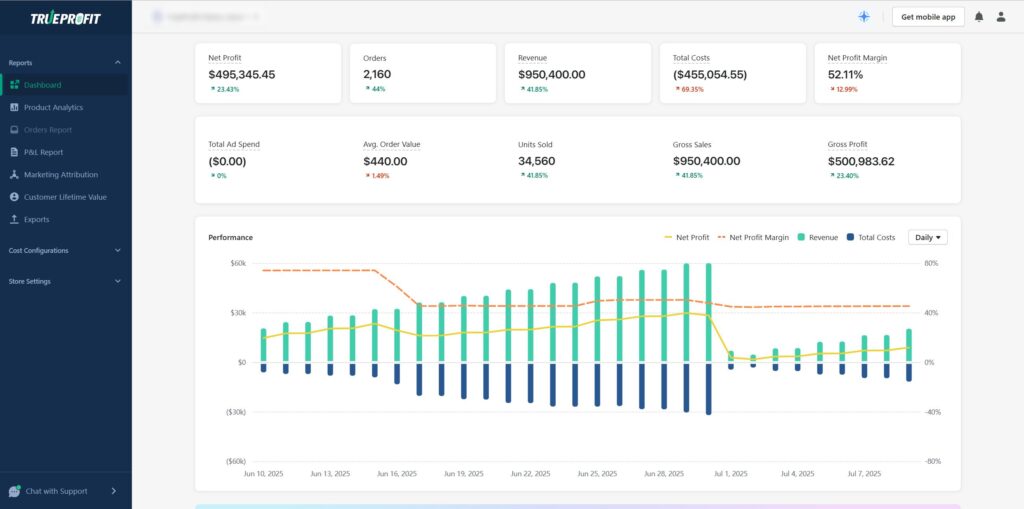
Shopify’s native analytics do not account for ad spend or most variable costs. Spreadsheets work until order volume makes them unreliable, which is usually right when accurate data matters most. TrueProfit closes that gap and lets every scaling decision be grounded in what you actually keep, not what you hope you are making.
Best for: Shopify dropshipping stores at any stage that want real margin visibility rather than revenue estimates
Pricing: From $35/month with a free trial available.
A note on timing: The merchants who benefit most from TrueProfit are the ones who set it up before scaling ad spend, not after a quarter of unprofitable growth. Understanding your unit economics early is what makes it possible to scale something that is actually working.
Quick Reference: Best Dropshipping Apps for Shopify in 2026
| Category | App | Starting Price |
| Supplier / Sourcing | DSers | Free / $19.90+ |
| Supplier / Sourcing | Spocket | $39.99/mo |
| Supplier / Sourcing | Zendrop | Free / $49+ |
| Product Research | Minea | $49/mo |
| Product Research | AutoDS | $26.90/mo |
| Paid Acquisition | Meta Ads | Variable |
| Paid Acquisition | TikTok Ads | Variable |
| Email / SMS | Klaviyo | Free / ~$20+ |
| Social Proof / Reviews | Loox | $9.99/mo |
| Social Proof / Reviews | Ali Reviews | Free / $9.90+ |
| Social Proof / Reviews | Judge.me | Free / $15/mo |
| Landing Pages | GemPages | $29/mo |
| Customer Support | Gorgias | $10/mo |
| Order Tracking | AfterShip | Free / $11+ |
| Profit Analytics | TrueProfit | $35/mo (free trial) |
How to Build Your Shopify App Stack
Not every tool here needs to be active from day one. A staged approach keeps costs down and ensures each app is being used at the right time for the right purpose.
- Layer 1: Before your first sale: Connect a supplier app and install TrueProfit. These two are non-negotiable from the start. One gets products to customers; the other tells you whether doing so is actually profitable.
- Layer 2: Once traffic is consistent, Add your paid acquisition channels, a review app, and an email marketing tool. These amplify what is already working and help retain the customers you are paying to acquire.
- Layer 3: Once volume justifies it: Bring in a landing page builder, a customer support platform, and a shipping notification tool. At low order volumes, these are useful extras. At scale, they pay for themselves many times over.
The stores that stall out in Shopify dropshipping are rarely undone by one bad decision. More often, they grow fast on revenue, never get real visibility into their margins, and eventually realize they have been funding growth out of what felt like profit. Build for clarity from the start. Revenue tells you how busy you are. Profit tells you whether the business is worth building.