
Artificial intelligence has become a driving force behind modern digital transformation. Businesses across industries are rapidly adopting AI-powered solutions not just to automate repetitive tasks but also to analyze vast amounts of data and deliver smarter, more personalized customer experiences. As organizations increasingly rely on advanced technologies, the demand for high-quality AI software development continues to grow, making AI a strategic priority for business leaders seeking competitive advantage. In fact, a 2026 Forbes Technology Council article cites that 78% of organizations used AI in at least one business function in 2024, with adoption growing sharply year-over-year, highlighting how essential AI has become across industries.
One company helping organizations harness these capabilities is GeniusSoftware, which delivers custom AI-driven solutions to solve real-world business challenges and drive measurable results.
Table of contents
The Growing Importance of AI Software Development
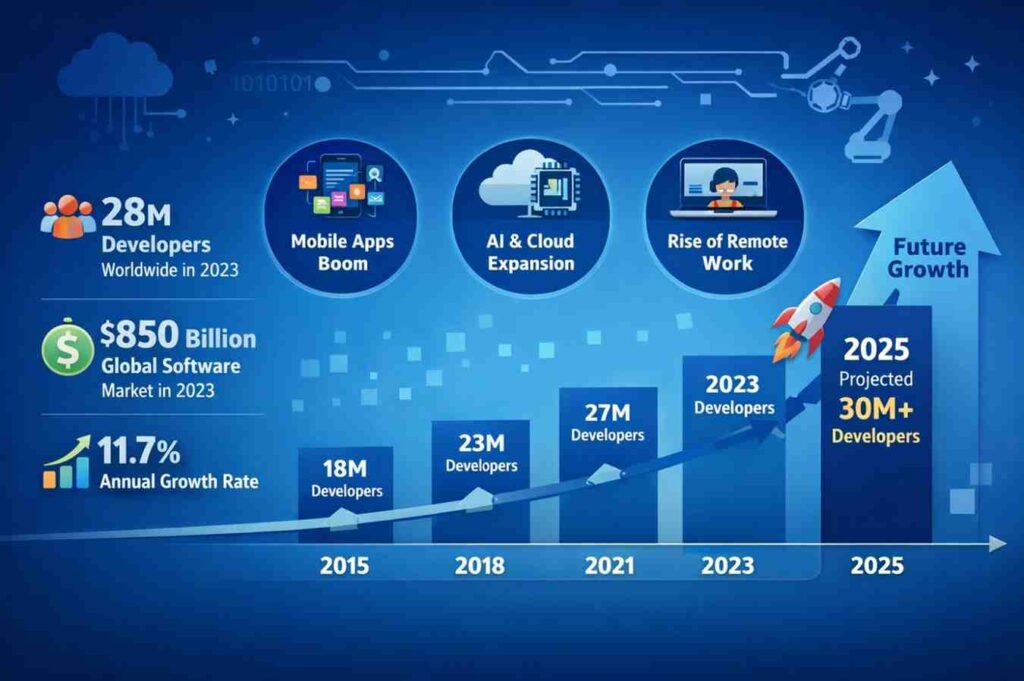
AI software development involves creating systems that can learn from data, improve their performance over time, and make decisions autonomously. Technologies like machine learning models, natural language processing tools, and predictive analytics platforms have become embedded into many products or services that we see in the world today.
- Automate complex workflows: AI reduces manual effort, minimizes errors, and allows employees to focus on strategic tasks.
- Analyze large amounts of data: AI quickly processes data and identifies patterns and insights that are difficult or impossible to detect manually.
- Support decision-making: AI enables executives and teams to make confident, data-driven decisions.
- Enhance customer experiences: AI delivers personalized interactions, predictive recommendations, and intelligent assistance.
- Optimize business processes: AI improves efficiency and profitability across operations, including resource allocation and supply chain management.
But designing reliable AI solutions is not trivial and requires in-depth expertise in software engineering and AI technologies. China and the US have kicked off discussions to resolve their differences over AI and strengthen controls on its use.
How AI Development Drives Business Innovation
Enterprises implementing AI solutions report tangible gains in productivity and operational efficiency. AI systems analyze data significantly faster than human teams and are adept at spotting trends and anomalies that may otherwise fall through the cracks. That’s because AI can use past and present data to forecast market patterns, enabling businesses to implement proactive strategy changes. AI-powered chatbots can help (in customer service) automate support, 24/7 answering, and reduce response times, improving the customer experience.
E-commerce businesses leverage AI to personalize user experiences, offering product recommendations tailored to individual preferences, which drives engagement and revenue. In finance, AI is used to detect fraud and security threats in real time, protecting both the organization and its customers from risk. These capabilities allow businesses to scale operations faster while maintaining high accuracy and efficiency, giving them a significant advantage in competitive markets.
GeniusSoftware AI Software Development Solutions
Companies seeking advanced AI technologies often turn to platforms like GeniusSoftware AI Software Development, available at GeniusSoftware AI Solutions. These solutions help organizations design, develop, and implement intelligent systems that align closely with business objectives.
A structured AI development process typically includes multiple stages:
- AI consulting and strategy planning: evaluating business needs and identifying areas where AI can deliver the most value.
- Machine learning model development: designing algorithms and predictive models tailored to specific business problems.
- AI-powered application design: integrating AI capabilities into user-facing software or enterprise systems.
- Integration with existing enterprise systems: ensuring AI solutions work seamlessly with CRM, ERP, or other digital platforms.
- Monitoring and optimization of AI performance: continuously improving models to maintain accuracy and effectiveness over time.
This end-to-end approach ensures that AI systems deliver tangible business benefits rather than being experimental tools with limited impact.
Industries Benefiting from AI Development
Artificial Intelligence is rapidly revolutionising industries. AI also helps in healthcare, including diagnostics, medical data management, and patient care. Financial institutions use AI to monitor for fraud, risk mitigation, and automate compliance. AI is being utilized by eCommerce platforms for recommendation engines, dynamic pricing, and personalized marketing to improve customer engagement and increase sales.
On the other hand, logistics and supply chain companies deploy AI to predict demand as well, optimize delivery routes, enhance functional efficiency to save costs, and improve quality of service. With rapid AI adoption, companies that invest
The Future of AI in Business
The future of business technology will be heavily shaped by artificial intelligence. From predictive analytics to intelligent automation, AI-driven software is expected to reshape operational processes, customer engagement, and strategic decision-making. Companies that adopt AI today gain access to new opportunities for innovation, efficiency, and growth, establishing a strong foundation for long-term success.
Partnering with experienced AI development teams like GeniusSoftware ensures businesses can build scalable, intelligent solutions that support innovation while maintaining operational efficiency. In a competitive, data-driven world, leveraging AI effectively is no longer optional; it’s a critical component of modern business strategy.