With the rapid development of AI, project management AI is revolutionizing how teams plan, execute, and deliver projects. A wide range of AI solutions tailored for project management is now available, helping organizations streamline workflows and enhance decision-making throughout the project lifecycle. By leveraging artificial intelligence, project professionals can streamline workflows, optimize resource allocation, and enhance decision-making to achieve higher project success rates. This article explores the impact of AI in project management, highlights key project management tools with AI features, and discusses how organizations can harness AI to improve project outcomes.
Key Takeaways
- AI Project Management leverages technologies like machine learning and predictive analytics to automate tasks and enhance decision-making.
- It helps with automating repetitive tasks, optimizing resources, predicting risks, and improving team collaboration.
- Key tools such as Lark, Asana, ClickUp, Wrike, and Trello offer AI features that streamline project management processes.
- Organizations should address challenges like integration, resistance to change, and data quality to fully benefit from AI.
- The future of AI in project management will shift roles towards strategic leadership, enhancing efficiency and collaboration.
Table of contents
What is AI Project Management?
Project management AI refers to the application of artificial intelligence technologies such as machine learning, natural language processing, and predictive analytics to automate and enhance various project management tasks. These AI systems support project managers and teams by reducing manual effort and tasks, providing data-driven insights, and enabling more effective team collaboration across project environments.
AI in project management helps with:
- Automating repetitive tasks and status updates
- Optimizing resource allocation based on team skills and availability
- Predicting potential risks and bottlenecks before they impact timelines
- Enhancing communication through meeting summaries and real-time data sharing
- Supporting strategic decision-making via scenario planning and data analysis
- Supporting project planning through intelligent scheduling, resource forecasting, and workflow optimization.
- Providing data-driven insights by analyzing historical data as well as real-time data
AI can also reduce administrative overhead by adjusting workload distribution and recognizing when schedules need to be rebalanced.
By incorporating AI, organizations can increase efficiency, reduce project risks, and accelerate delivery, all while empowering project managers to focus on leadership and stakeholder engagement.
Benefits of AI in Project Management
The integration of AI technologies into project management offers numerous benefits:
- Improved Resource Management: AI analyzes project data and resource availability to optimize assignments, forecast future resource needs, and prevent overloading team members.
- Enhanced Risk Management: Predictive analytics identify potential issues early, allowing proactive mitigation strategies.
- Automated Task Management: AI-powered automation handles routine updates, progress tracking, and scheduling adjustments.
- Data-Driven Decision Making: AI tools sift through large volumes of historical and real-time data to provide actionable insights, enhancing decision-making by improving the accuracy and strategic quality of project decisions.
- Better Team Collaboration: Natural language processing enables AI to summarize meetings, transcribe discussions, and facilitate clear communication.
- Increased Project Success Rates: By reducing manual errors and improving planning accuracy, AI contributes to higher rates of on-time and on-budget project delivery.
Additionally, sentiment and velocity analysis can detect when team members are overextended, suggesting resource shifts to maintain productivity and morale.
Key AI Project Management Tools
Choosing the right project management tools that include AI features is essential to leverage these benefits effectively.
Key features of AI project management tools include automating repetitive tasks, real-time monitoring of project progress, and comprehensive support that enhances planning, execution, and evaluation. These functionalities help teams improve efficiency and decision-making throughout the project lifecycle.
AI tools like ClickUp, Asana, and Wrike automate scheduling, generate reports, and analyze bottlenecks to streamline workflows.
Below are some leading solutions transforming project management through AI:
1. Lark: Unified Collaboration with AI-Powered Project Management
Lark is an all-in-one collaboration platform that boosts teams’ productivity, designed to unify messaging, video meetings, cloud-native documents, sheets, calendar, email, and automation tools into a single workspace. With AI-powered features, Lark enhances project management by automating workflows, enabling real-time document collaboration, and providing intelligent scheduling that optimizes resource allocation.
Key AI capabilities of Lark include:
- Automated meeting transcription and summarization using natural language processing
- AI-driven task reminders and progress tracking to keep teams aligned
- Smart calendar function that balances team availability and project timelines
- Customizable workflow automation tools to reduce manual project management tasks
- Multilingual support to facilitate global team collaboration
Lark’s seamless combination of communication and project management tools empowers project teams to collaborate efficiently, make data-driven decisions, and accelerate project delivery.
2. Asana: AI-Assisted Goal Setting and Task Automation
Asana is a work management platform designed to help teams plan, track, and manage work in a shared system. In an AI project management context, Asana’s AI is generally positioned to help teams clarify work, reduce repetitive coordination, and standardize execution artifacts (such as updates and summaries) so projects stay aligned with goals.
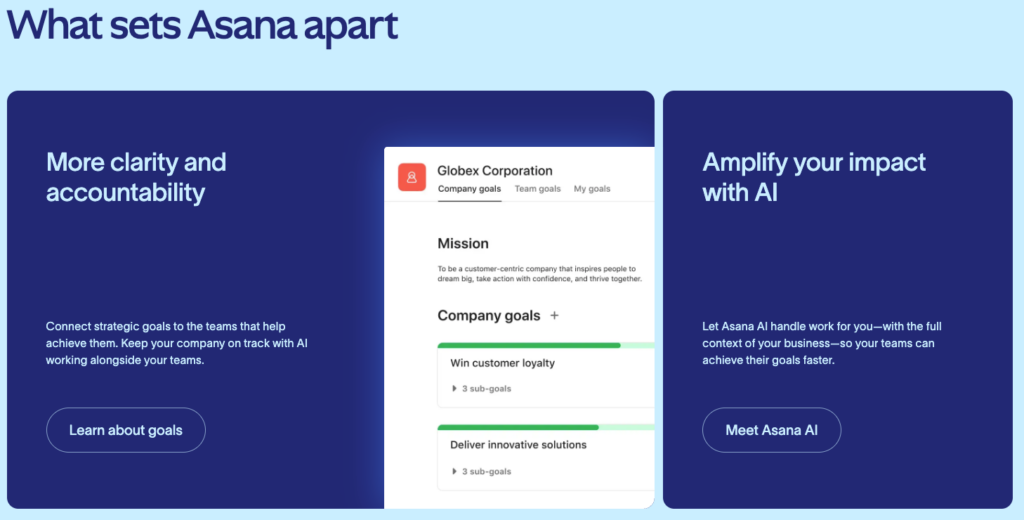
Key AI capabilities of Asana may include:
- AI-assisted writing and refinement for project communications (e.g., updates or descriptions), depending on where AI is enabled
- AI-generated or AI-improved summaries of work items (such as tasks or projects), depending on configuration
- AI assistance for breaking down goals into structured work (draft plans/checklists) that teams can review and adjust
- AI-supported workflow automation concepts (helping reduce routine manual steps), subject to plan/admin controls
- Governance/admin controls to manage where AI is available and how it’s used, depending on workspace settings
Asana’s AI value for project teams typically comes from making it easier to keep priorities, ownership, and reporting consistent especially when multiple stakeholders need the same “source of truth” for progress.
3. ClickUp: Comprehensive AI Workspace for Task and Document Management
ClickUp is a work platform that brings tasks, documents, and team collaboration into a single workspace. For AI project management, ClickUp is commonly positioned as adding an AI layer to planning, drafting, and organizing work, aimed at reducing time spent on routine coordination and content creation.
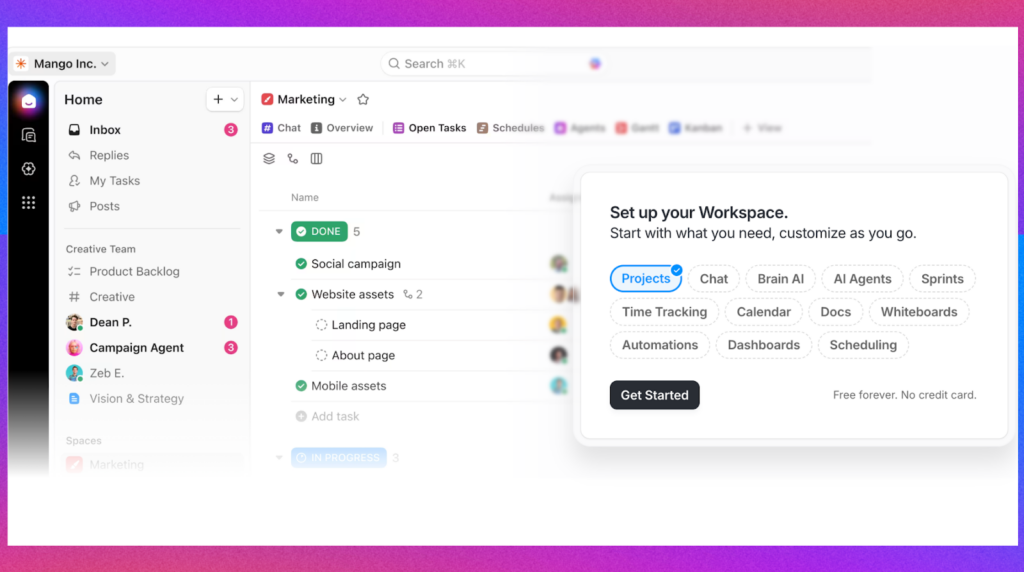
Key AI capabilities of ClickUp may include:
- AI-assisted drafting, rewriting, and summarizing of project content (e.g., docs, updates, or descriptions), depending on enabled features
- AI helps turn high-level goals or requests into structured task lists/subtasks for teams to refine
- AI-assisted search or retrieval experiences across workspace content, depending on permissions and scope
- AI-supported automations (suggesting or enhancing rules/workflows) to reduce repetitive PM actions, depending on the plan
- Admin/permission considerations that determine what AI can access and where outputs can be applied
ClickUp tends to fit teams who want AI to operate where work artifacts live, so tasks and documentation can stay connected without constant copy-paste between tools.
4. Wrike: AI-Enabled Work Management for Workflow Acceleration
Wrike is an enterprise work management platform built to coordinate complex workflows across teams. In AI project management, Wrike is often positioned around using AI to streamline repetitive work, accelerate planning/reporting tasks, and support visibility across initiatives especially when teams rely on consistent processes.
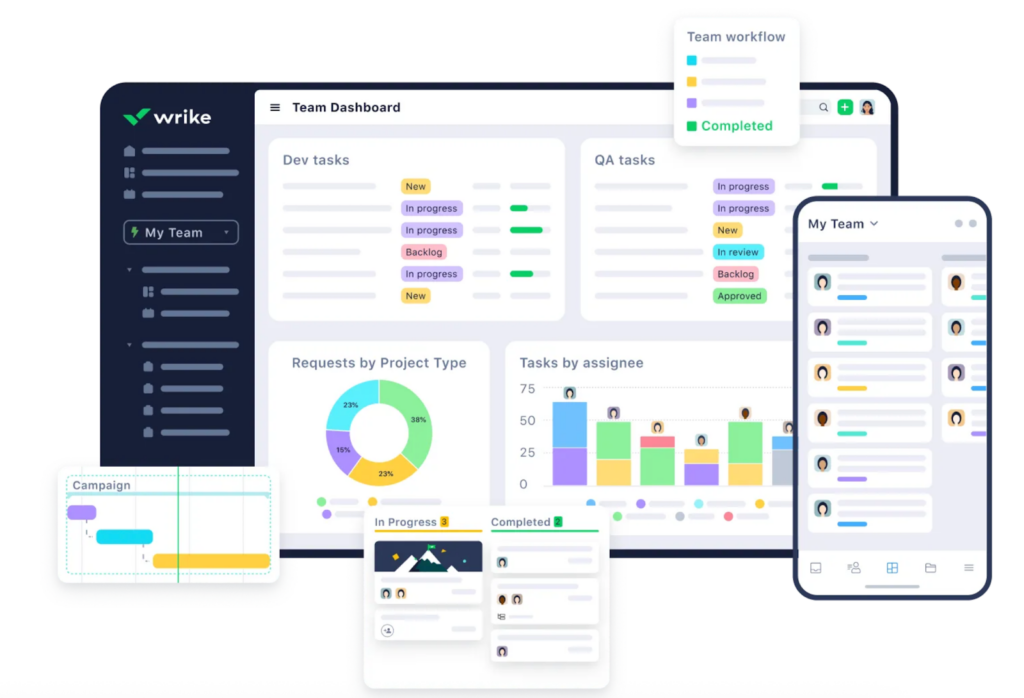
Key AI capabilities of Wrike may include:
- AI-assisted summarization and content generation for work items (e.g., turning long threads into concise updates), depending on availability
- AI support for workflow acceleration (helping automate routine steps and reduce manual coordination), depending on configuration
- AI-assisted reporting or insight workflows (drafting reports or highlighting notable changes), depending on enabled features
- AI-enabled agents/copilots are conceptually designed to help execute repeatable process tasks, subject to enterprise controls
- Governance features (permissions/admin settings) that control AI usage across teams and workspaces
Wrike’s AI tends to be most useful when your workflows are standardized enough that AI outputs can be reviewed quickly and applied consistently across projects.
5. Trello: Visual Project Management With AI-Enhanced Content and Automation
Trello is a visual project management tool centered on kanban boards, designed to make work status and flow easy to see at a glance. For AI project management, Trello’s AI story typically focuses on helping users generate, transform, or summarize content on cards and pairing that with automation and integrations to reduce repetitive board upkeep.
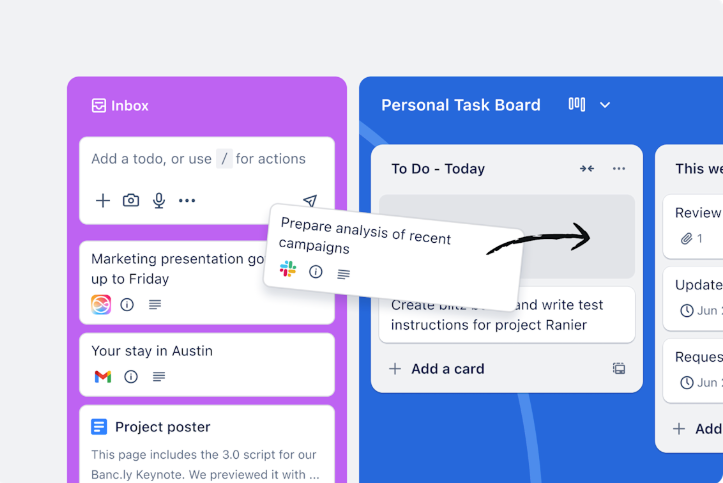
Key AI capabilities of Trello may include:
- AI-assisted writing for card content (e.g., generating or transforming descriptions), depending on what’s enabled
- AI-powered summarization of card content or activity to speed up updates and handoffs
- Automation features (rules/buttons) that reduce repetitive actions on boards, with AI serving as an assistive layer where available
- AI-supported brainstorming or structured idea generation that can be captured directly into cards/lists, depending on features/add-ons
- Permissions/admin controls that influence where AI can be used and what content it can access
Trello’s AI value is often strongest for teams who run lightweight workflows on boards and want faster updates, clearer summaries, and less manual “board maintenance.”
Integrating AI into Your Project Management Efforts
To successfully incorporate AI into project management, organizations should follow these best practices:
- Evaluate Current Processes and Define Objectives: Identify repetitive tasks and inefficiencies where AI can add the most value.
- Select the Right AI Tools: Choose solutions that align with your project environments and integrate smoothly with existing software development and collaboration platforms. Organizations may also consider supplementing their main platform with additional tools to enable more comprehensive automation and project planning.
- Provide Adequate Training: Ensure project managers and teams understand how to use AI tools and interpret AI-generated insights.
- Ensure Data Quality and Security: Maintain accurate, timely, and secure project data to maximize AI effectiveness.
- Balance AI with Human Oversight: Use AI to augment human judgment, not replace it, maintaining governance and alignment with business goals.
- Monitor Progress and Measure Performance: Track key performance indicators (KPIs) to assess AI’s impact on project outcomes and continuously refine processes.
Project managers are encouraged to connect with the PMI community to stay up to date on AI integration and industry best practices. Additionally, AI can enhance project monitoring by providing real-time project status updates through AI-powered dashboards.
Overcoming Common Challenges
As organizations embrace AI in project management, project managers and teams often encounter several common challenges that can impact the success of their AI project management efforts. Understanding these obstacles and knowing how to address them can make the difference between a smooth AI transformation and a frustrating experience.
1. Integrating AI Tools with Existing Systems
One of the most frequent hurdles is integrating new AI project management tools with established project management systems and workflows. Compatibility issues can disrupt ongoing projects and slow down adoption. To overcome this, project managers should prioritize AI tools that integrate seamlessly with popular project management platforms and collaboration software. Choosing solutions that support open APIs and flexible data exchange ensures a smoother transition and helps teams leverage AI without interrupting business operations.
2. Overcoming Resistance to Change
Introducing AI technologies can sometimes lead to resistance from team members who are unfamiliar with AI or concerned that automation will replace their roles. Project managers can address this by providing comprehensive training and ongoing support. Helping teams understand how AI in project management can automate repetitive tasks, streamline status updates, and free up time for more strategic work.
3. Ensuring High-Quality Project Data
AI systems rely on accurate, up-to-date project data to deliver reliable insights and recommendations. Poor data quality can undermine the effectiveness of AI-powered decision-making and predictive analytics. Project managers should implement robust data governance policies, including regular data validation checks and clear data management procedures. Maintaining data consistency across different tools and platforms is essential for optimizing resource allocation and achieving project success.
4. Addressing Potential Risks and Bias
AI adoption poses potential risks, including algorithmic bias and decisions that may not align with business goals.Regularly monitoring AI outputs and involving human oversight in key decisions helps maintain alignment with organizational objectives and supports ethical AI use.
5. Navigating Evolving Technologies
The rapid pace of AI innovation, such as advances in large language models, prompt engineering, and generative AI, can make it challenging for project professionals to stay current. Continuous learning and professional development are crucial. Project managers should encourage their teams to keep up with the latest AI technologies, market analysis techniques, and scenario planning tools to remain competitive and maximize the transformative power of AI.
By proactively addressing these common challenges, project managers can unlock the full potential of AI project management tools. As AI technologies continue to evolve, project professionals who embrace change and invest in the right skills.
The Future of AI in Project Management
AI is poised to handle up to 80% of routine project management tasks by 2030, reshaping project managers’ roles from administrative coordinators to strategic leaders. AI insights will enhance strategic decision-making and portfolio management by integrating AI-driven analysis.
The AI revolution in project management will enable teams to collaborate more effectively. Moreover, it will help teams anticipate and mitigate risks proactively, allowing them to deliver projects with greater precision. In addition, AI will support project managers in making more informed strategic decisions by providing valuable data insights. For example, AI can instantly compile complex data into professional stakeholder reports and real-time dashboards, thereby eliminating hours of manual data entry. Similarly, ChatGPT can create initial project plans, suggest tasks, and define dependencies based on project descriptions. AI is predicted to help project managers monitor the status of every project. Including anticipated benefits and compliance with key performance indicators. For instance, Motion, an AI-first planner, acts as a digital executive assistant and is ideal for individuals or lean teams struggling with prioritization.
Conclusion
Project management AI is transforming how teams collaborate, plan, and execute projects. By leveraging AI-powered tools such as Lark, organizations can optimize resource allocation, automate tedious tasks, generate reports to streamline project documentation and communication, and enhance decision-making, thereby improving project success rates. Embracing AI in project management not only increases efficiency but also empowers project managers. The future of project management lies in the seamless integration of AI technologies.