
Mobile commerce now accounts for 59% of global retail e-commerce sales, totaling $4.01 trillion in 2025, according to Sensor Tower’s State of Mobile 2026 report. Native retail apps for stores drive 66% of mobile sales, delivering twice the conversion rate of mobile websites. For retail businesses, that gap isn’t a trend to watch. Its revenue is being left on the table right now.
The right apps for stores don’t just add features; they change how modern ecommerce operates. They connect online and physical channels, automate repetitive work, and give us cleaner data to make faster decisions. Here, I collected the seven must-have tools for retail business that genuinely boost success in 2026, with specific app recommendations, pricing, and performance data for each.
Key Takeaways
- Mobile commerce will account for 59% of e-commerce sales, driven by native retail apps with higher conversion rates than websites.
- Retail tech should utilize MACH architecture for flexibility, scalability, and integration of tools without vendor lock-in.
- Key apps like Shopify, Klaviyo, and Neto improve operations, customer retention, and inventory management for retail businesses.
- Investing in apps that solve specific operational gaps helps retailers maximize revenue opportunities and enhance efficiency.
- AI-powered tools like Tidio streamline customer support while reducing costs and improving response times.
Table of Contents
- The Modern Retail Tech Stack: Why MACH Architecture Matters
- 7 Must-Have Apps for Stores in 2026
- 1. Shopify & Shopify POS, The Foundation
- 2. Klaviyo: Email and SMS Marketing That Pays Back
- 3. Neto + Pick n Pack: Inventory and Fulfillment
- 4. Yoast SEO + Plug-in SEO: Organic Discoverability
- 5. Judge.me + Reviews.io: Social Proof and Google Seller Ratings
- 6. Marketplace Connect: Centralized Multi-Channel Selling
- 7. Tidio + QuickoAI: AI-Powered Customer Support
- Apps for Stores Comparative Data
- Choosing the Right Apps for Your Store
- FAQs
The Modern Retail Tech Stack: Why MACH Architecture Matters
Before picking individual apps for stores, it helps to understand the framework behind the best-performing retail tech stacks.
MACH architecture, Microservices, API-first, Cloud-native, and Headless, is the design approach that lets retailers mix and match best-of-breed tools without being locked into a single vendor. Each component is independently deployable, automatically updated, and replaceable without rebuilding everything else.
For small retail businesses and growing multi-store operators, MACH architecture means:
- Add a new marketing app without reconfiguring your POS
- Scale during peak seasons without hardware upgrades
- Replace underperforming tools without downtime
A Unified commerce platform built on MACH principles connects your point of sale, e-commerce, inventory, and customer data into a single source of truth. That’s the foundation every other app on this list connects to.
7 Must-Have Apps for Stores in 2026
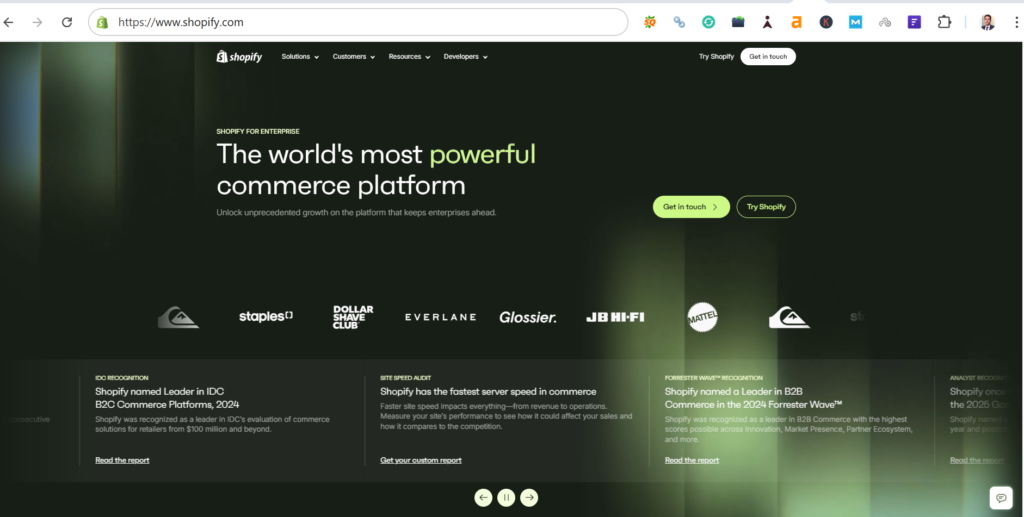
1. Shopify & Shopify POS, The Foundation
Best for: Managing online and physical stores from one dashboard
Shopify remains the default starting point for apps for small retail businesses and growing brands alike. The point of sale apps for retailers built into Shopify POS sync in-store and online inventory in real time, eliminating the overselling problem that costs retailers an average of 35% in avoidable lost sales.
Why it works:
- Inventory updates across channels the moment a sale occurs
- Works offline, syncs when the connection is restored
- Connects to barcode scanners, receipt printers, and cash drawers
- Supports staff permissions and performance reporting
Pricing: Shopify Basic starts at $39/month. Shopify POS Pro is $89/month per location.
This is your retail operations software core. Every other app for stores on this list connects to it.
2. Klaviyo: Email and SMS Marketing That Pays Back
Best for: Customer retention and lifecycle automation
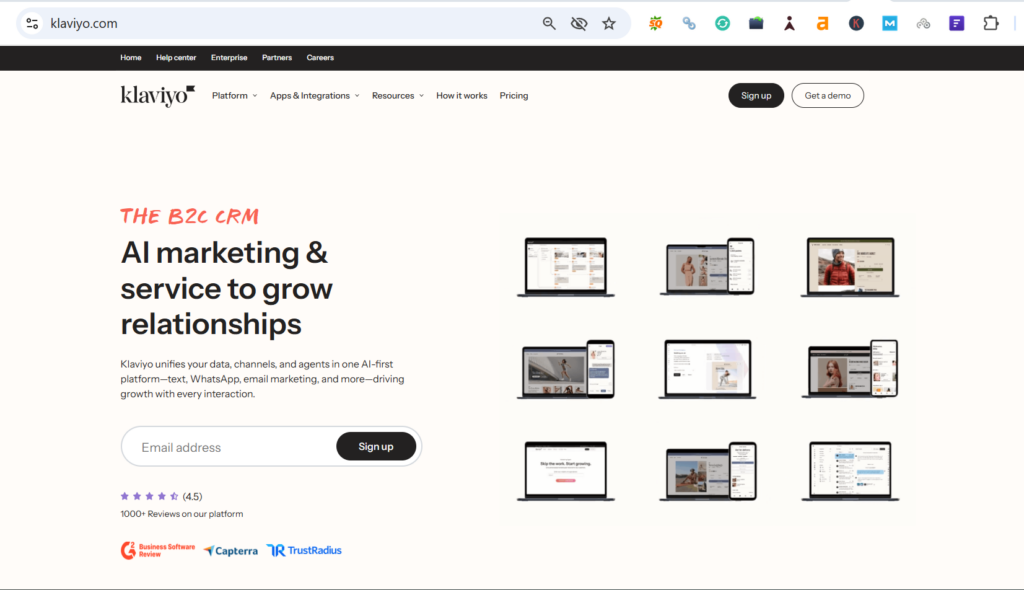
Klaviyo is the industry standard for retail marketing apps that integrate deeply with Shopify data. The marketing automation market was valued at $6.65 billion in 2024 and is projected to grow at a CAGR of 15.3% from 2025 to 2030, and Klaviyo sits at the center of that growth for retail.
What makes it stand out as a digital tool for retail businesses is the depth of its segmentation. You’re not just sending emails, you’re triggering campaigns based on purchase history, browsing behavior, and predicted lifetime value.
Key performance data from Klaviyo’s 2024 Benchmark Report:
- Abandoned cart workflows generate an average of $3.65 per recipient, up to $28.89 for the top 10% of optimized flows
- Welcome email workflows deliver a 58.26% click-to-conversion rate
- Automated workflows generate up to 30x more revenue per recipient than standard campaigns
Pricing: Free up to 250 contacts. Paid plans start at $20/month for 300 contacts.
This is one of the highest-ROI retail automation apps for stores available at any price point.
3. Neto + Pick n Pack: Inventory and Fulfillment
Best for: Omnichannel inventory sync and order accuracy
Inventory accuracy in traditional retail environments ranges between 55% and 80%, according to RFID Journal (Dean Frew, November 2025). That gap, representing at least $500 billion in misrepresented inventory globally, directly affects stockouts, excess orders, and canceled revenue.
Neto (now Maropost Commerce Cloud) provides native retail inventory management apps with real-time tracking, bulk updates, and demand-based reordering across multiple locations. Add Pick n Pack on top for mobile order picking, wireless printing, and verification tools that reduce fulfillment errors.
Together, these apps are used to manage inventory for stores:
- Real-time stock visibility across all locations
- Omnichannel inventory sync between physical and online channels
- Faster order processing with mobile picking workflows
- Foundation for RFID-enabled inventory visibility as you scale
Pricing: Neto starts at $199/month. Pick n Pack is $69/month (excluding GST).
For multi-store management apps, this combination handles the operational complexity that breaks simpler retail management apps.

4. Yoast SEO + Plug-in SEO: Organic Discoverability
Best for: Driving consistent traffic without ad spend
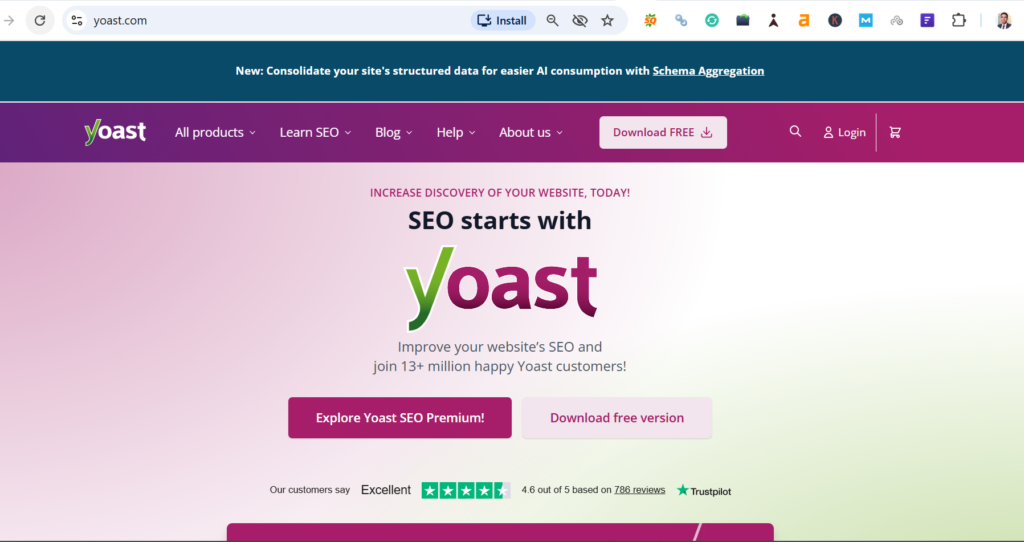
Plug in SEO is one of the most widely used e-commerce apps for retailers on Shopify for identifying technical SEO issues, broken links, missing meta descriptions, slow-loading pages, and structured data errors. Yoast SEO complements it with on-page optimization guidance for product descriptions and blog content.
Both tools function as retail analytics tools for organic search performance, helping you understand which pages rank, which need work, and what your competitors are targeting.
Why this matters for apps for stores:
- 53% of mobile users abandon a page that takes more than 3 seconds to load (Aarki, 2026)
- On-page SEO improvements compound over time, unlike paid traffic, they don’t stop when you stop spending
- Schema markup from these tools feeds Google Shopping rich snippets
Pricing: Plug in SEO has a free tier. Yoast SEO for Shopify starts at $19/month.
5. Judge.me + Reviews.io: Social Proof and Google Seller Ratings
Best for: Building trust and improving Google Ad performance
89% of shoppers check online reviews before purchasing, and 49% list positive reviews among their top three purchase decision factors, according to Trustpilot’s research. These apps for retail customer management and social proof are direct revenue drivers.
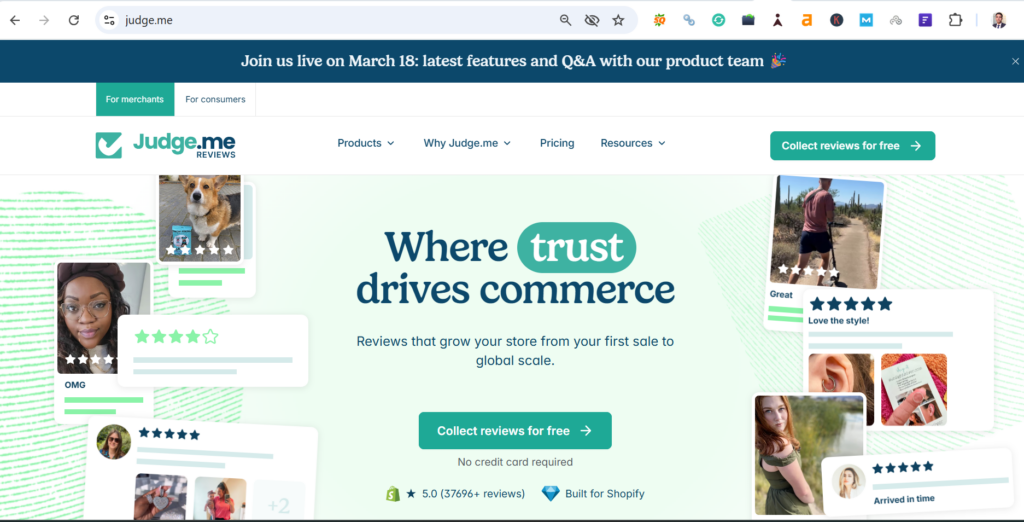
Judge.me automates review collection with photo and video UGC, displays star ratings in Google search results, and has a feature-rich free plan. Reviews.io adds Google Seller Ratings support, which, once active, can boost Google Ads click-through rates by up to 10%.
Google Seller Ratings requirements (Birdeye, 2025):
- Minimum 100 unique reviews within the past 12 months
- Average rating of 3.5 stars or higher
- Reviews collected through a Google-approved partner
Pricing: Judge.me free plan available; paid from $15/month. Reviews.io from $65/month with a free trial.
These retail business productivity apps pay for themselves quickly in improved ad performance alone.
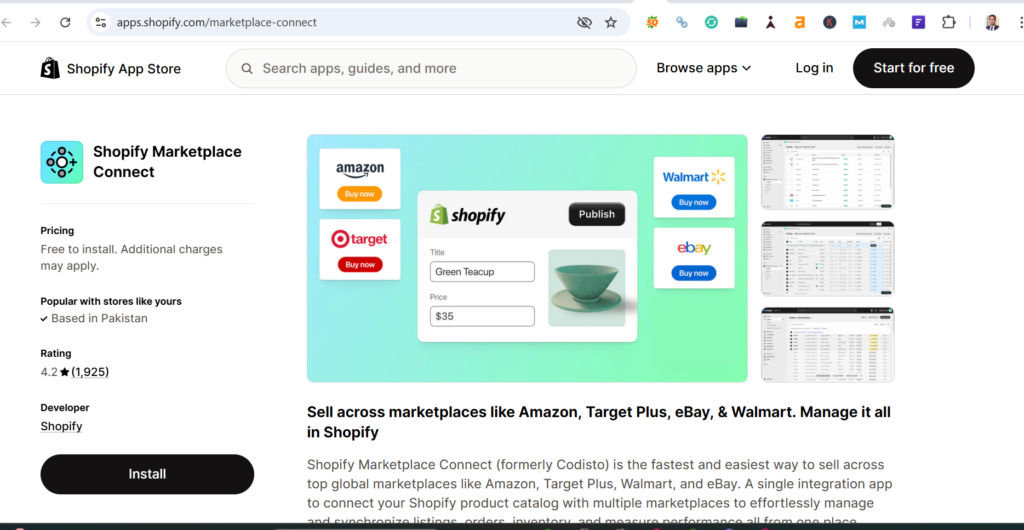
6. Marketplace Connect: Centralized Multi-Channel Selling
Best for: Managing Amazon, eBay, and Walmart from one place
Marketplace Connect (available on Shopify) lets you list, sync, and fulfill orders across Amazon, eBay, Walmart, and Etsy from a single Shopify dashboard. It’s one of the most underutilized apps for stores and store management software options for retailers who already sell on multiple channels but manage them manually.
Core capabilities:
- Centralized inventory management that prevents overselling across marketplaces
- POS and ERP integration to unify order data
- Bulk listing creation and price synchronization
- Order management is routed through your existing Shopify workflow
For retailers who want to build Retail Media Networks (RMNs) reach without separate ad accounts and dashboards for each platform, this is the bridge.
Pricing: Starts at $99/month on Shopify.
7. Tidio + QuickoAI: AI-Powered Customer Support
Best for: Reducing support costs while improving response times
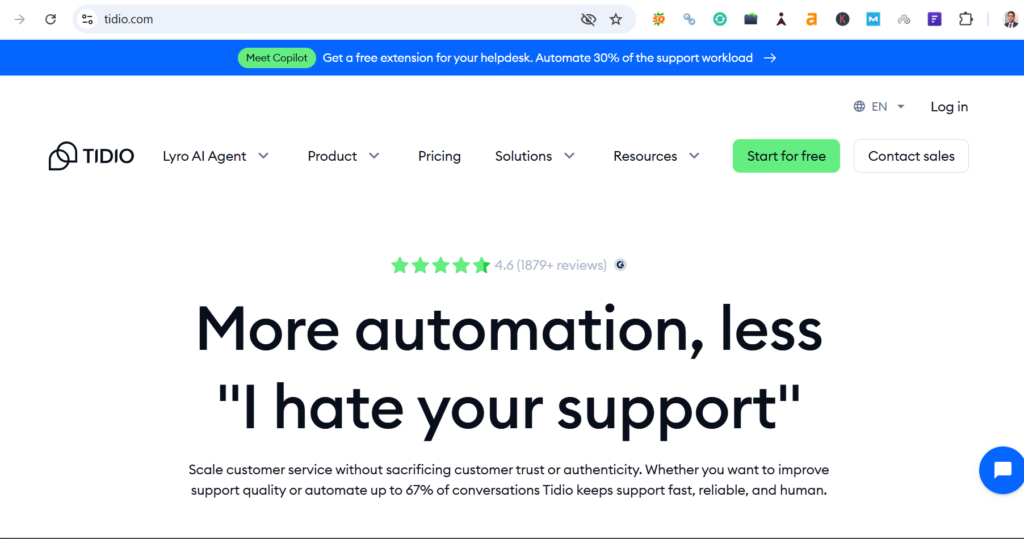
Tidio combines live chat, AI-powered chatbots, and email marketing in one dashboard. Its chatbots handle common queries 24/7, freeing up store associates for higher-value interactions. QuickoAI adds multilingual conversational support and a product recommendation engine, making it one of the more capable retail business productivity apps for stores serving diverse customer bases.
AI retail chatbots are positioned to reduce operational customer service costs by up to 60% through automation of repetitive support tickets, according to SaaS retail solutions research (Siddhi Infosoft, 2026).
What these apps for stores deliver:
- 24/7 customer support without adding headcount
- Multilingual support for international customer bases
- Product recommendations integrated with your catalog
- FAQ automation that reduces ticket volume
Pricing: Tidio free plan available; paid plans from $29/month. QuickoAI pricing varies by implementation.
Apps for Stores Comparative Data
App Category Market Growth (2024–2026)
| App Category | 2024/2025 Market Size | Growth Rate | Source |
|---|---|---|---|
| Retail Inventory Management Software | $9.37B (2025) | 12.5% CAGR | Business Research Company, 2026 |
| Marketing Automation | $7.3B (2023 base) | 12.74% CAGR through 2032 | Polaris Market Research |
| Email Marketing Market | $12.5B (2024) | ~12% CAGR to 2030 | OpenPR, 2024 |
| Mobile App Market (total) | Growing to $524.80B by 2026 | Accelerating | Statista |
Mobile App vs. Mobile Web Performance Metrics
| Metric | Mobile App | Mobile Web | Source |
|---|---|---|---|
| Conversion Rate | ~5.7% (2x mobile web) | 2.85% | Aarki / SQ Magazine, 2026 |
| Average Load Time | 3–5 seconds | 8–12 seconds | Appmaker.xyz, 2026 |
| Cart Abandonment Rate | Lower (streamlined UX) | 85.65% | Baymard Institute / Aarki, 2026 |
| Shopper Preference (US) | 85% prefer apps | 15% prefer mobile sites | Capital One Shopping, 2025 |
| UX Investment Return | Up to 400% conversion lift | Baseline | SQ Magazine, 2026 |
Choosing the Right Apps for Your Store
The best apps for managing retail stores share three qualities: they integrate cleanly with your existing stack, they’re affordable enough to run without enterprise-level budgets, and they scale without forcing a platform switch as you grow.
Start with your biggest operational gap. Losing orders to inventory errors? Start with Neto and Pick n Pack. Losing customers after the first purchase? Start with Klaviyo. Not showing up in search results? Plug in SEO costs less per month than a single Google Ads click in most retail categories.
The retailers pulling ahead in 2026 are not necessarily the ones with the biggest budgets. They’re the ones running tighter, better-connected retail technology solutions, where all apps for stores earn their place by solving a specific, measurable problem.
FAQs
Start with Shopify for your e-commerce and POS foundation, Klaviyo for email marketing, and Plug in SEO for basic technical SEO health. These three cover sales, retention, and discoverability, the three pillars of early-stage retail growth.
Tools like Neto and Shopify POS provide omnichannel inventory sync, updating stock levels in real time across all physical and online channels whenever a transaction occurs. This prevents overselling and stockouts simultaneously.
MACH (Microservices, API-first, Cloud-native, Headless) is a design framework for retail tech stacks that allows each tool to be replaced or upgraded independently. It eliminates vendor lock-in and makes adding new apps for online and physical stores faster and less disruptive.
You need at least 100 unique reviews collected within the past 12 months from a Google-approved review partner (such as Reviews.io or Trustpilot), with an average rating of 3.5 stars or higher.
Yes. AI-powered tools like Tidio and QuickoAI automate responses to common queries, order status, product questions, and returns policy, reducing the volume of tickets requiring human handling. Research from retail SaaS providers indicates cost reductions of up to 60% for businesses that use apps for stores and deploy AI chatbots across their support channels.