
Every founder knows the moment when culture starts to slip. You open your fifth office, and suddenly, your Singapore team doesn’t quite feel like part of the same company as New York. A star performer quits, citing: “I just didn’t feel seen anymore.”
Research commissioned by AWS shows that 86% of startup leaders believe culture contributes to growth, yet many admit it’s the first casualty of hypergrowth. The uncomfortable truth? The explosive headcount growth, geographic expansion, and layered management that signaled your success turn into the very forces eroding what made your company special.employee recognition technology
But outstanding leaders understand that scaling culture isn’t about preserving the past. It’s about building systems that amplify the values and behaviors that mattered from day one. And increasingly, those leaders are turning to recognition technology not as an HR add-on, but as a strategic infrastructure for scaling the startup vibe.
The stakes are clear. Companies with strong cultures see 4x the revenue growth of those with weak cultures, according to Harvard Business Review. Culture shouldn’t be considered a soft issue. When scaling your business, it becomes a leadership problem that demands a leadership solution.
Table of contents
The Startup Vibe: What Makes It Special?
The “startup vibe” isn’t about ping-pong tables or free lunches. What actually defines early-stage culture are three core elements:
- Immediacy of impact,
- Visibility of contribution, and
- Direct connection to leadership.
In a 15-person company, everyone sees how their work matters. The designer gets to watch the founder demo their feature to customers that afternoon. The engineer hears the sales team close deals using the product they built last week. Recognition is instant because proximity makes it effortless.
Startup culture is characterized by flat organizational structures where decision-making is decentralized and employees are empowered to take ownership. When everyone reports to the founder or sits within earshot of leadership, there’s no recognition lag. No bureaucratic delay between great work and acknowledgment.
This creates “tight feedback loops.” The time between action and reward is reduced, making the connection between behavior and outcome crystal clear.
Culture naturally diffuses from the founder to employees through proximity and frequency of interaction. But this organic cultural transmission has an expiration date. And that date arrives faster than most founders anticipate.
The Challenge: Culture Breaks as You Grow
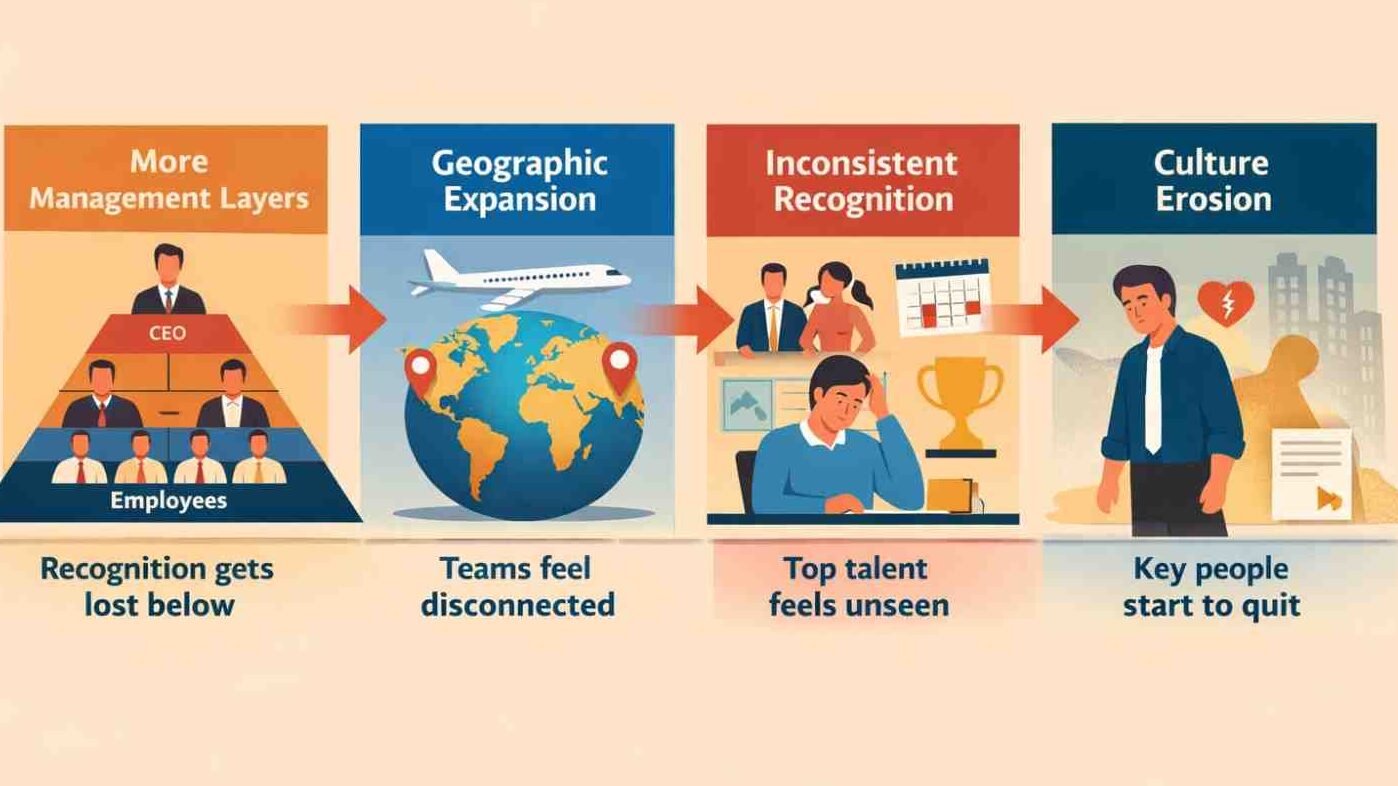
The breakdown happens predictably. As the business matures and the employee population grows, founders lose their line of sight. Adding management layers means the direct connection between the founder and employees is severed. So, culture must now be actively managed rather than naturally diffusing.
As management layers get added, you hire middle managers. This means leadership rarely finds out about great work happening at the bottom. Recognition becomes wildly inconsistent. Your best performers feel invisible. The tight feedback loops between the CEO and the employees? Gone.
Furthermore, once you open offices in new cities, half of your team rarely meets the CEO. Casual hallway recognitions that used to happen organically are now impossible across time zones. Research shows that talent is the primary growth challenge for hypergrowth companies, and maintaining culture is their biggest talent priority.
The data makes it clear. A Forbes article says 66% of employees would leave their jobs if they didn’t feel appreciated, and those who don’t feel appreciated are twice as likely to quit within the year. Around 63% of US companies find retention harder than hiring, making this crisis even more acute.
Yet most founders respond by doubling down on the wrong things. They hold on to the residue of early culture, i.e., the happy hours, the all-hands rituals, the Slack channels, hoping nostalgia will fill the gap. What actually made the early days work was a recognition system that operated constantly: frequent, visible, immediate, and value-based. That system is what needs to scale, not the surface rituals.
So, how do you scale a recognition system for large employees? How to rebuild a tight feedback loop for employees? The answers lie in treating recognition culture as infrastructure, not aspiration.
Recognition as a Culture Keeper
Outstanding leaders understand that at scale, culture becomes an engineering problem. You need infrastructure that operationalizes the tight feedback loops that happened naturally when you were small. You need technology to do what human attention can’t, i.e., see everything and make excellence visible across the organization.
According to a 2025 study by Vantage Recognition and Great Place to Work® India, employees who consistently feel appreciated show18% higher motivation, 16% stronger intent to stay, 14% greater agility, and deliver 11% better customer excellence. Recognition doesn’t just make people feel good; it shapes behavior and reinforces values.
According to Gallup, organizations with high engagement are 23% more profitable, 18% more productive, and 21% less likely to experience turnover.
But here’s what separates recognition technology from traditional programs: scale without dilution.
A platform makes every recognition visible and permanent. When someone in your Singapore office gets recognized for living your values, your entire company sees it and not just their immediate team. Peers can recognize peers without waiting for manager approval, just like in the early days. And every recognition ties back to your actual values, not vague platitudes. Over time, you’re not just celebrating good work; you’re showing everyone exactly what “living our culture” looks like in practice.
Now that you have understood the concept, let’s understand the execution as well.
The New Leadership Playbook: Using Recognition Technology
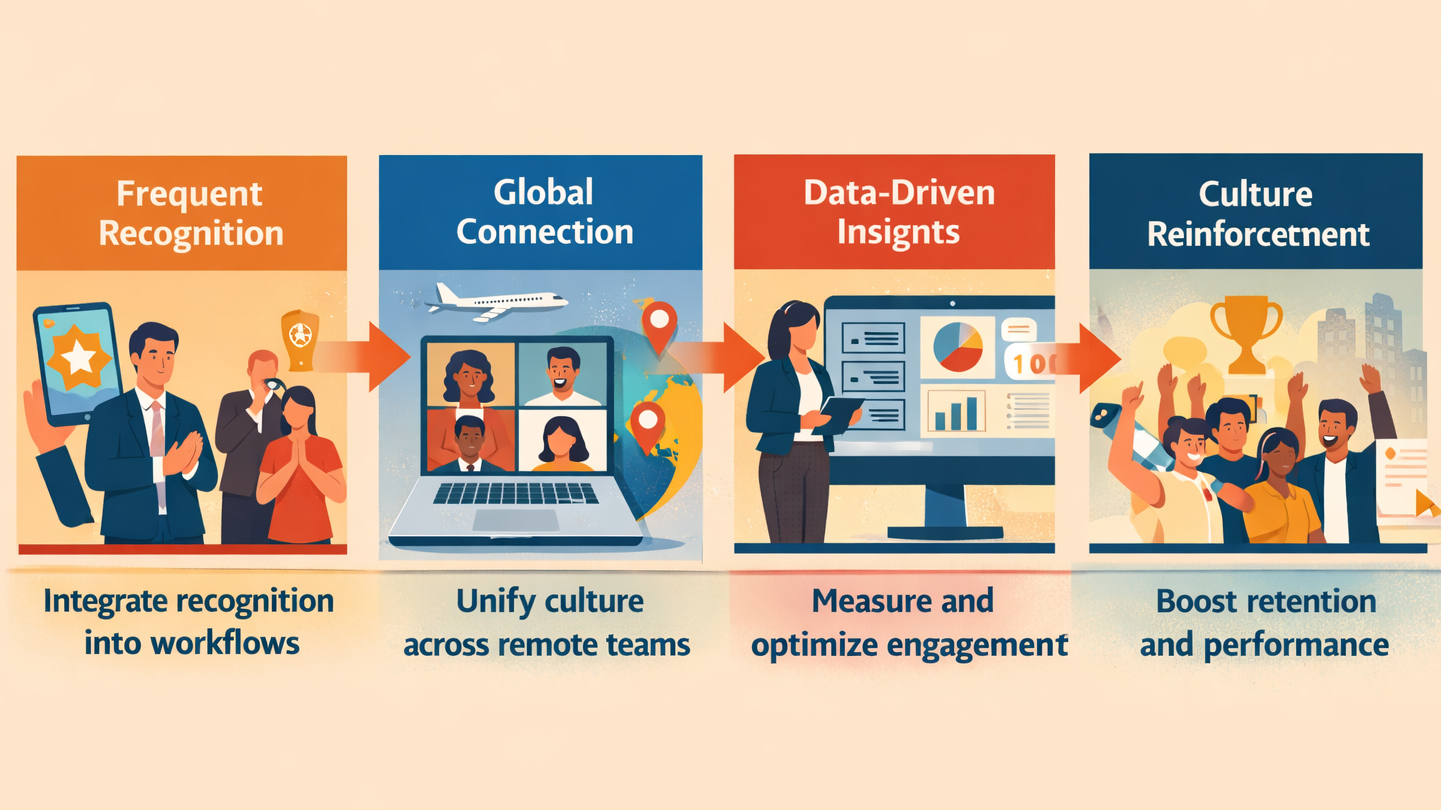
Having technology isn’t enough. Outstanding leaders approach recognition technology with intention, strategy, and executive ownership. Here’s how they make it work:
1. Define Culture in Observable Behaviors
Skip vague aspirations like “innovation.” Define specific actions: “shares work-in-progress before it’s perfect” or “brings customer feedback into product decisions.” Your recognition program reinforces these concrete behaviors daily.
2. Make It Leadership-Led
Recognition must start at the top. Executives need to use the platform daily, publicly recognizing employees across all levels and locations.
3. Train for Quality
Generic praise doesn’t change behavior. Teach specificity: “Your analysis showing mobile redesign revenue impact helped us accelerate the timeline. That’s the data-driven decision-making we need.”
4. Embed into Workflows
If employees need separate logins or have to leave their primary communication app to give recognition, adoption dies. Integrate with existing tools. For example, Microsoft Teams integrates with the recognition platform of your choice, making recognition as easy as sending a message.
5. Create Transparency
Make recognition public and visible. When Customer Success sees Engineering recognized for fixing bugs, they learn what matters. New hires scrolling feeds watch your culture in action.
6. Connect to Rewards Thoughtfully
Budget: $200- $350 per employee annually. Balance public acknowledgment with tangible rewards like gift cards or extra PTO. Keep it authentic, never transactional.
7. Avoid Common Pitfalls
Don’t launch and disappear. Don’t recognize the same people repeatedly. Don’t use generic templates. Don’t substitute recognition for fair pay or fixing toxic management. Recognition amplifies a healthy culture but can’t fix a broken one.
Featured Case Studies: Recognition Technology in Action
Fujitsu: With 7,000 UK employees, Fujitsu invests £1 million annually in recognition schemes. Paula Evans, Head of Pensions and Benefits, states: “We’re doing this to drive the right behaviors from our employees aligned to our corporate values, so we can deliver for our customers.” They offer awards from £100 to £1,000, distributing 123 Platinum awards in just over a year, with recognition happening in minutes, recreating tight feedback loops at enterprise scale.
Wipro: Wipro, a global technology company with over 250,000 employees across six continents, faced the challenge of maintaining an appreciation-based culture in a hybrid and remote work environment. They implemented a comprehensive employee recognition platform that automated manual processes, such as long-service awards, while enabling real-time peer-to-peer and manager-led recognition. The platform integrated seamlessly with their HRIS systems and Microsoft Teams, making recognition accessible from anywhere.
The Last Word: Culture Is a Leadership Choice at Scale
The culture dilution you’re experiencing isn’t inevitable; it’s a consequence of not building systems to replace what happened organically.
When you were 15, you already ran a recognition program. You noticed great work, connected it to values, and celebrated it publicly. With 1,500 people, you need technology to do what your attention used to do.
Your best people aren’t leaving for money. They’re leaving because they feel invisible. Recognition technology makes excellence visible again, creates performance-driving feedback loops, and gives you the infrastructure to operationalize your values.
The question isn’t whether you can afford to invest in recognition technology. It’s whether you can afford not to.
Outstanding leaders build systems that preserve what made their company special. Culture at scale is a leadership problem. Will you let it happen to you, or will you engineer the systems that amplify what mattered from the start?
It’s time to make your move.