Wearable technology now does more than count steps or monitor heart rates – it could change the lives of over a billion people worldwide who suffer from migraines. This neurological disorder shows up as moderate-to-severe or tension headache episodes and affects about 15% of Australians. The economic impact is massive, with high costs to Australia’s working-age population and healthcare system.
Migraine sufferers would find it revolutionary to know when an attack might strike. A survey of 565 people showed that 88.8% wanted a device that could predict migraine attacks, and most preferred wearing it on their wrist. Recent advances in wearable health technology have made this possible. Smart wearable devices have shown promising results – their average balanced accuracy is a big deal as it means that it tops 84% when detecting attacks one night before they happen. Wearable medical devices like the Empatica Embrace Plus can track physiological data during sleep and help spot subtle changes that precede migraine attacks.
This piece will get into wearable technology’s role in migraine prediction and how these medical devices work. You’ll learn why they are a breakthrough in healthcare. We’ll look at the science behind prediction models, weigh personalised against generalised approaches, and explore current limitations along with future possibilities of this promising technology.
Table of contents
How Wearable Technology Detects Migraine Signals
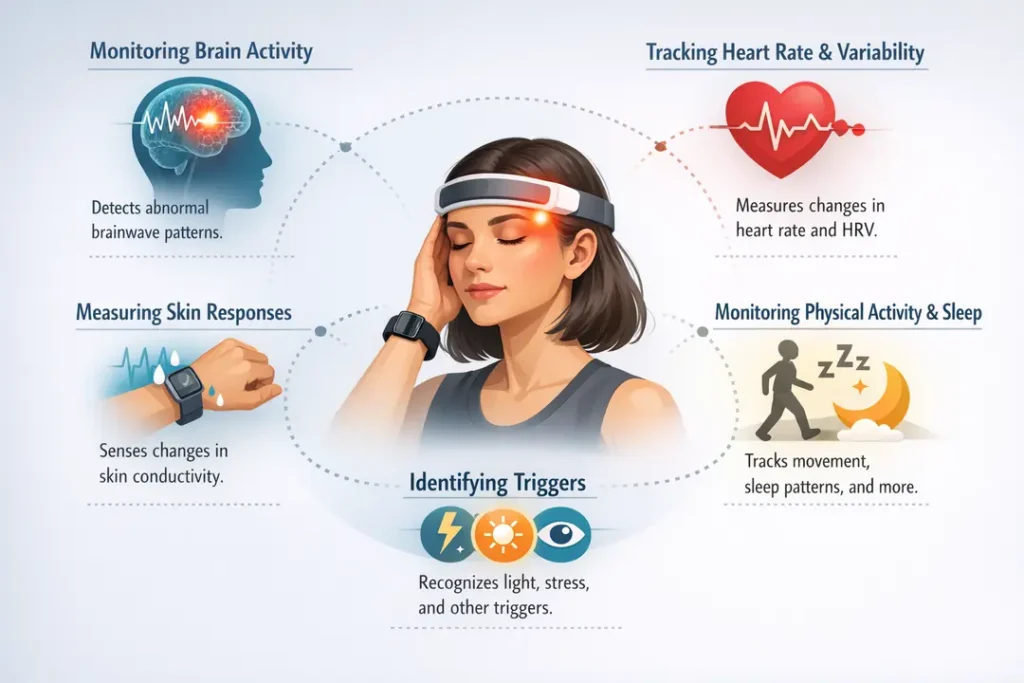
Our bodies signal an impending migraine attack hours before pain begins. This prediction secret lies in measurable changes. The autonomic nervous system (ANS) regulates involuntary bodily functions and changes during various migraine phases.
Understanding the role of the autonomic nervous system
Critical haemodynamic signals, such as body temperature, heart rate, and sweating, are regulated by the ANS. This system shows distinct patterns of dysfunction in people with migraines and tension headache. Many migraine patients show sympathetic hypoactivity between attacks and exaggerated sympathetic responses during attacks. Wearable technology can detect measurable changes in biomedical signals resulting from this dysregulation.
Key biosignals: EDA, skin temperature, and heart rate
Three primary biosignals show the biggest changes before a migraine in wearable health technology:
- Electrodermal activity (EDA): measures the skin’s electrical conductance, which changes with sweating controlled by the ANS
- Skin temperature: fluctuates in distinctive patterns before migraine onset
- Heart rate and variability: shows altered patterns in the pre-migraine state
These signals show the highest F-statistic values and most significant p-values in short analysis frames of 5–10 minutes. This makes them valuable tools for early detection. Features like mean, median, maximum, minimum, and peak values from these signals provide the strongest predictive power.
Why sleep data is more reliable for prediction
Sleep monitoring has become the gold standard for migraine prediction. Scientists found that analysing sleep signals provides a more accurate estimate of the probability of migraine the next day. Sleep disturbances and migraines have a known connection, especially when you have nighttime and early morning attacks.
Sleep data has fewer movement-related disturbances than daytime measurements. The Empatica E4 wristband and similar wearable medical devices can collect cleaner sleep data. This leads to prediction accuracy that exceeds 84% when using customised models.
Wearable technology’s biggest advantage in migraine management? Users can know right when they wake up if they’re likely to have a migraine that day. This allows them to take preventative medication in time.
The Science Behind Migraine Prediction Models
Sophisticated machine learning algorithms convert raw biosensor data into actionable insights, powering the impressive predictive capabilities of migraine-detecting wearables.
How machine learning interprets biosignals
Wearable health technology collects physiological data that machine learning models like XGBoost, KNN, SVM, and neural networks process. The XGBoost-based generalised prediction model achieved 0.806 in accuracy, 0.638 in precision, and 0.595 in recall with appropriate analysis frames. These models detect subtle relationships between physiological signals and migraine onset that traditional statistical methods might overlook. Machine learning models offer sufficient expressivity to capture complex relations among putatively causal factors, unlike conventional statistical approaches.
Importance of short analysis frames (5–10 min)
Research shows that 5 and 10-minute analysis frames produce substantially better results than longer intervals. The ANOVA results demonstrate that these shorter frames capture meaningful variations between pre-migraine nights and migraine-free nights more effectively. These concise time windows show higher F-statistic values and more significant p-values, which suggests they contain valuable information for migraine prediction.
Feature extraction: what the models actually learn
Machine learning applications require prepared biomedical signals, which are derived from raw data through feature extraction. The models learn from 78 distinct features extracted from collected signals. These features focus on statistical metrics that represent patterns in electrodermal activity, skin temperature, and heart rate data.
Why traditional metrics like median and min matter
Traditional statistical metrics have proven most valuable for prediction. The analysis extracts features such as the mean, median, standard deviation, maximum, and minimum for each interval. These simple measurements contain vital information about physiological states before migraines. Traditional features show higher predictive power than complex alternatives because they capture subtle physiological changes effectively before migraine onset.
Wearable technology medical devices can now convert raw sensor data into predictive insights and alert users hours before symptoms begin.
Personalised vs. Generalised Models: What Works Best
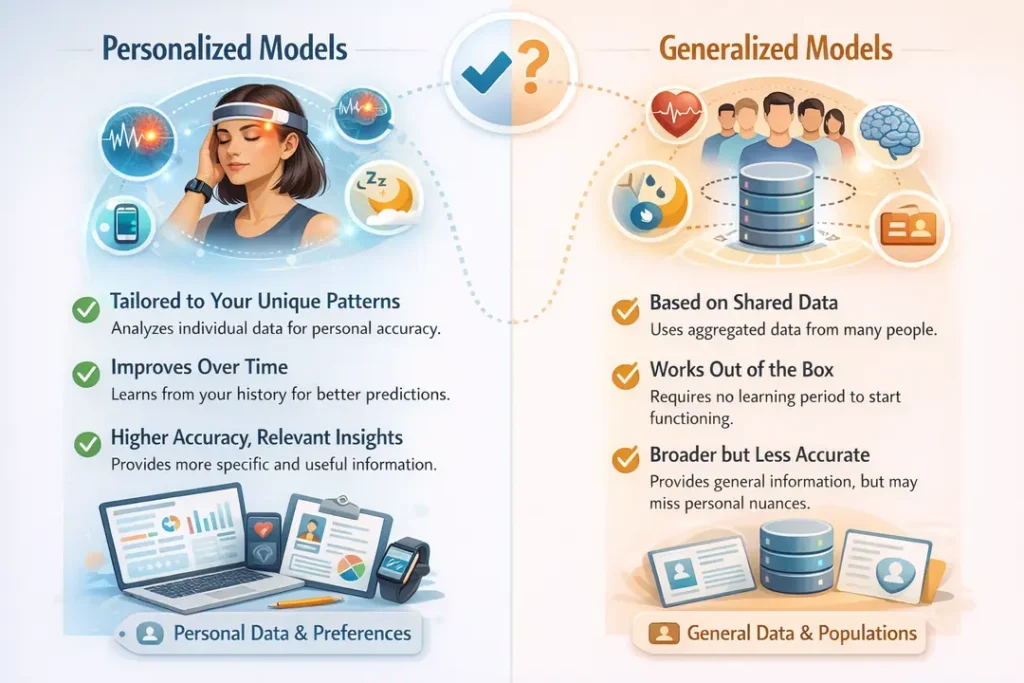
Developers of wearable health technology face a critical choice as they build migraine prediction systems: should they build a single model for everyone or tailor models to each individual? Research gives us a clear answer.
Why personal models outperform general ones
Individual-specific models consistently deliver better results than generalised approaches in direct comparisons. Models developed from pooled data of all participants showed limited predictive performance, reaching only 0.65 accuracy. The KNN model achieved remarkable results with a mean recall of 0.91 and an Area Under the Curve (AUC) of 0.83. Random forest models also performed well with strong specificity (0.77) and a high AUC (0.81). The evidence points to models that are tuned to individuals while exploiting group data as the quickest way to predict migraines.
Challenges with user-independent models
User-independent models need much larger user groups to work. These generalised systems struggle with several issues:
- Small sample sizes that lead to high bias and variance
- Overfitting that captures noise instead of true patterns
- Lack of external validation prevents a realistic performance evaluation
The high rate of non-response to various treatments suggests there’s no one-size-fits-all approach, as treatment suitability changes from person to person.
How cost-sensitive learning improves recall
Researchers have explored cost-sensitive learning to boost prediction accuracy. This technique improves recall metrics for several participants by making the model more sensitive to migraine samples. The technique’s effectiveness varies across individuals, underscoring the need for tailored approaches in classifier training.
The need for more diverse datasets
Current wearable technology in healthcare has limitations due to restricted participant diversity. Studies use narrow inclusion criteria, like specific migraine frequency ranges, that limit generalisability. Smart wearable technology applications need larger, more diverse participant groups. Current models often miss important triggers, such as weather conditions or menstrual cycles, that could affect prediction accuracy. These circumstances make standardising outcome measures crucial to advancing this promising field of wearable medical technology devices.
Limitations and What’s Next for Migraine Prediction
Wearable technology shows promise in predicting migraines, but several challenges stand in the way of its widespread use.
Small sample sizes and data imbalance
Current wearable-technology migraine studies often draw from relatively small participant groups of 20–30 people, which limits both statistical reliability and broader applicability. Moreover, the imbalance between migraine and non-migraine days creates classification challenges for machine-learning models in real-world populations. Many people report far more headache-free days than migraine days, and activities such as daily household tasks and sleep are impacted even on non-headache days. For example, in a large observational survey of over 17,000 adults with migraine, nearly 52.7% reported sleep interference and 70.7% reported mood impacts at least some of the time, while 24.8% required help with housework due to migraine burden. These results highlight not only the clinical significance of migraine days but also the pervasive interictal effects that classification models must account for when distinguishing migraine from non-migraine signals.
Missing triggers like weather or hormones
Today’s wearable health technology models leave out vital environmental factors. Weather changes affect 35-50% of people with migraines, yet prediction systems rarely include weather data. Women’s hormonal changes trigger migraines in about 60% of cases – another big gap in current tech solutions.
Future of wearable technology in healthcare
Wearable technology’s next step needs broader datasets and combined data streams. Smart devices will soon track medications and symptoms in real time while monitoring body signals. These changes will create comprehensive migraine management systems rather than simple prediction tools.
Potential of adaptive, self-learning systems
The most exciting developments lie in systems that learn from user feedback. These smart models would grow with their users and become more accurate over time. Wearable technology aims to do more than just predict migraines; it should suggest tailored treatments based on how each person responds.
Conclusion
Wearable technology has become a game-changer for over a billion people worldwide who suffer from migraines. This piece shows how these devices detect subtle changes in the body through the autonomic nervous system, especially during sleep. The ability to predict attacks with 84% accuracy definitely changes how we manage migraines.
Customised prediction models work substantially better than general approaches. General models don’t perform very well in terms of accuracy, hovering around 65%. But personalised versions can achieve impressive recall rates up to 91%. The future of migraine prediction doesn’t lie in universal solutions. It needs systems adapted to each person’s unique body patterns.
Some limitations still exist. These technologies haven’t reached their full potential due to small sample sizes, data imbalance, and missing environmental triggers such as weather or hormonal changes. On top of that, most studies use narrow inclusion criteria, limiting how widely we can apply their findings.
The future looks bright. The next generation of migraine prediction technology will likely feature adaptive, self-learning systems that fine-tune predictions based on user feedback. Smart wearables will evolve beyond simple prediction tools into detailed management systems. They’ll track medications and symptoms while monitoring body signals.
Migraine sufferers could see a dramatic improvement in their lives by knowing when an attack might strike before symptoms appear. This prediction power enables timely medication, lifestyle changes, and better stress management. A previously unpredictable condition becomes something we can prepare for and handle more effectively.