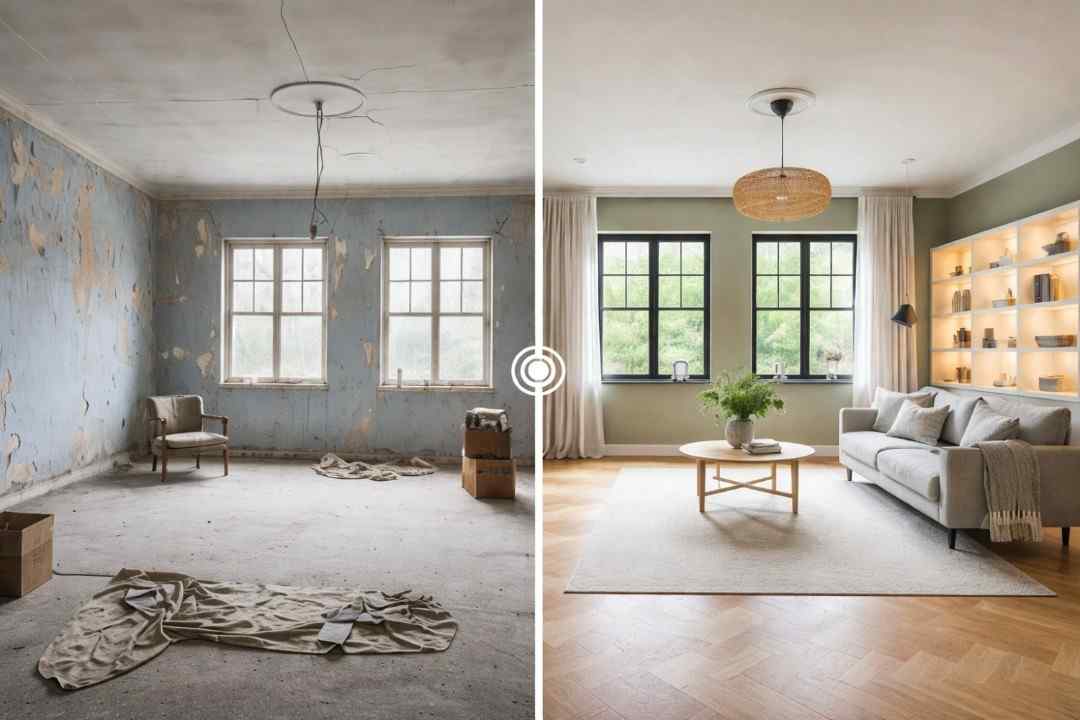
The designing of rooms generally starts with assurance and finishes with indecisiveness. Individuals make decisions and commit to them because they appear sensible, only to find out later that the space is off in minor ways. VDraw is concerned with the ambiguity between meaning and action. The ability to visualize decisions at an early stage will help users make decisions more slowly, view them, and modify them before a room commits to compromises they did not foresee.
Table of contents
- The Moment When People Begin to Question Their Personal Decisions.
- When Conventional Options Seem to be Secure and Bland.
- Overselling How Flexible a Room Really Is.
- Mixing up Decisiveness with Progress.
- The Effect of AI Room Design on Real Judgment.
- Practical Applications in which AI Room design will be natural.
- Finding Common Ground in the Differences of Opinions.
- Learning Design Judgment, Not Theory, but Exposure.
- The significance of AI Room Design to Content and Trust.
- The End: Selecting Not Hoping But Seeing.
The Moment When People Begin to Question Their Personal Decisions.
There is a hiatus that is hardly recognized in every design project. It is the quiet moment when doubt sets in and one wonders whether the chosen direction is the right one. This pause often appears just before a decision is finalized, when the weight of responsibility becomes clear.
Rather than being a flaw, this hesitation reflects care and awareness. It encourages designers to question assumptions, reconsider alternatives, and think about how their choices will affect real users. When acknowledged, this brief pause can lead to more thoughtful and intentional design decisions.
When Conventional Options Seem to be Secure and Bland.
Many individuals revert to what is familiar. Regular colors, common designs, and common furniture are not risky, even though they can be uninspiring. As soon as the AI Room Design is presented, those safe options cease to be abstract. Their presence in a real-world setting often reveals whether they are chilling or merely dead, forcing users to give a second thought before they rest.
Overselling How Flexible a Room Really Is.
Theoretically, rooms are flexible. In practice, circulation patterns, door placement, and light sources quietly dictate what truly works. These elements shape movement, usage, and comfort long before furniture or finishes are considered. The AI Room Design makes these constraints visible, turning implicit rules into clear visual guidance. By doing so, it becomes harder to ignore them and easier to appreciate the room’s natural behavior, allowing the space to be understood not as an abstract container, but as an environment with its own logic.
Mixing up Decisiveness with Progress.
Decision-making is productive, but often untimely. AI Room Design reframes this by shifting fluidly between decision-making and monitoring. Instead of locking users into early assumptions, it encourages exploration, allowing progress through experimentation and observation. Choices evolve gradually, shaped by feedback and visual outcomes, rather than being fixed prematurely.
The Effect of AI Room Design on Real Judgment.
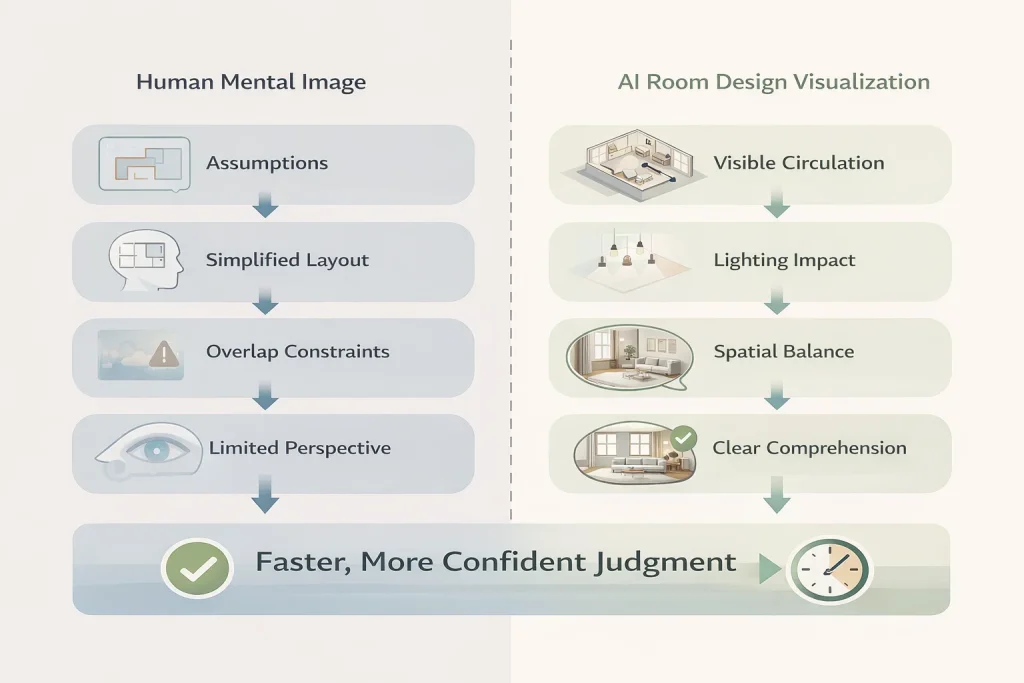
AI Room Design is not necessarily inspirational, but it transforms evaluation.
Allowing Visual Evidence to Substitute Guesswork.
The images of the mind are inherently partial. They smooth over flaws and simplify complexity. AI Room Design removes these assumptions by replacing imagined clarity with visible reality. It highlights areas that demand attention, allowing users to respond only to what is actually present, not to what they believe they see.
Detecting Hidden Imbalances Early.
There are design problems that are not wrong yet. A room can feel acceptable at first, yet slowly become uneasy or uncomfortable over time. AI Room Design carries these subtle imbalances forward, making them visible and tangible early in the process, before they turn into daily inconveniences that are harder to correct.
Revision: Making It a Normal Process, Not a Failure.
When one changes direction, it seems like one is saying he or she was wrong. In AI Room Design, there is a revision in the process. Users can change layouts or styles with no sense of correction, but in the form of discovery.
Practical Applications in which AI Room design will be natural.
Design instruments can be useful only when they conform to flawed realities.
Designing Within the ±Existing Lifestyles.
Customary behavior shapes rooms as much as furniture does. Patterns of daily movement, routines, and shared use quietly define how a living space performs over time. AI Room Design makes these implications visible, allowing users to see how a room responds to real actions rather than idealized concepts. This clarity helps reveal the gap between design intentions and how the space is actually lived in.
Home transition management Expectation management.
Rushed decisions are usually made in response to moves, renovations, and changes in life. AI Room Design will offer a visual reprieve, allowing the user room to consider whether the new ideas were indeed what they needed to include in the next stage of their lives, rather than making a reaction under stress.
Finding Common Ground in the Differences of Opinions.
The discussion of the design may be emotional if they all have different ideas. The perception of a common visual source by AI Room Design shifts the argument from personal taste to observable results.
Moving Room Design into Expanded Visual Work.
Images of rooms rarely remain solitary. They circulate through presentations, content, and ongoing projects, gaining meaning as they are referenced, revised, and compared. Over time, they become part of a larger conversation, shaping decisions and influencing how spaces are understood and developed.
Refining the Potentials of the Visuals till they seem resolved.
Formative images tend to be hesitant. The image-editing tools in VDraw enable users to work on details step by step, helping transform the results of AI Room Designers into something that seems settled and purposeful.
Organizing Video Files to present the same content in a uniform manner.
Video walkthroughs or clip assets are often shared to exchange ideas about rooms. Watermarks that can be spotted do not obey the design. For cleanup, the Video Watermark Remover by VDraw allows one to retain visual attention without re-creating the content, starting from a blank slate.
Sustaining Consistency between Design Processes.
Visual drift is a risk as the project progresses. The creation, editing, and refinement of visuals using a single platform can help ensure that the output of AI Room Design remains consistent, even as ideas change over time.
Learning Design Judgment, Not Theory, but Exposure.
The majority of individuals acquire taste through reaction, rather than study.
Watching How Small Changes Reshape the Whole Room.
Reorganizing even a slight change in color or proportion can give a room an entirely new feeling. With AI Room Design, these shifts become immediately visible, allowing users to observe cause and effect directly, without instructions or explanations.
Inventing Bold Moves With Short-term Consequences.
Powerful design decisions are often avoided because they feel final and difficult to reverse. AI Room Design removes this fear by keeping choices flexible and reversible. Viewers can experiment with bold layouts or ambitious hues, see the results instantly, and then make a calm, informed decision to refine, keep, or discard them without the pressure of permanent commitment.
Developing Trust through Comparison Repeatedly.
Repeated exposure to variations in intuition improves over time. An AI Room Design silently teaches users to identify balance, tension, and flow by comparison, rather than description.
The significance of AI Room Design to Content and Trust.
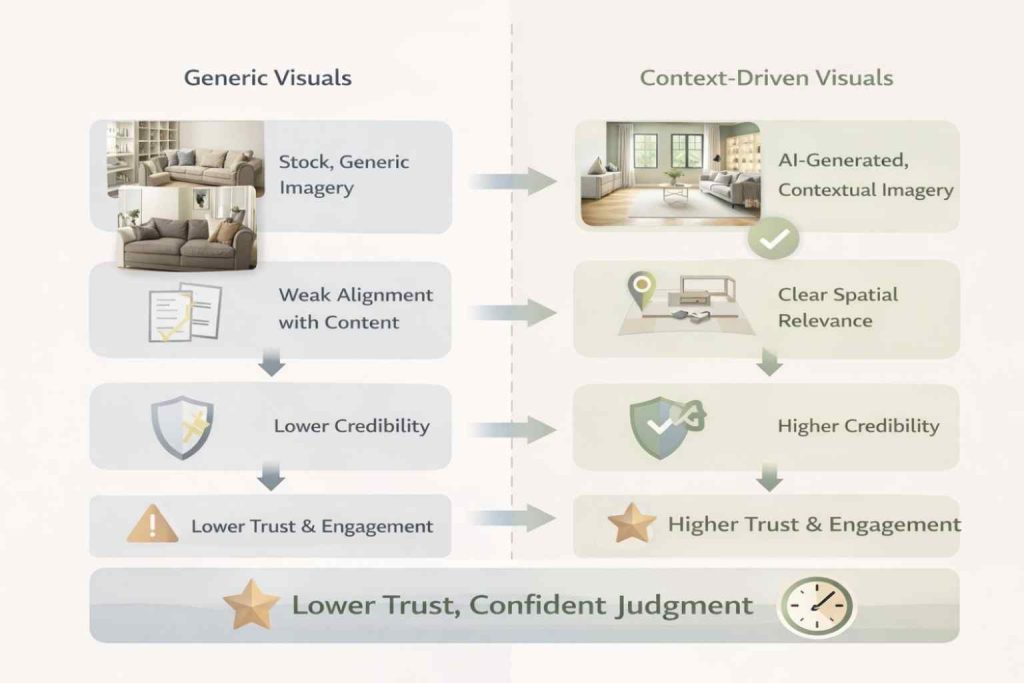
The visual plausibility has, time and again, proven to be a highly effective means of conveying information.
Sustaining Certain Ideas by Certain Pictures.
Trust increases when visuals closely align with the topic being discussed. AI Room Design enables creators to produce room imagery directly tied to their narrative, rather than relying on generic or stock visuals. This connection strengthens credibility and helps audiences better understand and engage with the intended message.
Prevention of Visual Fatigue in Continuous Content.
Regular publication often leads to recurring imagery, which can dull interest over time. AI Room Design allows new interpretations to emerge within the same theme, refreshing visuals while maintaining consistency. This balance helps keep content engaging and varied without causing confusion or breaking the nar
Promoting Greater Interaction via Understanding.
Fashionable illustrations reduce the effort needed to interpret an idea. Clear, visually appealing representations help translate abstract spatial concepts into something immediately understandable. When readers grasp the layout, scale, and relationships within a space quickly, they experience less cognitive friction. This ease of understanding encourages them to spend more time with the content, explore details, and engage more deeply with the material rather than moving on prematurely.
The End: Selecting Not Hoping But Seeing.
The AI Room Design created by VDraw does not make things less uncertain, but it makes less blind commitment. It makes people take a step back, modify, and make a decision that is not on the spur of the moment by demonstrating what ideas do before locking down. Less hasty decisions, fewer silent sorrows, and fewer rooms that do not suit the dwellers of the same.