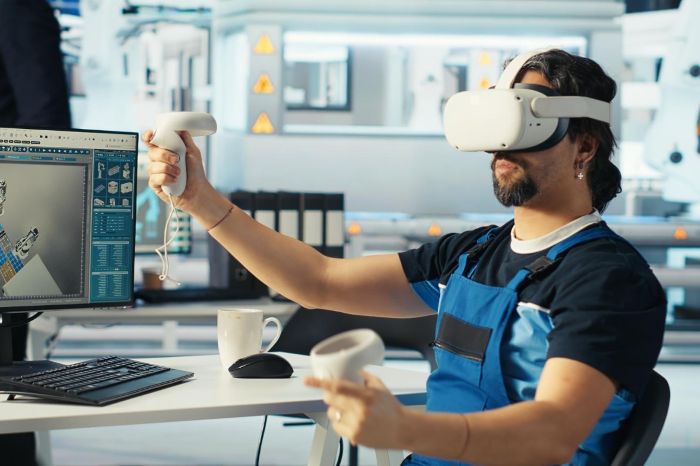
One of the most exciting shifts in design and engineering is the integration of immersive technologies with CAD design software. This has accelerated rapidly in recent years. Virtual reality (VR) and augmented reality (AR) are no longer niche tools reserved for gaming or entertainment. Instead, these immersive environments are transforming how designers, engineers, and stakeholders engage with complex models. They also make collaboration across distances possible.
This article assesses how immersive environments are transforming CAD workflows, examining current capabilities and future directions.
Key Takeaways
- Immersive environments integrate AR and VR with CAD design, enhancing spatial awareness and collaboration.
- These technologies help reduce reliance on physical prototypes and improve communication with stakeholders.
- Modern tools allow real-time editing and immersive interactions, improving training and design comprehension.
- Collaboration in immersive CAD fosters better decision-making and inclusive input across teams and industries.
- Despite challenges, the shift toward immersive environments is becoming mainstream, redefining design and engineering workflows.
Table of Contents
The Convergence of Immersive Tech and CAD: Context & Motivation
Traditional CAD platforms, while powerful, constrain the designer’s perspective to flat viewports on a screen. Manipulating 3D models with a mouse and keyboard often feels indirect, which can limit spatial understanding and intuition. VR and AR technologies aim to bridge the gap. They enable designers to step inside their creations and interact with them on a large scale.
By improving spatial awareness, immersive CAD helps reduce the need for expensive physical prototypes while streamlining communication with non-technical stakeholders. Clients and decision-makers can now walk through a proposed design, gaining clarity that 2D renderings or screen shares can’t provide. This shift is particularly useful in industries where precision and scale are vital, such as architecture, automotive, and aerospace engineering.
For example, in building design, walking through a structure before it exists allows teams to identify potential problems in layout, accessibility, or ergonomics before construction begins. Similarly, in mechanical design, engineers can more intuitively evaluate the fit and function of components. Viewing them at life size makes this possible.
Modern Tools, Interfaces, and Workflows
Recent advancements have made immersive design increasingly accessible. Some VR-CAD systems integrate directly with modelling kernels like OpenCASCADE, allowing real-time editing in engines such as Unreal or Unity. In other workflows, automated pipelines convert CAD files into VR-ready scenes, enabling quick transitions from desktop to immersive review. Platforms like Theorem Solutions already provide CAD-to-XR automation and support multiple headsets.
User interfaces are also adapting. Designers can now manipulate models using six degrees of freedom (6 DoF) and perform gesture-based operations. They can also leverage collision-based editing that mimics the feel of physical modeling. Experimental frameworks are pushing further. These frameworks enable parametric edits directly within immersive environments.
These tools open up opportunities not only for designers but also for educators and trainees. Engineering students can now explore assemblies in VR, gaining a more intuitive understanding of mechanical systems. Training simulations also benefit from immersive CAD models, which allow users to practice procedures in a safe, controlled environment.
Collaboration and Decision Making in XR Immersive Environments
Instead of relying on static screenshots or video calls, teams can conduct immersive design review meetings (DRMs). Participants interact with the model in real time. CAD improves decision-making by reducing ambiguity and supporting more inclusive stakeholder input.
Campfire’s AR/VR platform, adopted by Collins Aerospace, enables distributed teams to examine complex aerospace assemblies together. It includes features like annotations and co-editing.
Compared to 2D screen sharing, these immersive sessions provide richer communication. Although challenges remain around latency and synchronizing versions across platforms.
The collaborative potential extends beyond engineering firms. Architects and urban planners can invite city officials or clients into shared immersive environments. This helps evaluate public spaces or infrastructure projects. In product design, marketing teams can even preview consumer experiences, ensuring alignment between design intent and customer expectations.
As more organizations adopt hybrid and remote work, immersive CAD environments may become essential for distributed teams. They can function as virtual meeting rooms where the model itself is the central point of discussion.
Challenges and Future Prospects
Rendering highly detailed CAD geometry in real time remains computationally demanding. This is particularly true when collision detection and interference checking are required. Ergonomics also poses challenges, as extended headset use can lead to discomfort. Integrating immersive platforms seamlessly into established CAD toolchains takes careful planning.
Adoption depends on training and cultural readiness, as well as prices, but AI-driven design assistants are already easing performance bottlenecks. Hybrid AR/VR modes may soon enable designers to transition seamlessly between desktop precision and immersive exploration.
Looking further ahead, the combination of immersive CAD, generative design, and AI could open entirely new workflows. Imagine an engineer stepping into a VR workspace and specifying design constraints through natural gestures or voice commands, while plant augmented reality tools help visualize complex industrial layouts in real time. AI could then generate optimized variations instantly. Similarly, AR headsets may enable engineers on-site to overlay CAD models directly onto physical spaces using plant AR systems, accelerating assembly, inspection, and maintenance.
Standardization across platforms will also play a role in adoption. As file formats and APIs become more unified, the process of moving models between desktop CAD, immersive environments, and manufacturing pipelines will become smoother. This will lower barriers to entry and encourage more firms to experiment with immersive design.
Conclusion
The integration of VR and AR into CAD workflows is more than a technological upgrade. It represents a shift in how humans interact with digital creations. By enhancing spatial understanding, streamlining collaboration, and reducing reliance on physical prototypes, immersive environments promise to make design and engineering more efficient, intuitive, and inclusive.
While challenges remain in areas such as hardware ergonomics, rendering performance, and cultural adoption, the trajectory is clear. Immersive CAD is moving from experimental to mainstream. The coming years will likely see it become a standard tool in the designer’s toolkit. For industries driven by precision, innovation, and collaboration, the fusion of CAD with immersive technologies is not just the future—it is rapidly becoming the present.