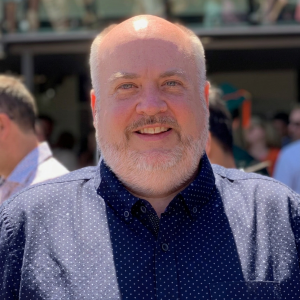
Kevin Ray Podcast Transcript
Kevin Ray joins host Brian Thomas on The Digital Executive Podcast.
Brian Thomas: Welcome to Coruzant Technologies Home of The Digital Executive Podcast.
Do you work in emerging tech, working on something innovative? Maybe an entrepreneur? Apply to be a guest at www.coruzant.com/brand.
Welcome to The Digital Executive. Today’s guest is Kevin Ray. Kevin Ray is a 25-year veteran of the consumer electronics and gaming industry.
Has developed hit games generating billions in revenue, and currently serves as the chief Technology officer and co-founder of Nomo Smart Care, where he leads product development and technology strategy. Throughout his career, he has helped bring innovative digital entertainment products to market.
Combining deep technical expertise with strong business leadership. He previously held leadership roles at Majesco Entertainment, Mattel Interactive, Hasbro co-founding games.com, and Micro Pros contributing to major milestones across the interactive entertainment landscape.
Well, good afternoon, Kevin. Welcome to the show.
Kevin Ray: Thanks for, uh, so much for having me. Really excited to be here.
Brian Thomas: Absolutely my friend. I appreciate it. And making time zones and calendars connecting is sometimes challenging. I know you’re in the Bay Area of Northern California. I’m in Kansas City. So again, appreciate the time zone shift.
Kevin, if you don’t mind, I’m jumping into your first question here. You’ve spent 25 years in consumer electronics and gaming helping develop products that generated billions in revenue. What key experiences shaped your journey to becoming chief tech, chief technology officer and co-founder of Nomo SmartCare?
Kevin Ray: That is true. I’ve spent 25 years building consumer electronics video games, and usually the first thing people ask me is exactly that. How did you end up in healthcare? Well, the answer is there’s almost everything to do with both. There’s three real direct parallels that I can think of in the video game business that really led to how we’ve built Nomo Smart Care.
First is security. Nearly all massive multiplayer games today incorporate digital object sales. Some have fully integrated marketplaces with user generated content being sold and traded, but also ladders, rankings, and tournaments. The security requirements for those environments exceed most banking platforms with the addition of all of the HIPAA related issues.
The violations are quite enormous. And so if you get hacked, you’re out of business. Even if it’s just your ranking system, your core audience leaves you and you’re done. So at Nomo we’re handling health data for families and that security first mindset from gaming was foundational from day one.
The second one is for sure infrastructure, economics. Most multiplayer games today are what are called free to play. Most players pay nothing, and the revenue comes from just a small percentage of heavy spenders who we call whales. Whale don’t appear until year after. You’ve built a massive base of active players.
So, the challenge is building infrastructure with low enough operating costs so you’re not burning through $20 million a month waiting for scale. At Nomo, we solve this by really fully embracing what’s called functional programming. We’re entirely serverless and we leverage edge compute where our devices adjudicate events locally, and that gives us scaling costs and speed of scaling the superb.
We without a doubt, have the lowest operating costs in the industry, which we’re then able to pass on to consumers. And then finally, user experience. I guarantee every one of your listeners today has played a game or two, whether it was on Xbox or PlayStation, PC or their phone. And the one thing I know for sure is that none of them started by sitting down and reading the manual.
Even the most complex games, walk users into the experience softly and easily. New features are introduced as the explore and the UI design drives that entire development process. We brought that exact philosophy to Nomo, and it’s even more critical for us because unlike video games where your core audience is 18 to 30 5-year-old male, for us it’s 63-year-old woman.
It’s usually the caregiver is the oldest daughter. We have, many of our users are in their eighties and older, and we’re very proud that this audience has embraced and applauded us for what we’ve built.
Brian Thomas: That’s awesome. And I really like that backstory. Being in technology and healthcare predominantly in my career I saw that the, that parallel that you.
Laid out here for us the three parallels between gaming and healthcare. And you top that off with or started that off with security infrastructure economics. And you talked about how that scale, and there’s obviously that price point you can’t outspend before you really start making a profit in that world.
Of course. And then of course, lastly is the user experience. And that is so important as we talk about this a lot on the podcast. So thank you. Sure. And Kevin. No more SmartCare, you are now focused on connected health and SmartCare technology. What inspired your transition, again, from gaming and entertainment into this what we call this healthcare innovation?
Kevin Ray: Well, like all good ideas, it started over coffee. My friend and co-founder Mike O’Shaughnessy, a serial entrepreneur we were in a coffee shop brainstorming new product ideas. We came up with a pretty good list. We had some real winners in there. But the conversation shifted towards family. Mike and I were both putting in a lot of miles traveling around the world, dealing with supply chain issues on every different time zone around the world.
And as common with guys our age. We’d had issues with aging parents. Mike had shared really details of re losing both his mom and his dad. His mom went out to the barn to put away her horses, noticed the light was out. She climbed up a ladder to change the bulb, something she’d done many times before.
And this time she took a hard fall. She knocked herself out. She lay on the driveway all night because nobody knew she was outside. The next day a mailman found her, and by then it was too late. She never fully recovered. Mike’s dad was on the couch watching a football game, and he suffered a stroke. He knew what was happening.
He tried to call for help, but he couldn’t. And hours later, his brother came to check on him and had to break down the door to get inside to see what was going on. And by then it was too late. His father never recovered either. Coincidentally, I’ve just been through something similar. My mother-in-law broke her hip.
She successfully had hip replacement surgery, but when she came home, we did what most families do. We set up a TV in her bedroom. We gave her a bell. We said, mom, if you need anything at all, you just ring that bell. We’ll come running. We’ll get you whatever you need. Well, that’s exactly what you should not do.
You should take the TV out of her room. You should take the bell out of her room. You should take the magazines and books and you should tell her if she needs anything, she should get up and walk. Nearly all the poor outcomes from hip replacement surgery come from not mobilizing that joint and unfortunately, she developed necrotic tissue around that new joint and eventually sepsis, which killed her.
And Mike looked at me after we went through this and he said, Kev, why isn’t there some device that we can just buy and plug in? That answers the simple question, how’s mom and I don’t wanna sell fear. I wanna sell love, I wanna sell caring. That was it. That was the birth of Noma, and this has been a passion project for our entire team.
Most of us are older, senior engineers and designers, and we’re also customers. We use our own product to keep an eye on our own parents. There’s no other product like it.
Brian Thomas: Thank you. I really appreciate that Love again, the backstory, again. A bunch of engineers getting around a table at a coffee shop, nothing like it when you’re brainstorming all kinds of cool solutions, but you really found a solution or a gap in the market.
And you highlighted that by telling these stories of our elderly parents. That again, whether it was a health challenge or just the mobility that they don’t have like they used to have when they were younger and of course in the end causes their demise. So, I like what you’re doing, developing something for adults that can really, elderly adults that could really use the help.
So, thank you. And Kevin, you’ve spent years mentoring entrepreneurs at Stanford and uc, Berkeley. What are the most common mistakes you see early-stage founders make when building and scaling technology products?
Kevin Ray: Indeed, I’ve been a perennial mentor in Steve Blank’s Lean Launchpad class at both Stanford and Berkeley school of Engineering and Hos business School.
The most common challenge with my teams and really with every startup is what we call the right side of the canvas. Most of your listeners are probably familiar with a business model canvas developed by Alexander Osterwalder, a single page canvas with nine building blocks that lets you describe a new business.
The right side is the part that deals with value propositions and product market fit, and that’s the hardest part. Who’s your customer and what the problem of theirs that you’re going to fix? I had a team once very, very smart guys, all finishing their PhDs, finishing their PhDs in electrical engineering so that they could then go finish their medical degrees.
These were really smart guys. They developed this product they use near infrared light to peer through the skull and measure blood flow in the brain. Something called near infrared spectroscopy to really deliver a poor man’s version of functional MRI. And they had built this tiny battery operated flexible device that they were able to sew into a knit baby cap.
And it could alert the mother 15 minutes before the baby woke up. And when the baby cried it accurately told ’em exactly why, whether it’s the baby hungry or tired, needed a diaper change, or just wanted to play tons of tests. It worked perfectly. It was awesome. Then they tried to validate it with actual customers and they spoke to scores of new parents, and every single parent said, no way.
Not 70%, not 80%, a hundred percent of the new parents that they talked to said, no way. The dads, the dads all said, wait, you wanna put something electrical on my baby’s head? Get out of here. And the moms, they all said, you’re gonna tell me why my baby is crying. I know why my baby is crying. And my team was crushed.
And they were having such a tough time dealing with this, and I told ’em, guys, this is great. Congratulations. In 12 weeks, you built prototypes. You’ve tested your hypothesis, you’ve invalidated some of your key premises. You’ve learned that there was no product market fit. Most people spend years and millions of dollars to learn that, and now you can pivot and try again.
Good ideas are a dime a dozen, or as Mark Cuban says good ideas are as valuable as sand. The real challenge is finding a good problem and then a solution, and then it’s all about execution. With Nomo, every single feature started with one question. What problem are we trying to fix? The product is simple.
Plug and play passively monitors movement in a home to determine activities of daily living. We developed AI that measures what’s normal, like whether mom gets up at 4:00 AM or sleeps until noon, we’re all different. What matters is recognizing when something isn’t normal and when it doesn’t happen at all, like Dad didn’t eat today or mom didn’t take her meds, or is sleeping way more than usual.
Nomo’s the only product that really answers that at a glance, and that is problem first thinking.
Brian Thomas: Thank you so much. I really appreciate that. And I love, the stories that you come out here, of course everybody loves a good story, but you talked about your time entering at Stanford, uc, Berkeley, and the example, and I think it, we called it near infrared neuros.
Oscopy or something like that. I apologize. But the point being is I was impressed. I was excited to hear and then find out no one, there was really not a need in the market, or you couldn’t, convince parents that they needed this particular tool. But the thing I took away obviously is. You were excited, you encouraged them.
They said, gosh, it only took 12 weeks. 12 weeks to get to that failure versus years. And I think that’s so important and entrepreneurs sometimes don’t understand that, and you really highlighted that point. But at the end of the day what you’re trying to do is what problem we’re trying to fix at no more, and that’s exactly what you’re focused on.
So I appreciate that. And Kevin, as we look ahead to the future, how do you see the convergence of gaming, consumer electronics and healthcare shaping the future of connected devices and smart care solutions?
Kevin Ray: Yeah, well, we follow a tradition I call happy surprises. One of the games I was involved with for years was cooking mom on Nintendo, and the creator was adamant that the users receive free and frequent new content, even the smallest little thing, and that it would give them a moment of joy, like as small as a flower blooming in the background, or a blue jay flying into the room where mama was cooking.
You know later, Xiaomi, the Chinese Superstore of consumer electronics mimic the same approach. They update their devices every Friday with a free feature update. It became so popular that the Chinese government grew concern when a government statistician pointed out to someone that national productivity dipped on Friday afternoons as millions of workers stopped what they were doing to check their phones for their free update.
We embrace that philosophy. At Nomo, we roll out updates to our product every two weeks. We constantly measure app performance, remove points of friction, and that discipline of delighting your customers continuously is what separates products that get used from products to get forgotten. Home is becoming the primary point of care.
90% of seniors want to age in their own home. Healthcare costs are climbing towards $6 trillion, and the system can’t scale by putting more people in facilities. It has to meet people where they live, and the companies that will win are the ones bringing consumer grade experience to healthcare grade problems.
We built our infrastructure to gaming scale designed for millions of users because connected care is going to be as common as a smart thermostat or a doorbell camera. We’re deployed at Walmart Best Buy, Amazon. We partnered with Elizabeth Dole Foundation and what started with a simple question in a coffee shop, how’s mom is becoming the answer for millions of families and we’re just getting started.
Brian Thomas: That’s awesome. I really appreciate that. And you shared some examples in whether you call these updates gaming, electronics whatnot, gamification, but it’s again that little dopamine effect people. Obviously were looking forward to that weekly update. Is that one example you explained about in China, but we all know that home is the place to be.
Home is now one of the number one places for health recovery. But what I like what you said about your platform is you’re measuring performance, you’re removing friction points, you’re pushing out updates every two weeks, and you’re making that customer experience one that can be remembered. And I really appreciate your focus in the healthcare space, especially for our elder, our aging adults.
And Kevin, it was such a pleasure having you on today and I look forward to speaking with you real soon.
Kevin Ray: Brian, thank you so much.
Brian Thomas: Bye for now.
Kevin Ray Podcast Transcript. Listen to the audio on the guest’s Podcast Page.