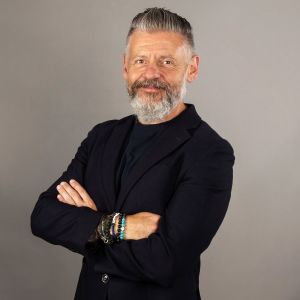
Colin Robertson Podcast Transcript
Colin Robertson joins host Brian Thomas on The Digital Executive Podcast.
Brian Thomas: Welcome to Coruzant Technologies, home of The Digital Executive podcast.
Do you work in emerging tech, working on something innovative? Maybe an entrepreneur? Apply to be a guest at www.coruzant.com/brand.
Welcome to The Digital Executive. Today’s guest is Dr. Colin Robertson. Dr. Colin Robertson or Dr. Col is the Chief Product Officer for Health and Wellness Company, Zinzino.
Dr. Col is an environmental physiologist with a PhD in exercise physiology who helps translate cutting edge sports science into practical strategies for athletes and ventures and everyday health seekers. For more than two decades, he has helped shape health strategies and standards for organizations worldwide, including Europe active, UK Active, and the National Health Science, a specialist in human performance and sports science.
He has coached and prepared global adventures to tackle extraordinary challenges from climbing Everest to rowing the Atlantic, and supported athletes and strength and conditioning across various sports, including rugby, wrestling, and wheelchair basketball in national and international competitions.
Well, good afternoon, Colin. Welcome to the show.
Colin Robertson: Thank you very much. It’s good to be here. Brian. Thank you for the opportunity.
Brian Thomas: Absolutely, my friend. I appreciate it and I really appreciate the fact that you made the time making our calendar sync up. We’re about five hours apart. I’m in Kansas City.
You’re near Liverpool. In England and I really appreciate that. ’cause I know sometimes traversing the globe can be hard to make calendars meet up. So, Colin, jumping into your first question, you’ve built a career spanning environmental physiology, elite sports science, clinical health strategy, and now serve as Chief Product Officer at Zinzino.
What pivotal moments shape your journey to where you are today?
Colin Robertson: Wow. That’s a, that’s a great question. I would say, my, uh, story looked linear, but it’s not. I went from working in high performance sports and, and then took a clinical role, and I did that because I felt. There was so much we were able to do in a high performance setting that the general population didn’t benefit from.
And so, I think a pivotal role for me was the, the six years I spent when I went back to the hospital and I worked as a clinical exercise physiologist and really. Unlearning some things, applying what I would call best practice from human performance, and then seeing how I could amalgamate those things to go forward in a more dual sense.
I went back to high performance sport and I started to work far more on a population health strategy. So, I think at the time people questioned my sanity on going back to the hospital setting, but I think that that was the moment that really. I was able to bring those worlds together and that’s what’s enabled my career ever since,yeah.
Brian Thomas: That’s awesome. I really appreciate that. And sometimes, you find more or you unleash more doing something more diverse in your career, you know, changing it up as they say, but. What you did is really bring that elite and high performance physiology and that that background together with your clinical together to make really something great.
And so, I appreciate that background, honestly. And Colin, as Chief Product Officer at Zinzino, how do you translate rigorous sports science and clinical research into practical, scalable health products for everyday consumers?
Colin Robertson: Well, I guess that’s, that’s where it, it’s kind of been coming together. So just to maybe add a little bit.
You know, I, I would, I’d worked in high performance sport. I was working in premiership football. I was working with Olympic athletes, decided to go back and wear clinically, and I did that because I. I was confident we could do rehabilitation better, whether you were rehabilitating from a chronic disease, musculoskeletal, whatever it was, and then that real deep end learning of complex pathology.
When I went back to sport, I felt like I had a clearer, broader understanding of the research context. Everything from the worst conditions to optimizing human conditions, and so prior to zino. My role was really as a, as a research coordinator where we would look at the best available research evidence and see how that could lend itself to literally global health strategies.
And so taken from that background and then coming into Zinzino, which is a research evidence-based nutrition company, was seamless. Because we judge everything by the same standard. What is the mechanistic explanation for this in the research in the science? What does that say is the best way to do this?
And then you interpret that, you apply that. There’s always a technical aspect when you are trying to produce a, a food supplement. And then you are looking at all those things that go back to clinical relevancy. You know, what is the therapeutic dose? What can we say genuinely works? Is there enough in this?
So, I think, although I didn’t know it at the time, you never do. I think all those experiences of change in practice from high performance to hospital, back to high performance, interpretation of data, taking that into global health strategies, and then bringing that in alignment to going, okay. How can we bridge nutritional gaps?
What does the research say? I feel like it just made sense. I feel like everything I’d learned and trained and the skills I developed over time really came together when I joined Zinzino. And that’s the mindset that we adopt as an organization, as a team. And certainly I preserve that to this day. It’s how we maintain our standards.
So yeah it’s complex. It’s challenging, but that’s what makes it rewarding.
Brian Thomas: I really love that story. You start out again, working with athletes, high performance in that area of professional football, Olympic athletes, and then going back into that clinical setting where there’s a huge research context as you talked about.
And then going back to high performance and really, again, melding the best of both worlds there. And. Again, what you’re doing today is only making people’s health, people’s lives and their performance in, in the cases of athletes much, much better. So, thank you. And Colin, you worked extensively in the Omega-3 space.
One key question I have for you, seeing as yesterday, was the global Omega-3 day. How can consumers and industry together ensure that Omega-3 supplementation is both scientifically effective, with the right forms, doses, et cetera, and ethically sustainable? While remaining affordable and accessible.
Colin Robertson: Wow. That, that is, yeah, that’s the, that’s probably the question that’s going to determine how my career is, is judged in all honesty. So, the area of Omega-3 when it comes to supplementation has been a rollercoaster. And even my experience way before joining Zinzino, you know, trying to embed. An Omega-3 strategy in high performance sport, and then when I was in the hospital, and you’re looking at the cardiovascular protective aspects of Omega-3, because logic would dictate you just tell somebody to eat more fatty fish, but.
Logic runs short when human rationality comes into play. Humans are creatures of habit and they like what they like and they don’t like what they don’t like, regardless of how good you tell them it is for them. And so, supplementation around Omega-3 is nothing new. The problem is, is that we’ve always known that Omega-3, when you turn it into a refined oil.
And you isolate it. It’s no longer attached to an equivalent of a polyphenol. It’s a little bit different ’cause it’s algae based, but it’s, it’s, it’s similar enough, it’s sensitive to heat, to oxidation. It, most of it won’t survive the stomach, the acid of the stomach. And then it gets into the gut where its first instances to really feed the bacteria.
And so. We’ve already, we’ve known for a long time that Omega-3 supplementation makes sense, but it’s difficult to determine whether or not it works. And the average person takes a product in good faith. But really all the epidemiology tells us that they don’t work. And there’s been a lot of studies.
There was a Cochrane systematic meta-analysis review in 2018 that said, listen, standard Omega-3 supplements don’t work, but we’ve moved forward. And again, going back to that notion of going from high performance to clinical, it’s what I would call the technological trickledown effect. In sports, we measure everything.
We always have, ’cause sport is one in, hundreds, thousands of seconds. So, we measure everything, whether it’s a person’s strength, parameters, we’re doing blood analysis, VO two max, you, me, you men, you name it, we measure it. And so really, and that’s what science is. Science is about effective measurement.
And so, what you have to do is you have to be able to go, well, test, don’t guess, let’s see whether or not you, first of all you need it, what is the status? Let’s do a blood analysis and then let’s target a supplementation strategy that will address that need, because I can’t emphasize enough, Omega-3 is an, it’s an essential fatty acid.
But the role it plays in optimizing human health is also essential. And so for the consumer out there, I would say that a bit like when you’re buying your car. You know that the cheapest car is probably not gonna be the best car. And you also wanna have certain guarantees in place with regards to the, how efficient, how safe everything you’d wanna know about that car.
Take that mindset and apply it to your supplementation test. The status and test whether or not what you are consuming can genuinely alter your position and get you above. And we know the levels that you need to be at. We know that we want you to be above 8% total of your fat is contributed from Omega-3, that EPA and DHA.
So, we, we have these really firm, well-recognized threshold in science. The key is to make sure that we get there. When that goes back again to your question about, the ethical, because a hundred years ago there was 2 billion people on planet Earth. Now there’s 8 billion, but it’s the same ocean, it’s the same ecology.
We’ve got, you know, four times the amount of people who need the same resources. And so sometimes even as a nutritionist, I feel guilty when I say just, just consume more fatty fish. That’s just not pragmatic. It’s not realistic. I can’t tell 8 billion people to eat more fatty fish. And so what we have to look at, and certainly how we judge ourselves is, are we prioritizing?
Invest in and support an ethical, the most ethical phishing standards, and can we certify that and also our investments in the future? Because the reality is we take the Omega-3 from the sea algae and we take it from the fish because the fish consumes the sea algae. We need to eliminate. That step, we need to rely less on the fish and more on the clean cultivation of the algae because that gives us sustainability, it gives us ecology, and it’s also far more ethical.
Then the technical aspect of that at the moment is developing. But we are hot on the pursuit and I think that anybody working in the Omega-3 space is is duty bound. To be making that type of investment in the future, we cannot keep taking fish from the ocean. It’s essential for human health. It optimizes human health, and there is a cleaner, more ethical way to do it.
We need to invest in that and do it better, and that’s certainly something that we take very, very seriously.
Brian Thomas: Thank you. I appreciate that. Colin. You talked about this Omega-3 supplementation. It’s very important as you said, for humans it’s essential fatty acid that we need. But you know, you talked, also talked about some of the problems which is good here that you test.
Don’t guess. You talked about measuring everything because Omega-3 is difficult to determine what is really working. I know that you said it’s very sensitive to gut acids and heat and that sort of thing, so. I really appreciate you breaking that down. But it is important that we look to the future as population grows.
We need to make sure that we’re ethically sourcing our Omega-3 wherever we get that, including the ocean, of course. And Colin, the last question of the day here as we look ahead. How do you see the future of health, performance, science and personalized wellness evolving over the next decade? And what breakthroughs excites you most?
Colin Robertson: Oh yeah, that’s it. I, I mean, I think we’ve embraced the idea of measurement and I really enjoy that because, as I said a moment ago, science is all about measurement. It’s how we can accurately measure something and then determine what is the best case given what we know and whether it’s wearable tech.
Most people will have a smart watch they either wear every day or they use it for when they’re exercising or physically active. You know, for us, we are still campaigning a lot to take those kind of blood measurements where we can analyze things really at, at a deeper biological physiological sense.
But I think that the future of this is gonna be, that we can do that in less invasive means. I think that, the same way that we’ve shifted gut measurement from taking fecal samples to now, we can take really. In depth blood analysis that gives us a biochemical insight rather than just, what’s there.
We can see what’s actually happening now. And I think as we move forward, our technology will advance to the extent where we can take those measurements by other means. Currently there’s a lot of work around infrared. There’s a lot of work around Salome taking Sali samples, and I think it’s really exciting because.
You used the word, it’s really provocative and I enjoy it individualization, we have these guidelines that can guide us and lead us to better health, but there’s a huge amount of individual variants, and I think for far too long. Whole industries really have given far too generic advice, and I think that we are now on the very threshold of a new dawn of giving people hyper individualized guidance based on real world measurement.
And we’re making that measurement easier and easier, more convenience, more at home. And that’s what excites me. I think that this breaking the narrative of one cap fits all. Empowering people to have better health based on their terms, their needs. I think we really are at the, we’ve already commenced, we’ve come a long way, but I think what’s around the corner is way more exciting.
I think we are gonna literally change global health statistics by making it matter on a personal level. And so that’s really what I’m hoping to spend the rest of my career on, playing a part in achieving.
Brian Thomas: That’s awesome. And we talk a lot about technology and smart tech here, health tech type devices and platforms including AI.
But you talked about that smart tech is key using tech for those less invasive measurements. Right? You talked about biochemical insights Salome and with the technology in this really. I guess refined or advanced measurements, we’re able to really hyper individualize, as you said, specific nutritional plans for everybody, making it very personal, which in the end makes the person a tad more healthy for sure.
Knowing that we can just get very specific to a particular human. So, thank you. I really appreciate that. And Colin, it was such a pleasure having you on today and I look forward to speaking with you real soon.
Colin Robertson: Thank you very much, Brian. I enjoyed it. Thank you so much. Have a good day.
Brian Thomas: Bye for now.
Colin Robertson Podcast Transcript. Listen to the audio on the guest’s Podcast Page.