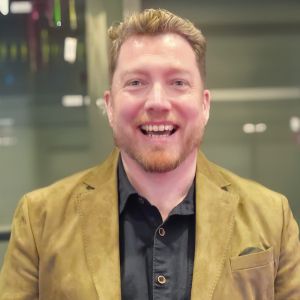
Colin Cooper Podcast Transcript
Colin Cooper joins host Brian Thomas on The Digital Executive Podcast.
Brian Thomas: Welcome to Coruzant Technologies, home of The Digital Executive podcast.
Do you work in emerging tech, working on something innovative? Maybe an entrepreneur? Apply to be a guest at www.coruzant.com/brand.
Welcome to The Digital Executive. Today’s guest is Colin Cooper. Colin M.B. Cooper is a technologist, educator, and futurist whose journey into computing began long before AI dominated global conversation.
Growing up in the UK, he found both escape and possibility in technology. Taking apart his father’s, Olivetti 486 at age 13, teaching himself DOS from the manuals and rebuilding the entire system from scratch. By 15, he had already co-developed his first website for a national organization setting the trajectory.
For a career defined by curiosity, resilience, and forward thinking.
Well, good afternoon, Colin. Welcome to the show.
Colin Cooper: Thank you. I’ve been so looking forward to this.
Brian Thomas: Absolutely, my friend. I appreciate it. And you’re hailing from the UK, you’re north of London, about two hours, but I just really appreciate you making the time today.
I’m in Kansas City, so I got about a seven hour time difference here. So, let’s just jump right into your first question. You’ve been working at the intersection of technology and human behavior long before today’s AI boom. How have you seen. Perceptions of AI shift over the past two decades, and what do most people still misunderstand about it?
Colin Cooper: Yeah, Brian, I think that’s a really good question. I started working in AI and VR technologies about 17 years ago, so before it was cool, if you will, and. What a lot of people don’t realize is, is that probably for about 12 years, most people have been using ai. If you’ve had a smartphone, you’ve had remnants of AI on that, or speakers that we have in our home.
I think the biggest shift that we’ve seen certainly in the last couple of years is obviously large language models and it’s made it accessible. To everybody to be able to use that technology. One of the things that we are seeing though is, especially now the shift in human behavior, is that we’re becoming very reliant on the tech.
And it’s, in some respects, I think it’s making the human race or could in sectors make the human race quite lazy.
Brian Thomas: Yeah, absolutely. And I appreciate that you’ve been doing technology and in fact your bio alludes to it kind of dates you. Right. But you’ve been working in some of this emerging tech long before it became mainstream, which I think is really cool.
But that is a big point right now. We’ve got people that absolutely are using technology as a crutch and in some cases, like social media or, or gaming is kind of become that next drug I think. In my opinion, but I appreciate the insights. Colin, IXR focuses on immersive intelligence and AI powered learning systems.
What does immersive intelligence mean in practice, and how is it different from traditional e-learning or VR experiences?
Colin Cooper: IXR. What we are doing is, is that we’ve combined multiple technologies together to create this immersive intelligence. And I, I’d like to swing back to the first question about, what are some of the things that people misunderstand about, where the technology, AI and that technology boom.
The reality is, is most people in their daily lives are only using about 5% of what the AI technologies is capable of. So, what we’ve done is, is that we’ve. Looked at education worldwide and gone, okay, we aren’t preparing students for the real world, if you will. And there’s this gap, which I’ve personally seen over the last 26, 27 years in hiring between kids coming out of school to what?
There’s real world skillset that you need, like creativity, curiosity, critical thinking, et cetera. And so, what we’ve been able to do is use technologies like. Artificial intelligence, combining that with XR technologies like augmented reality and virtual reality. But the most important thing is making sure that the tech is human centered.
And then, so what you’re doing is, that you are having human centered learning using these technologies, which we call immersive intelligence. So imagine that you’ve got little Johnny who’s maybe studying algebra. And he’s doing fractions and he’s struggling specifically with fractions. He’s doing it at grade 10, but he’s only understanding it at grade eight.
Imagine then if you’ve got technology that on the fly would be able to help little Johnny with. Being able to have lesson plans to be able to scaffold him back up to 10. So, it’s creating this immersive intelligence that’s customized and creating customized curriculum on the fly to every single student based on where they’re at, their likes, their needs.
And that’s essentially what immersive intelligence is.
Brian Thomas: That’s awesome. That’s a great, obviously use case for that. I liked what you mentioned early on today people are only using about 5% of AI’s capabilities, which I think is interesting which I could agree with that for sure. But your immersive intelligence platform, you’ve combined all the best of the best, XR, VR, AI, making sure that tech is human-centered though, which I think is really important for this immersive intelligence.
But again, love the story. And Colin, switching gears here. The Future Framework is a strategic blueprint for navigating rapid technological shifts. Can you walk us through the key pillars of that model and how organizations are using it to stay ahead?
Colin Cooper: Yes, absolutely. I think one of the biggest challenges that I’ve seen over the years is that when new technology comes out, often the adoption rate in businesses is often quite low.
A new computer or a new program, and you often get pushbacks. You get the early adopters that go, yes, I’m very interested, but then as time goes on, you start to get people that just. Point blank, refuse to use it. And that can become problematic in high performance in any organization what the future framework was designed around.
And this was designed originally about 20 years ago with some of the tech stuff that we used to implement when we were doing servers and computers and networking. And it’s based on these things. So, F stands for Foundations in Digital Literacy. U is understanding emerging tech. T is the tool integration and workflows of what’s needed.
U stands for upskilling through immersive learning. R is the real world application and innovation, and E stands for evolution, mindset, and culture. And what we’ve been able to do is combine all these together in. Example, a full day workshop and instead of adoption rates, say being in an example organization, there was one recently, the adoption rate of New Tech and within AI was sitting at around 22, 23%.
’cause there was a lot of pushback. After the Future framework, we are sitting at over 70%. It’s not perfect, but it’s a huge jump. And then if you continue to do it, you then start to get up into the eighties and nineties and that’s essentially what the future framework is. It’s getting. Organizations future ready and being able to get the humans that are in the room comfortable with tech that’s changing fast and essentially on a daily basis, especially in the AI world.
I think that there’s some, there’s a new thing coming out almost every day at the moment, so.
Brian Thomas: Absolutely. No, I really appreciate that. And I see that too. You know, I’ve worked in technology a long time, and there are challenges. The adoption rate’s typically low and which as you mentioned, can lead to people banning it altogether.
But I like your future framework. I tried to catch it all. I think foundations, understanding tooling. Yeah, go ahead.
Colin Cooper: Yes. No, no. So, foundations understanding tool integrations, upskilling through immersive learning, real world application and evolution mindset. And I’m happy to share that future framework for anyone that’s listening as well through of charge.
So, if that would be helpful
Brian Thomas: Absolutely. That would be amazing. And obviously we’ll have this on the website for the world to see, so that’s great. And Colin, the last question of the day, looking ahead to the next decade, what emerging technologies. Like AI agents, spatial computing, et cetera, will have the most meaningful impact on how humans learn, collaborate, and perform.
Colin Cooper: That’s a very interesting question. The next decade is a challenging one because I think. My belief is that in the next 24 months, we’ll then set the tone for the next 10 years following that. So if when we’re going into 2026 and 2027, depending on the growth that we have with the AI agents. Also, we are having quantum computing, which is coming out and the direction that we are heading in with using AI for healthcare and government policies and what we’re seeing in education, I do believe that we are standing on.
What I call the age of humanity. So we’ve got the age of AI that we’re currently in, and we also have this opportunity for the age of humanity, and I think the next two years are going to be very, very defining of what we see next. There’s a lot of interesting work, which has been done in the XR space, so a lot of the VR tech is either expensive or heavy.
But with the new XR glasses that are coming out over the next couple of years, it’s making it accessible. It’s becoming more affordable, and it’s not this big chunky unit. So that’s going to be some interesting tech to watch out for, and also holograms. There’s a lot of interesting research that’s been done into holograms.
I do believe that we’re going to see ai. In every home. And essentially with what we’re seeing now with a lot of the robots that are coming out and the, it’s, democratizing healthcare. So, I think there’s a lot of really exciting opportunities and positives, but with every positive, there’s a lot of negative, which is why I think that the next two years are going to be very defining.
So, I think the next 24 months will be very defining in what tech and how that tech is rolled out to what countries, and then that will define what the next 10 years would be. I hope that helps.
Brian Thomas: Absolutely. That’s pretty, I just love the insights, you talked about that next 24 months, definitely setting that tone for the next 10 years because we’re gonna see some explosive growth as we are now with AI and quantum computing.
But there’s a lot of great tech and you talked about holograms, VR, et cetera. I think I would agree with you. We are at that standing at the edge of the age of humanity as you call it. And I’m just really excited. I love emerging tech, but I know that we need to keep the humans truly in the loop and ensure there are good ethical guardrails along the way.
So, I appreciate that. And Colin, such a pleasure having you on today and I look forward to speaking with you real soon.
Colin Cooper: Thank you so much. I’ve thoroughly enjoyed it, and I hope your listeners did too. Thank you. Take care.
Brian Thomas: Bye for now.
Colin Cooper Podcast Transcript. Listen to the audio on the guest’s Podcast Page.