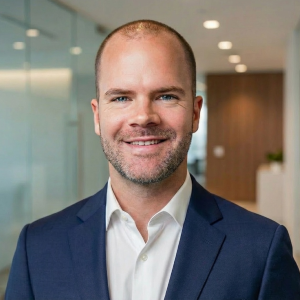
Boomer Anderson Podcast Transcript
Boomer Anderson joins host Brian Thomas on The Digital Executive Podcast.
Brian Thomas: Welcome to the Coruzant Technologies, Home of The Digital Executive Podcast.
Do you work in emerging tech, working on something innovative? Maybe an entrepreneur? Apply to be a guest at www.coruzant.com/brand.
Welcome to The Digital Executive. Today’s guest is Boomer Anderson. Boomer Anderson is the Co-Founder and CEO of Troscriptions.
An Inc. 5,000 company in the 99th fastest growing healthcare company in the United States according to the Inc 5,000 list. He’s also the CEO of Health Optimization Medicine and Practice, which is homehope.org. The nonprofit building, the Global Educational Foundation for physicians and practitioners committed to performance-based medicine.
Name to the 2026 Titan 100 as one of the top 100 CEOs in Chicago. Rumor operates at the intersection of entrepreneurship. Physiology and long-term systems thinking. At Troscriptions, he leads a mission-driven organization developing precision dose physician formulated products that support cognitive performance, stress, resilience, sleep quality, mitochondrial function, and overall human optimization.
The company’s mission is ambitious, but clear. Shift the global perspective from disease treatment to proactive health optimization. What began as a conviction that supplements should meet pharmaceutical level, rigor and ethical standards has evolved into one of the fastest scaling healthcare companies in America.
Well, good afternoon, Boomer. Welcome to the show.
Boomer Anderson: So nice to be here. Brian, thank you for having me and I’m looking forward to this conversation.
Brian Thomas: Absolutely. I appreciate it. Hailing outta Chicago, we’re at least we’re in the same time zone today. I’m in Kansas City. I traversed 54 countries, so I always like to bring that out in the first part of the podcast.
But if we could, Boomer, let’s jump into your first question. You operate at the intersection of entrepreneurship, psych, physiology, and systems thinking, leading both transcriptions and health optimization, medicine and practice. What experiences shaped your journey to where you are today?
Boomer Anderson: That’s such a good question, and I think later we should have a sidebar conversation about countries we’ve visited because I’ve had a fortunate life where I’ve been able to travel around much of this world.
But. I, I think there’s three main points that kind of shaped everything. And first off, you can’t really choose who you’re born to. And my mother was a yoga teacher. My father was a finance person, actually at one point worked for a firm in Kansas City called Kemper Mutual Funds. And so, I, I actually grew up not too far from you.
But the, you know That kind of dichotomy. East meets West existed from an early age, and so I, I early on knew that health contributed to performance. That brought me to investment banking where along the way I kind of very much was able to calculate a return on the money I invested in health. And so there was that intersection, but that early interest in finance really was a representation in my, my early interest in human behavior.
If you think about it, finance is human behavior at a macro level. And then health, particularly biochemistry, is human behavior. At a micro level. People don’t realize it, but their behavior is actually determined by things like their neurotransmitters, their gut microbes, as well as their hormone levels.
And so there’s a through line there. But the, the second of those stories, it of revolves around just general curiosity when you mention systems thinking, I always loved putting together how seemingly disparate fields had related patterns. And so, one of my quote superpowers, if you will, is pattern recognition.
And then finally the third story is something I almost got into on that first one. But when I was in investment banking, I had a, one of these careers that people, write about, hear about, et cetera, where it sort of hockey sticked. And I had done everything I wanted to in finance at 30. Looked around, saw everybody was 60 years old.
Decided to resign and become an entrepreneur, was gonna start and do something else. But as serving out my resignation period, went to a doctor, that doctor ordered all those tests that I wanted. Finally found somebody in Singapore who would, one of which was a cardiac CT scan for calcium. And you kind of know where this story is going, right?
I got the results back. They found out that I had heart disease at the age of 30. And so. What was a, just interest in health then became my full-time attention because I was trying to look for the answer to how do I not die at an early age? And so, unpacking that has really become my life’s work and has also led to these two companies that we’re here to talk about today.
Brian Thomas: Really love that. Multiple stories there, and that’s usually how the podcast begins, is. The story, the journey where you were and maybe what struggle or adversity you faced to get to where you are or you found a, a solution to a problem. So that’s awesome. And, and pattern recognition is, is something that I’m always excited to, to talk about, but appreciate the backstory.
Boomer, Troscriptions has become one of the fastest growing healthcare companies in the us focusing on precision dose physician formulated products. What gap in traditional supplements in healthcare did you set out to solve?
Boomer Anderson: Yeah. So, if you look at dietary supplements, and I didn’t know this before I entered into the dietary supplement market.
It’s a very lightly regulated industry, and if you look at the efficacy of dietary supplements, while 60% of all US households are consuming them, the efficacy is actually quite low. And part of the reason for that is it’s lightly regulated and what’s on the label isn’t always what you’re taking. And so there was an element of quality that we wanted to explore.
It was myself and four other healthcare practitioners, all medical doctors that started this organization. And so we wanted to do something that was for physicians, by physicians. And so we were looking to solve common issues that come through a practitioner’s door. These are things like focus, sleep, anxiety immune system function, depression, et cetera.
And we wanted to give people novel ingredients and perhaps even a new delivery mechanism instead of a capsule in order to try this. So, when you look at what we’re trying to do, we’re really a solutions company. We have all the intellectual power to do it, so we come up with solutions for you. We’re not your traditional supplement company.
We’re not gonna produce a vitamin C anytime soon. We’re not gonna produce a vitamin D. There’s other companies doing that out there. And so, if we have all the brain power, why not tackle the most complex problems that these healthcare practitioners face and give you sort of a one-stop solution for that particular issue.
Brian Thomas: That’s awesome. And again, entrepreneurs are problem solvers and that’s what you’re doing here is you’re tackling really the, the, the. Most complex or the tougher part of the problem. And I, I, I wish labels would give us the truth, right? I wish labels literally had the truth on ’em. But as you know, things are watered down, no pun intended, as far as that goes.
Boomer Anderson: You know what’s funny is like, for example, there was this actually happened, man. A decade or two ago there was a survey where people went into a GNC, bought the GNC supplements, tested them, and it turned out they didn’t meet label claims. That was, at the time, the largest supplement retailer in the United States.
Now things have gotten better. But they have not improved to where they need to be. And so what we’re really setting out to do is to create something that’s in-between a pharmaceutical com pharmaceutical company and a dietary supplements company. And that we’re calling that loosely, air quotes, fund pharma until I come up with some sort of better industry designation.
But we do all of the stu, we do all of the testing that your pharmaceutical companies do. We test for purity, potency, heavy metals, microbial analysis, and we do it on the ingredients as well as the final troche. But we’re just not gonna do clinical trials yet because people need help now. And clinical trials are prohibitively expensive.
Brian Thomas: I agree. And I’m glad again, you’re focused on that to improve transparency in, in this industry, especially health is the most important thing. So, Boomer, the next question I have for you. Through health optimization, medicine and practice, you’re helping build a global educational foundation for practitioners.
Why is physician education so critical to transforming the future of medicine?
Boomer Anderson: So, I wanna pan out for a second and say, not just physicians, but all healthcare practitioners. So, anybody who’s practicing integrative medicine, functional medicine, chiropractors, acupuncturists, even health coaches, right?
We’re looking to educate those. Let’s take a look at our current healthcare system. Now, healthcare bankruptcy is a real issue in the United States. We also have the highest healthcare costs in the world. The second being in Switzerland, the average person spends around $12,000 a year per individual on healthcare.
But we’re not getting the results. 66% of the country is overweight and that’s just also goes to show the success of these GLP one drugs, right. The key here is that the system is not sustainable. If we look at the financial situation in the United States, it continues to deteriorate and healthcare is a huge component of that, but it’s not healthcare it the, the word health.
Is actually not what we’re doing. We’re doing disease management. And don’t get me wrong with our current healthcare system, if you’re sick, if you are if you, God forbid, had a gunshot wound, had a broken leg or something, there are people in emergency rooms that can help you. And those are great, but who’s managing your health today?
And that’s really what we set out to do with health optimization medicine and practice, is we want to educate. A lot of these physicians who are burnt out on this current healthcare system, with particularly their interactions with health insurance, but also looking at bringing them back to why they became doctors and practitioners in the first place is to make people healthy.
And so we set out to answer first the question, what is health? And if we take you down to that, what is health to the basic cell level? If we can actually test for what supplements that you need, but also what sort of lifestyle adjustments you need to make. Give you a nice program for that. We can actually take somebody who on the surface is healthy and they’ve been coming to their doctor and saying, I have brain fog, I have energy issues.
I can’t sleep at night. But the doctor’s saying like, Hey, you’re okay. We give them solutions for that so that those. Seemingly near term, like minor issues of brain fog and not being able to sleep, don’t manifest themselves later into a crisis that then jacks up your cost of healthcare, but also leans on the very delicate financial system in the United States.
And so really what we’re fundamentally looking to do is to ju adjust everybody, shift perspective, if you will, from disease. To health and really getting people to put health first because, I, I like to adjust a quote from Jay-Z and just say, you can have 99 problems, but when you have a health problem, you actually have one problem.
And so what we’re really looking to do is to actually get people to take proactive care of their health so that these bigger issues, longer term don’t actually happen.
Brian Thomas: I, I really like that and I. On the technology side, I’ve been in healthcare many, many years. And so, healthcare is dear, near and dear to my heart, and I think health’s a big part of that.
I like what you’re doing. You’re talking about, doing education preventative, right? If you put health first, you’re gonna obviously be in a better position, especially as you get older or you run into a life changing, health altering event. So, I appreciate the, the insights there.
And Boomer, the last question I have for you today as we look ahead to the future, how do you see the global health optimization movement evolving over the next decade? And what role will entrepreneurs, physicians, and new healthcare systems play in shaping that future?
Boomer Anderson: So, it’s such a great question, right?
And if you look and pan out to the next decade, when I answered this question five years ago, I had a very clear picture of how it would take 10 years to get to now what I’m gonna say, we might get there in three, but when we talk about healthcare. For so long, and we did this due to resource allocation as well as costs.
For so long we treated every human as the same. And if you actually look at women and how we treat them from scientific studies, like women are generally treated as just complex men. And so what I’m pointing to is a world of. Rapid personalization, meaning that those n of one instances are actually how we work with each individual.
Now, what’s gonna lead to that? And what does that actually mean? So that means instead of you taking whatever influencer is recommending a particular supplement today, you’re gonna know exactly what your body needs. And you almost might know it in real time. You might know it. It’s probably healthier for people to get know it every quarter, every six months, but you’ll have almost live updates of what nutrients you need, what foods you should be eating as a result, and what lifestyle changes you should make.
And that sort of n of one living will allow people to. Hopefully get healthier faster and to resolve their issues faster. Now, what kind of technologies actually leads to that? Of course, I, I can’t have a conversation about technology anymore without talking about artificial intelligence, right? And so if we can take all of the world’s knowledge and information and every scientific study, which I used to spend three hours a day reading the new scientific studies that come out, I can just now get it out of quad or choose your LLM.
Now, I’m not saying those are perfect right now, right? There’s a lot of. A lot of issues with just taking what your LLM says and implementing it. You do have to kind have some assistance to look through the research and say, is this study even relevant to me? But if you have all of the world’s information at your fingertips, you can make those personalized recommendations so much faster.
So, then we look at the technologies, right? So you have also a decline in the cost of testing. So, Moore’s law roughly applies to certain lab tests as well, and so as frankly, the AI engine gets more and more investment money, eventually people are going to have spillover into health. For individuals, but that will spill over into what feeds the AI engine, which is going to be those test results.
So as more and more people have the availability to get tests, that testing cost is going to go down. So right now, metabolomics tests, which is a way to test your cellular level nutrition. It cost about $450. Now, that’s not feasible to do every six months for most people, but if we can get it down to a hundred dollars even less, then it becomes a lot more feasible.
So that decline in test, also feeding into AI plus this, need for an assistant, if you will. And I do think that AI plus physician or practitioner is the way forward, will lead to ideally better health, health outcomes for the future. So I’m super optimistic about it. I’m super excited about it.
There’s a lot of people doing work in, more disease states of course, ’cause that’s where a lot of money is. So, places like cancer like. Large diseases, but when we start bringing it into health and how to meet people healthier, those kind of three confounding factors, which are, are three converging factors.
Not confounding, converging factors, which is practitioners being the guide, your Morpheus, if you will. AI and then declining testing costs will all lead to rapid personalization where we all can have a healthier world.
Brian Thomas: I really like that and you provided some great insights. I think with the advancement of AI right now and having the availability of all that knowledge centralized, one place to be able to help you make faster, more efficient decisions is really important.
And again, be a human in the loop, right? We’ll have a, a healthcare provider and AI working together to get this done, but really do appreciate your insights. And Boomer, it was such a pleasure having you on today, and I look forward to speaking with you real soon.
Boomer Anderson: Thank you so much, Brian. It’s been a real pleasure and thank you for the opportunity to, everybody listening. Lovely. Please reach out whenever you have time.
Brian Thomas: Bye for now.
Boomer Anderson Podcast Transcript. Listen to the audio on the guest’s Podcast Page.