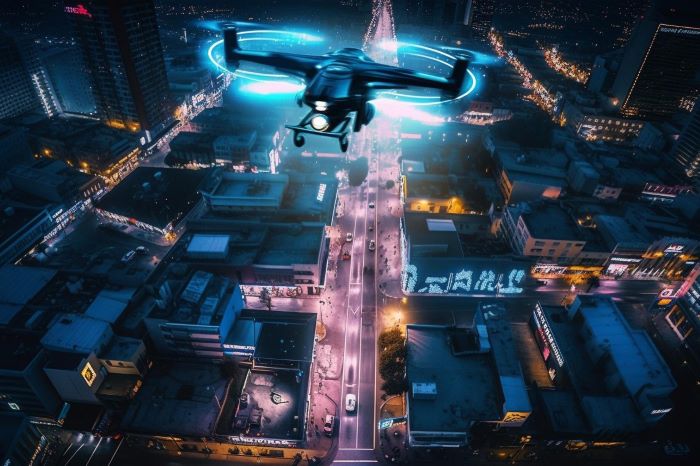
On March 30, 2023, the US Congress’s Subcommittee on Aviation held a hearing to discuss the FAA’s role in drone regulations. The hearing had a very Washington-ian title: “Harnessing the Evolution of Flight to Deliver for the American People.’’ The Subcommittee’s chairman, Representative Garret Graves (LA), set the tone in his opening statement when he said: “We cannot allow the opportunities these (drone) technologies provide to our constituents to be stifled by endless red tape and requests for more data and studies… The last thing we need is the FAA’s lack of leadership and its unwillingness to accept new ideas to drive the next great age of aviation out of America.”
From the FAA’s perspective, the hearing was, unfortunately, all downhill from there. And when discussing aviation, downhill is never a good thing.
Key Takeaways
- The FAA held a hearing discussing its role in drone regulations, emphasizing the need to reduce red tape.
- The FAA has faced challenges integrating drones into airspace, starting with the 2012 FAA Modernization Act and the 2016 Part 107 regulation.
- Concerns arise that excessive regulation may hinder public acceptance and innovation in the drone industry.
- Despite gradual progress, like the upcoming BVLOS rule, the FAA remains cautious due to safety risks and regulatory complexity.
- The future of Drone Regulations looks hopeful, with potential solutions like expanding type certifications for easier approvals.
A Brief History of the FAA and Drones
In 2012, Congress passed the FAA Modernization Act, which tasked the FAA with developing a “comprehensive plan to safely accelerate the integration of civil UAS (unmanned aerial systems) into the National Airspace System (NAS). This was more than a decade ago. At that time, drones were still relatively new in the public eye, but their promise was already obvious. In a 60 Minutes interview in 2013, Jeff Bezos famously promised that Amazon would soon be using drones for 30-minute deliveries. However, the FAA had other plans.
From the outset, the FAA recognized the enormity of this challenge, integrating drones into a world built for manned aircraft. The FAA—at least initially—set out to take baby steps toward a comprehensive regulatory framework, frequently describing its strategy as “crawl, walk, run.” In other words, the FAA aimed for incremental gains.
Spurred on by the 2012 mandate, the FAA soon began to crawl. In 2014, it awarded UAS test sites to seven states (New York, New Mexico, North Dakota, Nevada, Texas, Alaska and Virginia), with the intent that these locations would become proving grounds and incubators for this developing technology. Those sites have been largely successful toward that goal.
Two years later, in 2016, the FAA arguably stopped crawling and took its first step in drone regulation when it published the final rule for Small UAS Systems (commonly known as “Part 107”). This was a framework allowing small (under 55 lbs.) drones to be flown commercially. But Part 107 came with major caveats, most of which are still in effect.
Under the rule, drone operators cannot fly a drone beyond their visual line-of-sight (BVLOS) and are prohibited from flying more than one drone at a time. Combined, these restrictions make it nearly impossible to scale commercial operations under Part 107 (think of the Amazon example). The FAA does offer waivers for certain restrictions under Part 107. However, after eight years, the waiver application process remains extremely expensive, time-consuming and unpredictable (most waiver applications are denied). For these reasons, waivers are widely seen as a stopgap measure, not a long-term solution for the industry.
The FAA continues to chip away at Part 107’s limitations. In 2021, they issued a final rule for “Remote ID,” which essentially mandates digital license plates for drones. Also, a rule allowing BVLOS flights, widely considered the “holy grail” of drone regulations, is in progress and could be implemented in the next two years. Even so, the private sector widely views these incremental gains as an increasingly significant burden on the industry.
Helicopter Parenting? The Dangers of Too Much Regulation.
All regulations represent a balancing act between private innovation and the public good. Even the most fervent drone advocates recognize the need for some drone regulation. But, as the Aviation Subcommittee hearing last year made clear, there is widespread concern that by hyper-focusing on potential risks, the FAA is causing more harm than good.
The drone industry requires public acceptance of this technology, but if flying them is too burdensome, their benefits cannot be shown. The public will become more tolerant of drone accidents (and drone noise, trespasses, etc.) if and when drones can demonstrate their value, even amidst the risks. As examples, both airliners and automobiles have been accepted as “valuable” in our society. With this acceptance, those technologies earn a degree of tolerance when they malfunction, even tragically. For drones to earn this same level of public acceptance, people must first learn and accept their value. Drones will never be able to demonstrate this value when grounded on a shelf under endless red tape. In short, sitting on a shelf, they do no good.
Finally, over-regulation can be fatal to innovation. Like any emerging technology, the drone industry will continue to require a significant capital investment to drive research and development. Expenditures on unproven technology are essentially (educated) bets on the future. These bets will not be placed if there is too much uncertainty over the regulations for a product. Right now, the FAA has undoubtedly sown some doubt about whether, and how soon, the drone industry will move from walking to running.