
Across ASEAN, businesses are facing growing financial and regulatory pressure to operate more responsibly. While national carbon reduction commitments may represent the most critical rationale for change, pressure also comes from customers, investors, and supply chain partners who expect measurable progress on the sustainability front. Against this backdrop, circular economy and sustainability have moved from being abstract ideas to practical, mainstream priorities for everyday business. Circular economy concepts are often discussed and debated without clear definitions, which can lead to setbacks in transitioning to more sustainable operations across the circular economy ASEAN landscape.
To clarify, a circular economy focuses on extending the lifecycle of products and materials. Instead of the traditional “take, make, dispose” model, it encourages the “four ‘R’s”: reuse, repair, refurbishment, and recycling.
This approach offers a growth pathway that naturally helps environmental responsibility. Historically, this was an expensive move, with limited options and few financial incentives. Fortunately, new technologies and funding opportunities have started to make this transition viable for a much wider range of businesses across the circular economy ASEAN landscape. The following steps outline how organizations in ASEAN can use emerging technologies and techniques to move towards a more circular business model.
Key Takeaways
- Businesses in ASEAN face pressure to adopt a circular economy and sustainability due to financial and regulatory demands.
- A circular economy promotes the four ‘R’s: reuse, repair, refurbishment, and recycling, aiming to extend product lifecycles.
- Emerging technologies like data analytics, IoT, and AI can facilitate the transition to a circular business model.
- Training employees and integrating circular metrics into decision-making are crucial for successful adoption of circular practices.
- Building a culture of sustainability and innovation within organizations supports the ongoing transition to the circular economy.
Table of contents
- 1) Map Your Resource Flows with Data Analytics
- 2) Design Products for Longevity and Reuse
- 3) Use IoT to Monitor Product Life Cycles
- 4) Automate Waste Sorting and Recycling Processes
- 5) Integrate Circular Metrics into Financial Decision-Making
- 6) Train Teams and Build a Digital-First Sustainability Culture in Circular Economy ASEAN
- Closing the Loop Starts with Smarter Systems and Empowered People
1) Map Your Resource Flows with Data Analytics
Before making changes, it is essential to understand what exactly needs to be changed. For circular economy transitions, knowing where resources are used and wasted helps set the direction for the business, enabling it to secure big wins early and sustain its progress toward circularity.
Leveraging digital tools such as enterprise resource planning (ERP) systems and advanced analytics platforms can help track materials from procurement to disposal. If the business does not yet have an ERP or some other similar solution, then acquiring one should be a priority. In ASEAN markets, where supply chains typically span multiple countries, the added visibility offered by ERPs is especially valuable as it enables better coordination and reduces the likelihood of excess inventory or unnecessary disposal.
2) Design Products for Longevity and Reuse
Virtual modelling technology can support more thoughtful product design from the outset. Computer-aided design (CAD) software and simulation tools allow businesses to test durability, repairability, and material efficiency before real production begins.
Another approach may be to consider modularity in product offerings. Designing for modularity, for example, makes it easier to replace individual components instead of discarding entire products. This not only reduces waste but also opens up new revenue streams through maintenance, upgrades, and refurbishment services.
3) Use IoT to Monitor Product Life Cycles
The Internet of Things (IoT) allows for real-time monitoring of products and processes, even when you’re not in close physical proximity to them. For example, sensors embedded in equipment or devices can remotely track usage patterns, performance, and wear over time, enabling better maintenance and extending product lifespans. This is becoming a core enabler of circular economy ASEAN initiatives by keeping materials in use longer and reducing waste.
4) Automate Waste Sorting and Recycling Processes
For the facilities that can afford them, modern AI-powered sorting systems can significantly improve recycling rates at recovery facilities. These systems offload the physically and mentally taxing work of identifying and separating materials to machines, ensuring that more valuable resources are recovered instead of lost. As a bonus, the need for manual labor is reduced, freeing workers to do higher-level work.
5) Integrate Circular Metrics into Financial Decision-Making
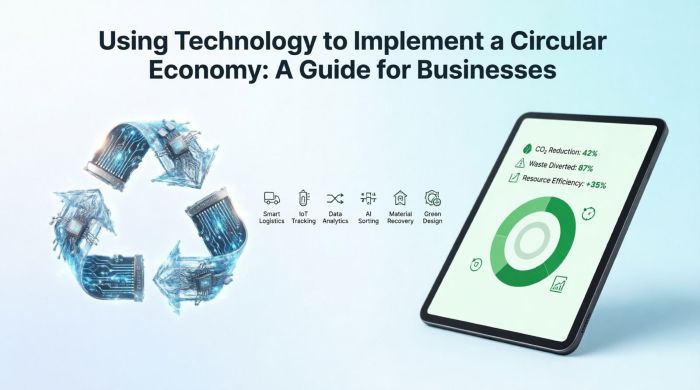
In real-world practice, adopting a circular model generally demands a realignment of financial operations. To start, using digital dashboards and reporting tools can help organizations track metrics such as material recovery rates, product lifespan, and resource efficiency.
Financial institutions are increasingly supporting this transition through green financing solutions. For example, circular economy funding programs in Singapore may reward businesses for adopting specific, proven sustainable practices. Integrating these metrics into decision-making helps organizations justify their activities to investors and other stakeholders while strengthening their position within the circular economy ASEAN ecosystem.

6) Train Teams and Build a Digital-First Sustainability Culture in Circular Economy ASEAN
Team training is, perhaps, one of the most underrated initiatives of a successful transition to circularity. Though technology is often hyped as a labor-saver, even the most sophisticated automation and robotics solutions are essentially levels that demand human input. And where critical human inputs are demanded, training is often necessary.
At the end of the day, your technology investments are only as effective as the people using them. For that reason, businesses making the leap to circularity must invest in training programs that equip employees with the skills needed to operate new systems and interpret the data they are deriving from them.
Building a culture that values innovation and sustainability is possibly more challenging. It’s one thing to get employees and leaders to understand the theory behind circular economics but ensuring that circular practices are embedded into daily operations demands repetition and, perhaps, unlearning things that have already been ingrained.
Closing the Loop Starts with Smarter Systems and Empowered People
Regardless of your sector, transitioning to a circular economy is going to be an ongoing process that evolves with your business and its backdrop. Yes, technology provides the tools to make this shift practical, measurable, and scalable. However, it remains up to the people in the organization to wield it in a way that consistently provides the promised benefits of circular economy ASEAN adoption.