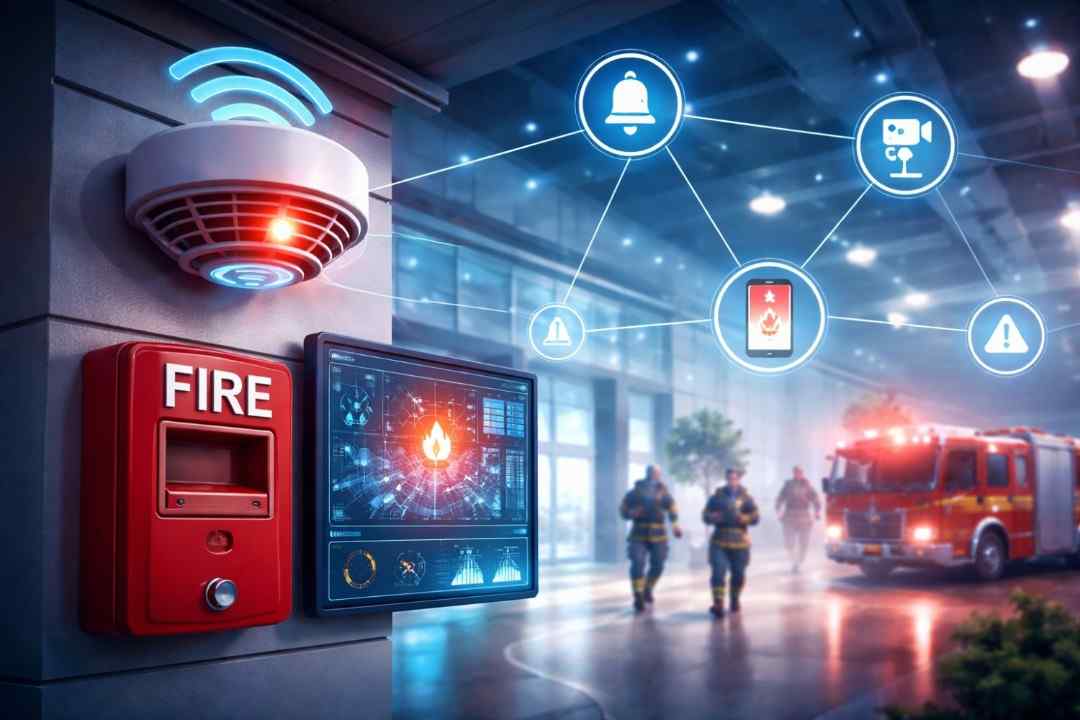
Fire safety is a critical concern for any city, but it is especially essential in a prominent, densely populated place like London. With residential blocks, offices, transport hubs, and historic buildings located close together, the speed at which a fire is detected and responded to can make a significant difference. Moreover, technology-driven fire alarm systems play a key role in reducing emergency response times by detecting risks earlier. These systems also share information faster and enable coordinated action.
According to the National Fire Protection Association (NFPA), the risk of dying in a fire is reduced by about 60% in homes equipped with working smoke alarms. This statistic highlights the life-saving value of early detection and reliable alarm systems.
Understanding how these systems work helps explain why modern fire safety relies heavily on technology rather than traditional methods alone.
Key Takeaways
- Fire Alarm Systems are crucial for fast fire detection and swift emergency response in densely populated areas like London.
- Modern technology-driven alarms utilize advanced sensors to minimize false alarms while enhancing real threat detection.
- These systems support clear communication, providing accurate information and coordinating responses between occupants and emergency services.
- Real-time monitoring helps identify potential risks before a fire occurs, improving overall safety and efficiency.
- Professional installation and adaptation to diverse building types ensure optimal performance in London’s complex urban landscape.
Table of Contents
The Importance of Early Detection in Fire Emergencies
The initial indication is the basis of the successful fighting of fires. The faster a fire is detected, the sooner occupants can be notified, and emergency response management organizations can take action. Conventional fire alarms used only restrictive smoke detection and could be slow to react or susceptible to false alarms.
These days, state-of-the-art sensors can detect smoke or heat, or even a decline in air quality, more effectively. In the context of London buildings where a diversity of activities take place under one roof, heightened sensitivity facilitates the detection of real threats. Detection happens without unnecessary delay.
Reducing the Time Between Ignition and Alert
Technology-driven alarms are designed to minimise the gap between the start of a fire and the activation of alerts. Therefore, faster detection means alarms sound earlier. This gives people more time to evacuate and reduces confusion during the initial moments of an emergency.
Smart Sensors and Advanced Detection Technology
Modern fire alarm systems use a combination of intelligent sensors rather than relying on a single trigger. These sensors analyse patterns, temperature changes, and smoke density to distinguish between harmless events and real danger.
In London, where steam from kitchens or dust from brilliant construction work is common, this technology helps reduce false alarms while still responding quickly to genuine fires. By improving accuracy, emergency services are alerted to real incidents without delay.
Integrated Communication Systems
One of the most significant advantages of technology-driven fire alarms is their ability to communicate instantly. Modern systems can be connected to building management systems, monitoring centres, and emergency services.
When a fire is detected, information about the location and severity can be shared automatically. As a result, this reduces the time emergency responders spend identifying where the problem is. It also allows them to prepare before they arrive on site.
Supporting Coordinated Emergency Response
Clear communication improves coordination between building occupants, fire wardens, and emergency teams. In large London buildings, this coordination is essential for guiding evacuations. It also ensures that responders reach the right area as quickly as possible.
Real-Time Monitoring and Alerts
Technology-based systems can even offer real-time monitoring that allows problems to be detected before a fire occurs. Anomalies in logs, out-of-service, or deviations from normal patterns can automatically raise alerts while initiating the investigation process.
For property managers in London, this would amount to not only potential risks being identified early, but also a lower chance of slow responses if something does go wrong. Meanwhile, another benefit of real-time monitoring is that it supports essential system protection. This helps to keep core systems stable and running at all times.
Faster Decision-Making for Emergency Services
When emergency services receive accurate and detailed information early, decision-making becomes faster and more effective. Importantly, knowing the exact location of a fire, the type of building, and whether evacuation is already in progress allows responders to act immediately.
This is particularly important in London, where traffic conditions and complex building layouts can affect response times. Technology-driven fire alarms help reduce uncertainty and support quicker, more informed action.
Supporting Evacuation Through Clear Alerts
Today’s fire alarm systems sound clear and consistent signals, sometimes even with voice commands. The alerts are intended to provide some explanation of what’s happening and how the occupants should respond.
The advice helps avoid panic and confusion that may hinder evacuation and delay emergency response. In crowded city spaces like London, people live and work in large numbers. For this reason, clarity is essential for keeping evacuations orderly.
Adapting Alerts to Different Environments
Technology allows alerts to be adapted to different building types and occupancy levels. This flexibility ensures that messages are appropriate for the setting, whether it is a workplace, residential building, or public space.
Integration With Fire Safety Standards and Regulations
Fire alarm technology is developed in line with safety regulations and best practices. In the UK, guidance from the Health and Safety Executive highlights the importance of effective fire detection and warning systems in protecting life.
Technology-driven systems help buildings meet these expectations by providing reliable detection and clear alerts that support a timely response.
Maintenance and System Reliability
There’s more to it than just detection – reaction time is also reliability. A system that flounders during an emergency can create hazardous delays. Many of today’s fire alarm systems have diagnostic capabilities to help firefighters troubleshoot malfunctions.
Frequent testing, accompanied by system feedback, helps assure that alarms will work as they are designed. In London, where times may work twenty-four hours a day, reliability is necessary to provide constant protection.
The Role of Professional Installation and Design
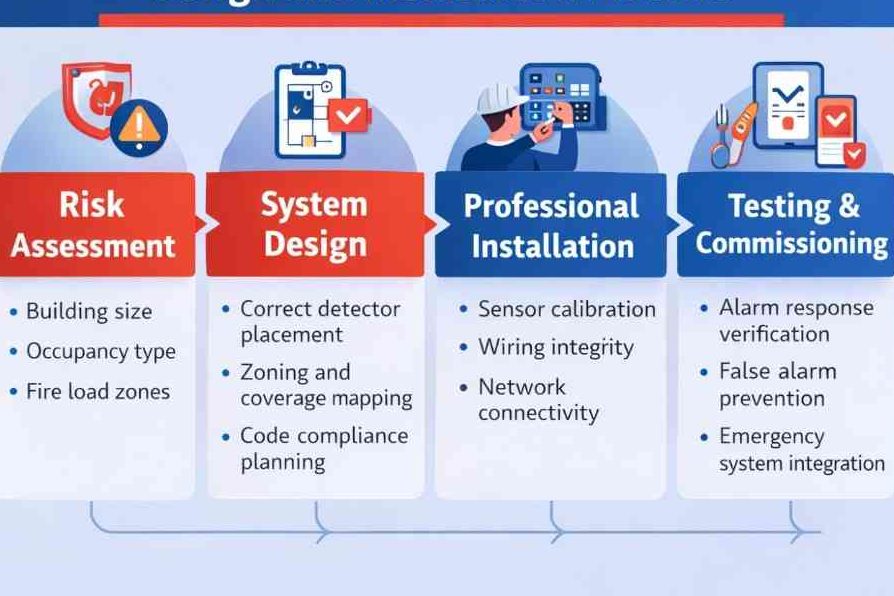
The effectiveness of a fire alarm system depends not only on its technology but also on proper planning and setup. Systems need to be designed according to the building’s layout, occupancy, and potential risks. For many London properties, professional Fire Alarm Installation in London ensures that detectors, control panels, and alarm connections are positioned for optimal performance. Proper installation enhances early detection and clear alerts. This improves safety for both people and property.
Adapting to London’s Building Diversity
In London, you have everything from newer high-rise buildings to old, quirky-shaped houses. Thanks to these systems being technology-based, we can customise fire alarm systems to fit the particular building we are protecting.
There are wireless modules; the sensor can be installed in any location, and it is scalable, so an adapted fire prevention system can be used without slow detection. This flexibility helps keep our response times fast across a variety of building types.
Using Data to Improve Future Response
Some more sophisticated fire alarm systems can store information on activations, response times, and system performance. This kind of info can be revisited to identify ways you can improve.
In the future, by analyzing this data over time, building managers and security personnel can refine protocols and improve their emergency response plans. Additionally, continuous development is essential to ensure that high levels of safety are maintained in a city as complex as London.
Conclusion
Technology-driven fire alarm systems play a vital role in improving emergency response time by enabling faster detection, more transparent communication, and more informed decision-making. In London’s dense, diverse urban environment, these advantages are significant in innovative construction projects. Here, connected building systems work together to enhance safety and efficiency. By combining advanced sensors, real-time monitoring, and integrated communication, modern fire alarm systems support more innovative construction practices. They also enable quicker, more effective responses when every second matters. As technology continues to develop, its role in fire safety will remain central to smart construction initiatives. This will help protect people and buildings across the city.