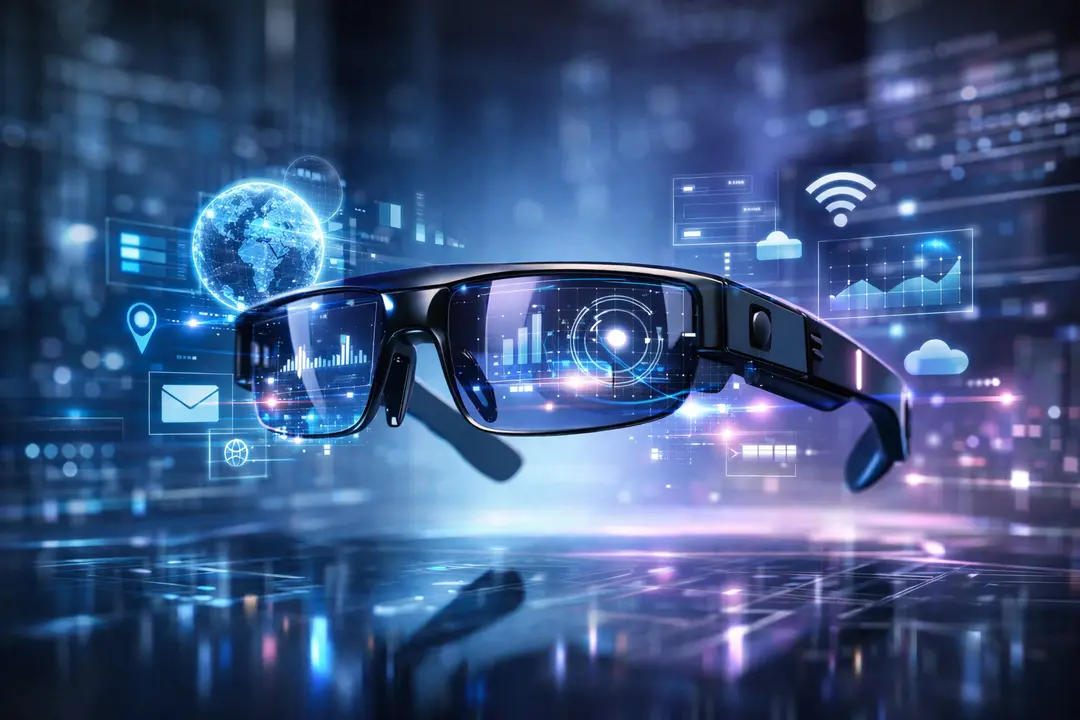
In 2026, smart glasses will no longer be just experimental gadgets. They are becoming practical tools for everyday capture, navigation, work support, and immersive entertainment. What makes modern smart glasses feel “usable” is not one breakthrough, but a full stack of technologies working together: displays, optics, tracking, cameras, AI, audio, connectivity, and power management.
Industry leaders have moved beyond simple prototypes. Devices like the RayNeo X3 Pro are now setting the standard for how these components integrate into a wearable form factor. This guide breaks down the 10 advanced technologies that power today’s hardware and explains how each one unlocks real AR Devices.
Table of contents
- MicroLED and Micro-OLED Display Engines
MicroLED and Micro-OLED are the “visual engines” inside the frames, responsible for displaying text, UI, and images in your field of view within an extremely small form factor. They largely determine whether AR text looks crisp, stays readable across lighting conditions, and feels immersive.
While earlier generations struggled with brightness, current flagships like the RayNeo X3 Pro utilize advanced MicroLED engines to deliver high-contrast visuals that remain visible even in direct sunlight. When comparing models, focus on peak brightness for outdoor use, resolution, pixels per degree (PPD) for sharpness, and color accuracy to ensure the digital overlay blends naturally with the real world.
- Waveguide Optics and Light-Combiner Systems
Waveguides and light-combiner optics route the display’s light into your eyes while keeping the lenses transparent. This is a crucial technology because it is the primary reason why true see-through smart glasses can finally look like normal eyewear rather than bulky headsets.
Strong optics make overlays feel naturally “anchored” in the real world, while weaker optics often show issues like edge blur, rainbow artifacts, or glare that quickly break immersion. When evaluating optics, check the field of view (FOV) and the lenses’ transparency when the display is off.
- Spatial Tracking: SLAM, 6DoF, and World Anchors
SLAM (Simultaneous Localization and Mapping) and 6DoF tracking are the core “where am I in space?” technologies. They let smart glasses understand their position and keep digital content stable as you walk, turn, and move. They decide whether navigation arrows drift or a virtual screen remains pinned to a specific spot in your room.
High-end units, such as the RayNeo X3 Pro, utilize optimized SLAM algorithms to minimize jitter. To assess tracking quality, look for stability during walking and turning, performance in low-light environments, and how quickly the system recovers when tracking is temporarily lost.
- Multi-Camera Systems: RGB, Depth, and Sensor Fusion
Modern devices increasingly combine an RGB camera for capture with depth or spatial sensors for geometry, then fuse that with IMU motion data for robust scene understanding. This sensor fusion improves hand tracking and gesture reliability, enhances virtual object placement accuracy, and helps AI features interpret what you are looking at.
The camera capabilities of the RayNeo X3 Pro, for instance, are designed not just for photography but also for real-time environmental analysis. When comparing devices, check stabilization, dynamic range in bright and dark scenes, and the clarity of privacy indicators.
- On-Device AI and Multimodal Understanding
Multimodal AI enables wearables tech to interpret voice, text, and visual inputs together. This is what turns hardware from “something that records” into an assistant that can translate in real-time, recognize objects, and answer complex questions. The integration of AI is perhaps the most significant leap forward in recent years.
Leading this charge is the RayNeo X3 Pro, which leverages powerful onboard processing to handle queries with minimal latency. When evaluating AI, focus on response speed, offline capability for core features, and privacy policies regarding what data is stored or uploaded.
- Audio Tech: Beamforming Mics and Open-Ear Speakers
Audio is often what determines whether smart glasses feel practical day-to-day. The key components are beamforming microphone arrays to isolate your voice, noise control for calls, and open-ear speakers that keep you aware of your surroundings.
Better audio makes voice control more reliable outdoors and in crowded areas, improving the usability of translation features on devices like the RayNeo X3 Pro. When comparing models, pay attention to wind-noise handling, sound leakage (privacy), and long-session comfort to avoid audio fatigue.
- Sensor Suite: IMU, Eye Tracking, and Environmental Sensing
The sensor suite typically includes IMU sensors for head motion, optional eye-tracking for gaze-based selection, and light and proximity sensors for auto-brightness. These sensors enable more natural interaction, such as the “look and select” targeting used in high-end smart glasses, and reduce power use through smarter rendering.
When evaluating sensors, check calibration speed and reliability. A well-calibrated RayNeo X3 Pro, for example, uses these sensors to adjust display brightness instantly when moving from indoors to outdoors, ensuring AR content remains visible.
- Connectivity: Bluetooth, Wi-Fi, and Low-Latency Streaming
Most smart glasses still rely on a phone or companion device for heavy lifting. Bluetooth handles audio and control, while Wi-Fi enables faster transfer, streaming, and cloud AI access. Stability and latency are the make-or-break factors here.
Strong connectivity enables remote-assistance scenarios where someone can see what you see. When comparing devices, look at connection stability across platforms and the battery impact of always-on wireless features, a balance that the RayNeo X3 Pro manages by optimizing data transmission protocols.
- Power, Thermal Design, and Battery Architecture
Because smart glasses pack displays, cameras, and AI into a tiny chassis, battery and thermal design are hard constraints. Manufacturers must use heat spreading and power scheduling to prevent overheating. This impacts whether you can use the device for extended sessions without discomfort.
The architecture of the RayNeo X3 Pro is specifically engineered to dissipate heat away from the temples and nose bridge. Instead of just looking at quoted battery life, consider charging speed, heat hotspots, and whether long sessions trigger performance throttling.
- OS, SDK, and App Ecosystem
The operating system and app ecosystem are the “invisible moat” that determines what the hardware can actually do. A strong ecosystem unlocks better navigation, productivity, and specialized workflows.
The RayNeo X3 Pro benefits from a growing developer community, ensuring the device’s utility expands over time. When evaluating this layer, check the update frequency, the availability of third-party integrations, and the platform’s developer openness.
How These Technologies Unlock Real AR Applications
Navigation and Contextual Guidance
AR Devices navigation works well only when display clarity and tracking are aligned. If brightness is weak, navigation becomes distracting. The RayNeo X3 Pro excels here by combining bright MicroLEDs with precise SLAM to provide arrows that stick firmly to the road.
Real-Time Translation and Travel Assistance
Translation depends on microphones and display readability. For travel, the best experience is fast, legible subtitles. Smart glasses act as a universal translator, breaking down language barriers instantly.
Remote Assistance and Work Documentation
For work support, the key is a stable first-person view. If someone remote can draw or point to what you are seeing, tracking becomes essential. This is a primary use case for enterprise-grade smart glasses.
Fitness and Action Capture
Outdoor usage stresses brightness and stabilization. You need a secure fit and predictable battery behavior. Action capture on the RayNeo X3 Pro feels fluid because the stabilization algorithms are tuned for head movement.
Entertainment and Big-Screen Experiences
Entertainment-first experiences depend on resolution and refresh rate. Comfort is especially important here, as you may wear the smart glasses for hours to watch a movie on a virtual giant screen.
Conclusion
Smart glasses in 2026 are powered by a full technology stack: advanced displays to make AR visible, spatial tracking to keep content stable, and multimodal AI to make the device intelligent. Devices like the RayNeo X3 Pro demonstrate how these technologies converge to deliver a seamless user experience.
If you evaluate smart glasses using these 10 technologies and align them with your primary use case, you will avoid “cool demo, hard to live with” purchases and find a device that fits your daily workflow.