
A practical guide to deploying LLM-powered accounts payable automation — without a large IT budget or enterprise-level complexity.
For most small and mid-size enterprises (SMEs), supplier invoice processing is one of those persistent operational headaches that never seems to get better. Invoices arrive as scanned PDFs, email attachments, mobile-phone photos, and structured electronic files — each in a slightly different format, each requiring a trained staff member to open, read, key in, and route for approval. At five to fifteen minutes per invoice, and with fully-loaded staff costs running $25 to $45 per hour, the math adds up quickly: many SMEs are spending $8 to $18 per invoice, every invoice, every month.
Enterprise automation platforms exist to solve this problem — but they are expensive, slow to deploy, and typically built for large organizations with dedicated IT teams. That gap is closing fast, thanks to Large Language Models (LLMs). The same AI technology that powers modern chatbots can now extract structured data from unstructured invoices with remarkable accuracy, handle diverse supplier formats without template configuration, and integrate with the accounting systems SMEs already use.
Key Takeaways
- LLM-powered accounts payable automation offers a cost-effective solution for SMEs struggling with manual invoice processing.
- Traditional automation fails due to template rigidity and lack of contextual understanding, leading to inefficiencies.
- An LLM-based system processes invoices with high accuracy, requiring no template configuration and significantly reducing operational costs.
- Key cost-saving strategies include intelligent model routing and a phased approach to implementation, enhancing efficiency and minimizing exceptions.
- Security and compliance measures are essential, including data encryption, access controls, and maintaining audit trails for financial documents.
Table of contents
- Why Traditional Accounts Payable Automation Keeps Failing SMEs
- The LLM-Powered Alternative
- What Accounts Payable Automation Actually Costs — and What It Saves
- The Key to Keeping Costs Low: Intelligent Model Routing
- Getting Started: A Phased Approach
- A Note on Security and Compliance
- The Opportunity Is Now
Why Traditional Accounts Payable Automation Keeps Failing SMEs
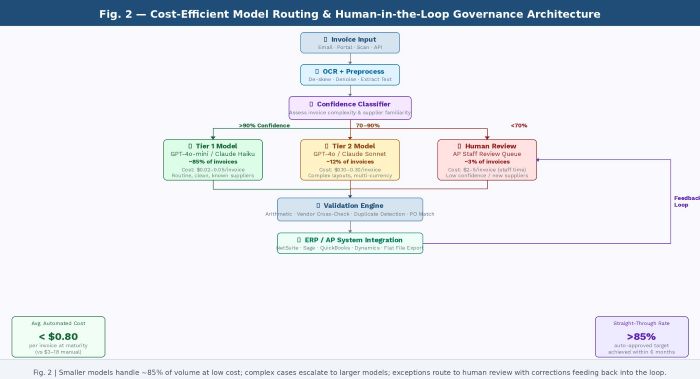
Template-based OCR tools and robotic process automation (RPA) platforms have been around for years, yet most SMEs still process invoices largely by hand. The reason is structural: traditional tools require predefined layouts. The moment a supplier updates their invoice template — or a new supplier is onboarded — the system breaks and requires manual reconfiguration. For a company working with dozens or hundreds of suppliers, maintaining those templates is itself a full-time job.
Rule-based systems also struggle with contextual understanding. Distinguishing ‘Subtotal’ from ‘Total Due,’ correctly mapping tax line items to the right general ledger code, or identifying that a supplier has changed their remittance address — these tasks require judgment that static rules simply cannot provide.
Fig. 1 | Conceptual comparison of traditional OCR + rule-based pipelines vs. LLM-enhanced document understanding workflows.
The LLM-Powered Alternative
An LLM-based invoice processing system works as a five-stage pipeline: ingestion, OCR preprocessing, LLM extraction, validation, and ERP integration. What makes it different from older accounts payable automation is Stage 3. Rather than matching against a rigid template, the LLM reads the OCR output as natural language, understands context, and returns a structured JSON object containing every required field — vendor name, invoice number, date, line items, tax amounts, payment terms, and totals.
Crucially, this works across invoice formats without any template configuration. A new supplier simply sends their first invoice; the system processes it. The validation engine then applies deterministic checks — arithmetic verification, vendor cross-reference, duplicate detection, and PO matching — before approved invoices are pushed automatically to the accounting or ERP platform.
What Accounts Payable Automation Actually Costs — and What It Saves
The economics are compelling. At scale, a well-configured LLM-based system processes a routine invoice for $0.35 to $1.30 — compared to the $3 to $18 per invoice typical of manual processing. For a company handling 2,000 invoices per month at an average manual cost of $8 each, annual spend is roughly $192,000. Automated, that same volume costs approximately $19,200 per year — a saving of over $170,000, before factoring in early-payment discount capture and error reduction.
Implementation costs for a cloud-based SME deployment typically run $15,000 to $60,000. That yields a payback period of one to four months at the volumes described above. The system also scales non-linearly: processing 50,000 invoices per month costs only marginally more than processing 5,000, because the main cost drivers are per-API-call fees, not headcount.
The Key to Keeping Costs Low: Intelligent Model Routing
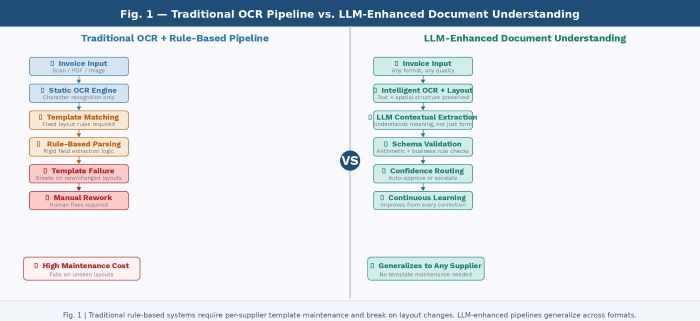
The single most impactful cost optimization strategy is routing. Not every invoice needs the most capable (and most expensive) AI model. A well-architected system sends 80 to 85% of invoices through a smaller, faster, cheaper model — such as GPT-4o-mini or Claude Haiku — at a cost of $0.02 to $0.05 per invoice. Only invoices with low confidence scores, complex line-item structures, or ambiguous fields escalate to a larger model. A confidence scoring layer evaluates each extraction and routes to one of three paths: auto-approve (above 90% confidence), soft review (70–90%), or full manual review (below 70%).
This tiered approach ensures human attention is directed where it genuinely matters, while the vast majority of invoices flow straight through to the ERP without anyone touching them. Reducing the exception rate from 30% at go-live to under 10% at twelve months is the most powerful ongoing lever for cutting per-invoice cost — every percentage point saved translates directly to reduced labor spend.
Fig. 2 | Cost-efficient model routing and human-in-the-loop governance architecture showing tier-based LLM selection and feedback loop.
Getting Started: A Phased Approach
SMEs that have successfully deployed LLM-based accounts payable automation consistently recommend a phased, agile approach rather than a full-scale big-bang implementation. The recommended starting point is a focused pilot covering the top 10 to 20 suppliers by invoice volume — typically representing 60 to 70% of monthly invoice count. Within six weeks, organizations can validate accuracy on known invoice formats, train AP staff on the exception review interface, and establish baseline performance metrics.
From there, expansion follows in stages: broadening coverage to 80% of invoice volume by month four, enabling PO matching and reducing exception rates through prompt refinement by month six, and reaching steady-state operations — with 85%+ straight-through processing — within twelve months. The feedback loop is critical throughout: every human correction is logged, analyzed for patterns, and used to improve extraction prompts and validation rules. Systems that invest in this loop consistently outperform those that do not.
A Note on Security and Compliance
Invoice documents contain sensitive financial data, so cybersecurity practices must be followed. Any deployment must implement TLS 1.2+ encryption in transit, AES-256 encryption at rest, role-based access controls, and automated retention-based deletion. Organizations using hosted LLM APIs should review the provider’s data processing agreement to confirm invoice data is not used for model training. A practical data minimization approach sends only the OCR text output to the LLM rather than the original invoice image — reducing the scope of data shared with third-party providers. Complete audit trails, retained for a minimum of seven years, are a standard compliance requirement for financial document processing systems.
The Opportunity Is Now
For SMEs that have accepted manual invoice processing as an unavoidable cost of doing business, the technology shift underway represents a genuine opportunity. LLM-based accounts payable automation is no longer an enterprise-only capability. It is deployable by a motivated two or three person project team, achievable within a single quarter, and capable of delivering ROI within months of go-live.
The journey begins with a simple exercise: pull six months of AP data, rank suppliers by invoice volume, collect three to five sample invoices from the top twenty, and test an LLM extraction prompt. The results are typically striking — and they make the business case for the next step obvious.
This article is part of a comprehensive design and deployment guide for Automated Supplier Invoice Processing (ASIP) systems, covering architecture, cost modeling, and implementation methodology for small and mid-size enterprises.