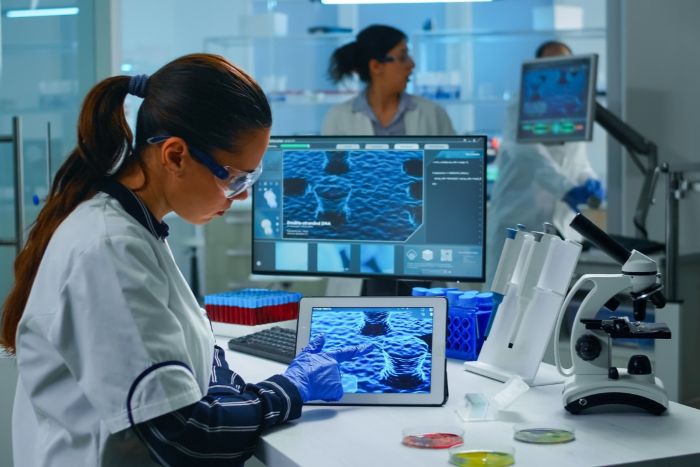
Spend enough time in a life science research lab and you start to notice where things actually break down. It’s rarely the science itself. More often it’s the infrastructure around it: the manual processes, the inconsistent transfers, and the workflows that made sense at a small scale and quietly fell apart when the project grew. Australian labs are facing this reckoning right now. The ambition is there. The question is whether the systems can keep up.
Key Takeaways
- Life science research often faces challenges due to outdated infrastructure, affecting scalability and efficiency.
- Genomics has outgrown manual pipetting, leading to inaccuracies in sample preparation and resultant data.
- Reproducibility in cell biology is critical; minor variations can significantly impact experimental results.
- Automation, particularly liquid handling robotics, enhances accuracy and efficiency in high-throughput experiments.
- Choosing the right automation platform involves practical considerations like compatibility with labware and integration with existing systems.
Table of contents
- Genomics Has Outgrown the Pipette
- Reproducibility in Cell Biology Is Harder Than It Looks
- The Logistics of Large-Scale Experiments Are Genuinely Brutal
- Where Liquid Handling Robotics Fits into Serious R&D
- Choosing a Platform That Actually Works for Your Lab
- Size, Maintenance and the Realities of Lab Space
- Integration With the Instruments You Already Use
- Building Research Infrastructure That Grows with the Science
Genomics Has Outgrown the Pipette
Sequencing technology has moved so fast that sample prep is now the bottleneck for a lot of teams. You can generate genomic data at extraordinary speed, but if your upstream handling is inconsistent, that speed is largely wasted. We’re talking about volume transfers at 2 μL or less, across thousands of samples, where any drift in technique introduces noise that’s nearly impossible to untangle later. Manual pipetting was never built for this. Skilled researchers doing their best still accumulate error across a long run. Biology doesn’t forgive it.
Reproducibility in Cell Biology Is Harder Than It Looks
Ask any cell biologist what keeps them up at night, and reproducibility will come up quickly. Cells respond to everything: the timing of a reagent addition, a degree or two of temperature variation, a slightly different volume in one well versus another. These aren’t dramatic failures. They’re subtle shifts that only show up when you try to repeat an experiment and get a different answer. Over time, that uncertainty erodes confidence in the data. Removing the variability from liquid handling is one of the more straightforward fixes available, and its impact on data quality is hard to overstate.
The Logistics of Large-Scale Experiments Are Genuinely Brutal
High-throughput work sounds exciting until you’re manually transferring samples across hundreds of plates at 11pm because the run took longer than expected. The cognitive load alone is a problem. Fatigue introduces mistakes, and mistakes in the middle of a large experiment don’t always announce themselves. They quietly corrupt results that took weeks to generate. Automation doesn’t just make large-scale experiments faster. It makes them survivable. A 384-well qPCR plate that might consume the better part of a researcher’s morning can be set up with samples and master mix in under 30 minutes. That time compounds across a week, a month, a year.
Where Liquid Handling Robotics Fits into Serious R&D
Biotech timelines are punishing. A program that slips because of reproducibility problems or inconsistent sample prep doesn’t just cost money; it affects everything downstream, from investor confidence to regulatory conversations. This is where liquid handling robotics earns its place in serious R&D environments. The best systems today deliver less than 2% deviation at 2μL volumes and less than 1% at 5μL across workflows that span qPCR setup, NGS library prep, bead cleanup, and ELISA. That level of accuracy means researchers are measuring biology, not troubleshooting technique. The distinction matters more than most procurement conversations acknowledge.
Choosing a Platform That Actually Works for Your Lab
A lot of automation equipment looks impressive in a brochure and sits underused six months after installation. Usually the problem isn’t the hardware; it’s the fit. The labware doesn’t match. The software requires specialist knowledge to tweak a simple protocol. The system can’t communicate with anything else on the bench. Before committing to a platform, these practical questions deserve honest answers:
- Does it handle your actual life science research labware, including 384- and 1536-well plates?
- Can a researcher build and adjust protocols without calling the vendor every time?
- Does it connect with your existing instruments?
- What does real-world precision look like, not just spec-sheet numbers?
Getting these answers upfront saves a significant amount of frustration later.
Size, Maintenance and the Realities of Lab Space
One underrated factor in automation decisions is physical footprint. Most labs aren’t flush with bench space, and a system that monopolizes a workstation creates its own problems. The most practical platforms weigh under 10 kg and take up less than 2 ft², which is roughly half the footprint of comparable instruments in their class. Models with expanded deck configurations add extra positions for higher-throughput workflows while keeping a similarly compact profile. Built-in HEPA filtration and UV decontamination manage contamination risk without adding bulk. And low-maintenance design matters in facilities that simply can’t afford unplanned downtime.
Integration With the Instruments You Already Use
Individual instruments are useful. Connected systems are a different proposition entirely. When a liquid handling platform integrates directly with your cyclers and analytical tools, researchers can set up, run, and review experiments from a single interface, without exporting or importing sample names between applications. That kind of connection removes a surprising amount of daily friction. Pressure-based liquid level sensing adds another layer of reliability, actively monitoring the aspirate and dispense process in real time and catching potential errors before they propagate through an entire run.
Building Research Infrastructure That Grows with the Science
The life sciences aren’t getting simpler. Genomic datasets are growing, cell biology is getting more complex, and biotech pipelines are under more pressure than ever to deliver faster with stronger evidence. Life science research labs that invest in capable, low-maintenance automation now will adapt far more easily as demands shift. The alternative, patching manual workflows or buying equipment that doesn’t scale, tends to cost considerably more over time in wasted reagents, repeated experiments, and lost momentum. Good infrastructure isn’t a luxury. It’s what serious research is built on.