
Charleston residents weighing home internet options often find themselves choosing for the fastest broadband between WOW! and Xfinity. This guide compares availability, speeds, pricing, and customer satisfaction to help you decide which cable provider makes the most sense for your address.
Key Takeaways
- Charleston residents can choose between WOW! and Xfinity for home internet, with availability as the key factor.
- Xfinity covers 93% of homes while WOW! reaches around 52%, offering more options within WOW!’s service area.
- Xfinity boasts higher download speeds, while WOW! offers better upload speeds, especially for remote work.
- WOW! has lower introductory pricing, but Xfinity provides a five-year price guarantee for stability.
- Customer service varies: WOW! is praised for responsiveness, while Xfinity faces complaints about hold times and transfers.
Table of contents
Where Can You Get Each Service?
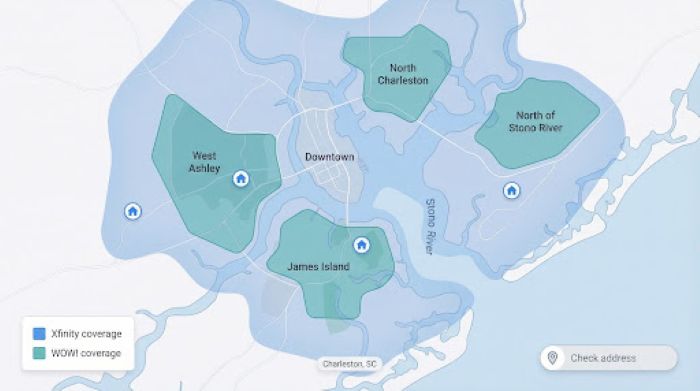
Xfinity’s cable network already reaches about 93 percent of Charleston homes, while WOW! passes roughly 52 percent—mainly in West Ashley, James Island, North Charleston, and neighborhoods north of the Stono River.
If your address sits outside WOW!’s footprint, Xfinity becomes the de-facto cable option. Inside a WOW-served block, you gain genuine leverage to choose the cheaper or faster offer.
The surest way to confirm service is to plug your exact street address into each provider’s checker. ZIP codes can mislead, and availability can shift house by house as new nodes light up.
Construction crews are a good omen: WOW! is extending fiber in other South Carolina cities, and Xfinity continues upgrading its DOCSIS 4.0 “10G” network. When trucks appear on your street, new plans—or faster tiers—often follow within weeks.
For now, availability is the key divider: Xfinity for near-universal coverage, WOW! for residents lucky enough to sit inside its current grid.
How Fast are WOW! and Xfinity?
Advertised Speeds and Network Tech
Both companies rely on hybrid fiber-coaxial lines: fiber feeds the neighborhood node, and coax carries the signal the final few hundred feet to your modem. That layout supports multi-gig downloads, while uploads remain lower than on full fiber.
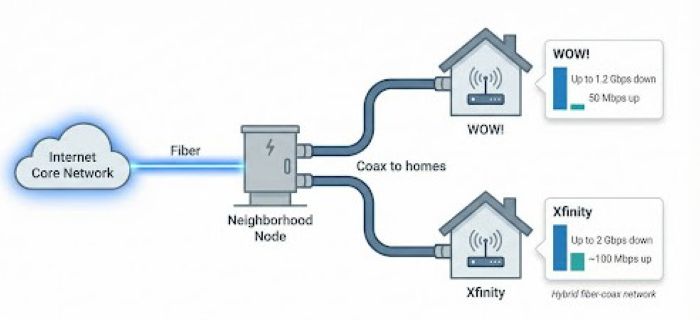
Xfinity lists a residential top tier of 2 Gbps down and about 100 Mbps up in Charleston. The next-highest “Gig” plan advertises 1.2 Gbps down and roughly 35 Mbps up.
WOW!’s fastest broadband cable plan reaches 1.2 Gbps down with 50 Mbps up. Mid-tier options sit at 600 Mbps or 300 Mbps, and each offers a healthier upload allowance than Xfinity’s comparable plans.
Spec sheets give Xfinity the download crown, but either provider’s gigabit plan leaves more headroom than a typical household can exhaust. The more relevant story is how those figures hold up once packets travel Charleston streets.
Real-World Speeds and Reliability
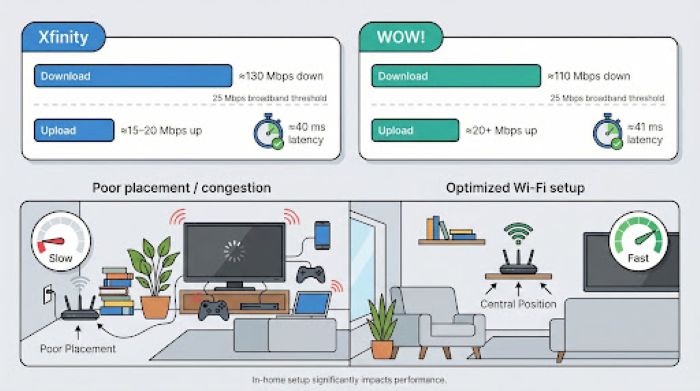
According to the testing site Realspeeds, Xfinity customers average 129 Mbps down and 17 Mbps up with about 40 ms latency. WOW! users see 108 Mbps down, 23 Mbps up, and roughly 41 ms latency.
Both networks far exceed the FCC’s 25 Mbps broadband threshold, so streaming and homework glide. Uploads tilt toward WOW!, a plus for residents who live on Zoom or back up large photo libraries.
Evening congestion is modest on either network, yet Wi-Fi hiccups inside the home can still drop a 300 Mbps plan to a crawl. Small fixes such as relocating the router away from dense walls, rebooting outdated gateways, or pausing bandwidth-hungry smart-TV updates often restore full speed; a concise checklist on how to fix slow internet walks through each step.
Latency in the low forties is acceptable for casual gaming, though fiber still halves that number. Competitive players may opt for AT&T Fiber when it reaches their block.
Storm-related outages do occur, yet community forums rarely label one carrier more fragile than the other. Comcast’s larger workforce helps restore service quickly when a line drops, while WOW!’s smaller nodes host fewer neighbors, which can ease congestion. Public filings show 2025 uptime above 99 percent for both.
Bottom line: Xfinity leads in raw download speed, WOW! answers with stronger uploads, and either network feels fast and stable for daily Charleston life.
Fastest Broadband: Plans, Pricing, and Value
Plan Options and Promotional Pricing
According to Forbes, WOW!’s 300 Mbps starter plan launches at $25 per month, rises to $30 after the intro period, and still includes the modem, Wi-Fi, and unlimited data. The 600 Mbps tier starts at $40, 1 Gig at $55, and the 1.2 Gig flagship tops out at $90, with no contract or equipment charge.
Forbes also notes that Xfinity starts higher but offers a five-year price guarantee. Its 300 Mbps plan is $55, 500 Mbps is $60, 1 Gig is $65, and the 2 Gig option is $85; each package includes the xFi gateway and unlimited data, so you avoid an extra hardware fee or data cap.
Placed side by side, WOW! wins the upfront price battle because its 300 Mbps plan costs half of Xfinity’s. Over five years, though, Xfinity’s guarantee narrows the difference. WOW!’s Price Lock Promise—about a $5-per-month add-on—freezes your base Internet rate for as long as you keep the plan; decline it and the promo price resets after 12 months, while Xfinity’s guarantee holds steady for five years. The choice depends on whether you prefer the lowest short-term cost or a bill that never changes.
Charleston households now enjoy unlimited data and included equipment by default, a perk that once separated cable rivals. With those pieces equal, focus on how much speed you need for the fastest broadband and how long you plan to stay.
Customer Service and Local Reputation for the Fastest Broadband
Fast speeds lose value if a billing glitch traps you in a phone maze. On support quality, the two providers differ.
WOW! acts like a midsize neighbor rather than a national corporation. Subscribers applaud its shorter hold times and the conversational tone of its reps. Month-to-month plans help; when you can cancel at any time, the company must keep you happy.
Xfinity benefits from scale but also hears complaints about long waits and multiple transfers despite its apps and storefronts.
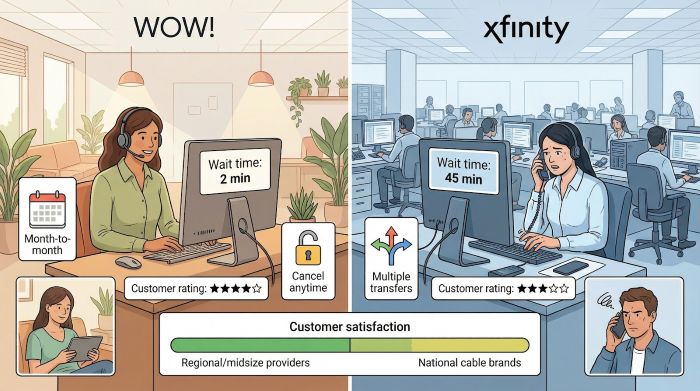
Numbers back up the anecdotes. The 2025 American Customer Satisfaction Index gives Xfinity a score of 69, slightly below the non-fiber industry average of 70; the aggregate score for smaller cable operators, which includes WOW!, lands at 70. J.D. Power’s 2025 residential internet study also ranks regional providers above national cable brands in the South region.
If you dislike haggling or surprise fees, that satisfaction gap matters. Decide whether you prefer the safety of an in-town store and a large workforce or a leaner team that banks its reputation on each call. Your tolerance for customer-service friction can tip the scales as surely as any speed tier.
Conclusion
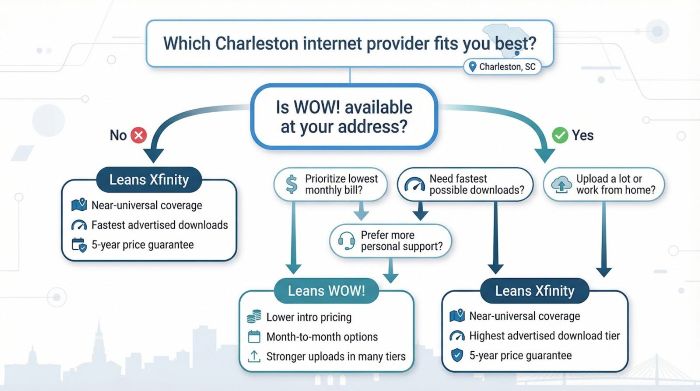
Your final choice for the fastest broadband hinges on address-level availability, desired speeds, and comfort with each provider’s support style. WOW! holds the clear price edge if your home falls inside its network, while Xfinity delivers near-universal coverage and the highest advertised download tier. With unlimited data and equipment now included by default, either service can meet Charleston households’ everyday needs; the better fit simply depends on which strengths matter most to you.