
Introduction: The Platform Engineering Movement
Platform engineering has emerged as the next evolution of DevOps, addressing challenges that surfaced as organizations scaled their DevOps practices. While DevOps successfully broke down silos between development and operations, many implementations have created new problems: cognitive overload as developers manage increasingly complex toolchains, inconsistency as teams make different infrastructure choices, and duplication of effort as every team builds similar capabilities independently.
Platform engineering is quickly moving from an emerging concept to an industry standard. According to Gartner, by 2026, approximately 80% of software-developing organizations will have established platform engineering initiatives. This projection reflects a significant shift in how companies approach software delivery. Rather than relying on fragmented DevOps practices, organizations are investing in internal developer platforms that standardize infrastructure, improve developer experience, and accelerate release cycles.
Platform engineering addresses these challenges by creating internal developer platforms (IDPs) that abstract away infrastructure complexity through self-service interfaces. Development teams get the autonomy they need without the burden of managing underlying infrastructure. Operations teams standardize on proven patterns without constraining innovation. The result is faster delivery, improved reliability, and happier developers.
This comprehensive guide explores platform engineering the principles, practices, and technologies that enable organizations to build effective internal platforms. Whether you are starting your platform journey or enhancing existing capabilities, these principles will help you create developer experiences that accelerate software delivery.
Table of contents
- Introduction: The Platform Engineering Movement
- The Problem Platform Engineering Solves
- Internal Developer Platforms
- Platform Team Structure
- Golden Paths
- Developer Experience
- Platform Architecture
- Security in Platform Engineering
- Measuring Platform Success
- Common Pitfalls
- Building Your Platform
- The Platform Engineering Ecosystem
- Conclusion: Platforms as Enablers
The Problem Platform Engineering Solves
Understanding the challenges that drove the emergence of platform engineering helps contextualize its value.
| Challenge | DevOps Reality | Platform Engineering Solution |
| Cognitive Load | Developers must understand the entire stack | Abstraction through golden paths |
| Toolchain Complexity | Many tools, steep learning curves | Unified developer experience |
| Inconsistency | Every team builds differently | Standardized patterns and templates |
| Duplicated Effort | Teams solve the same problems repeatedly | Shared platform capabilities |
| Operational Burden | Developers manage production systems | The platform team handles infrastructure |
Internal Developer Platforms
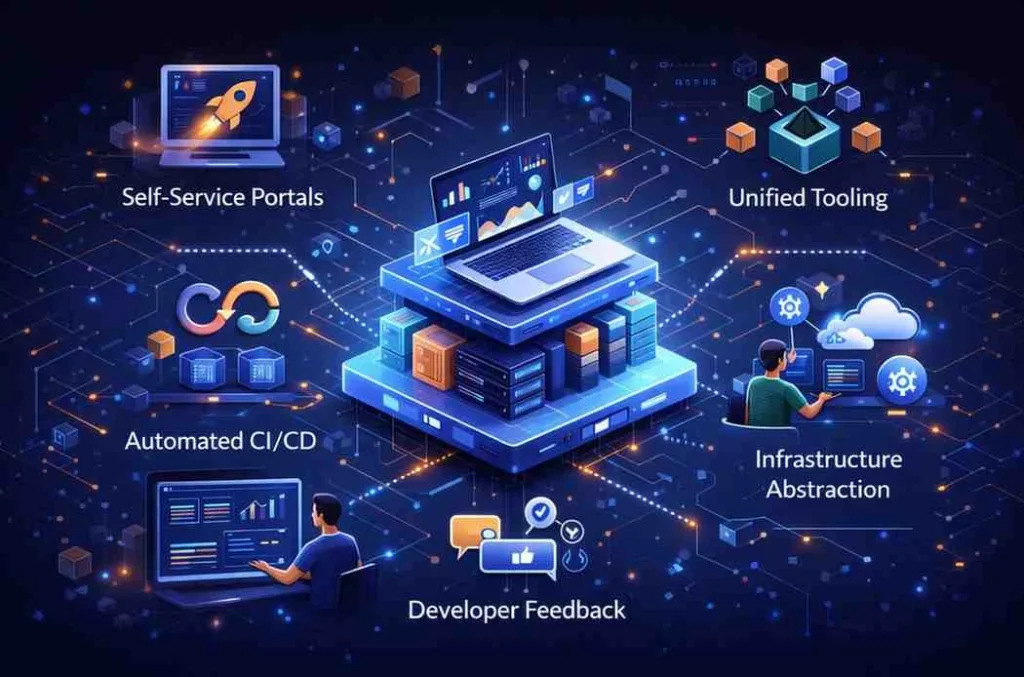
An Internal Developer Platform provides self-service capabilities that enable developers to build, deploy, and operate applications without deep infrastructure expertise.
Core IDP Capabilities
- Application scaffolding generating project templates
- Environment provisioning, creating development and production infrastructure
- Deployment automation managing release processes
- Observability integration provides monitoring and logging
- Service catalog documenting available capabilities
Building effective internal platforms requires deep infrastructure expertise and operational excellence. Organizations benefit from partnering with experienced platform and infrastructure specialists who have built platforms at scale and understand both the technical patterns and organizational dynamics that determine platform success.
Platform Team Structure
Platform teams serve internal customers and development teams and must balance standardization with flexibility to meet diverse needs.
| Role | Responsibility | Skills |
| Platform Product Manager | Roadmap, prioritization, stakeholder management | Product thinking, communication |
| Platform Engineers | Build and maintain platform capabilities | Infrastructure, automation, programming |
| Developer Advocates | Support adoption, gather feedback | Communication, empathy, and technical depth |
| SRE/Reliability | Ensure platform reliability | Operations, monitoring, and incident response |
Product Mindset
Successful platforms treat developers as customers. Platform teams apply product management principles, understand user needs, prioritize based on value, and continuously improve based on feedback.
Golden Paths
Golden paths are pre-configured, well-supported routes for common development scenarios. They encode best practices into templates and workflows that developers can adopt with confidence.
- Application templates with security and observability built in
- CI/CD pipelines with standardized stages and quality gates
- Infrastructure patterns for common deployment scenarios
- Documentation and examples enabling self-service
Developer Experience
Developer experience (DevEx) measures how effectively developers can work within the platform. Good DevEx reduces friction, accelerates onboarding, and improves satisfaction.
| DevEx Dimension | Indicators | Improvement Strategies |
| Cognitive Load | Learning curve, mental effort | Abstraction, documentation, conventions |
| Flow State | Uninterrupted productive work | Fast feedback, reliable tools |
| Feedback Loops | Time to understand the impact | Preview environments, fast tests |
| Self-Service | Independence from bottlenecks | Automation, portals, APIs |
| Documentation | Findable, accurate information | Docs as code, examples, tutorials |
Platform Architecture
Platform architecture determines how capabilities are exposed to developers and how they integrate with existing tools and processes.
Architecture Patterns
- API-first design enabling integration and automation
- Modular components that can evolve independently
- GitOps principles for declarative configuration
- Kubernetes as a common runtime abstraction
- Service mesh for consistent networking and security
Security in Platform Engineering
Platforms must embed security into the developer experience, making secure choices the easy choices.
- Security scanning integrated into CI/CD pipelines
- Policy as code enforcing security requirements
- Secure defaults in templates and configurations
- Secrets management integrated into deployment
Platforms should integrate automated security assessment capabilities that continuously scan applications and infrastructure, providing developers with security feedback without requiring security expertise.
Measuring Platform Success
Platform value must be demonstrated through metrics that matter to the business.
| Metric Category | Examples | What It Measures |
| Adoption | Teams onboarded, services deployed | Platform reach |
| Developer Velocity | Deployment frequency, lead time | Delivery speed |
| Reliability | Change failure rate, MTTR | Quality outcomes |
| Developer Satisfaction | NPS, survey results | Developer experience |
| Efficiency | Time saved, cost per deployment | Operational value |
Common Pitfalls
Platform engineering efforts can fail for predictable reasons.
- Building without developer input platforms nobody wants
- Over-engineering complexity that exceeds value
- Mandating adoption resistance instead of embracing
- Neglecting documentation capabilities, nobody can use
- Ignoring existing tools disrupting productive workflows
Building Your Platform

Successful platforms evolve iteratively, guided by real developer needs rather than internal assumptions. The first step is understanding developer pain points where workflows slow down, integrations create friction, or repetitive tasks waste time. Clear insight into these challenges ensures the platform solves real problems rather than adding unnecessary complexity.
Next, begin with high-value, low-complexity capabilities. Early features should deliver immediate impact, such as simple APIs, automation tools, or streamlined onboarding experiences. Quick wins build trust, encourage adoption, and create momentum without overwhelming engineering resources.
Establishing continuous feedback loops is equally important. Engage developer customers through community channels, analytics, beta programs, and direct conversations. This ensures the platform roadmap remains aligned with actual usage and evolving needs.
Iteration should be driven by adoption and satisfaction data. Monitor feature usage, retention rates, and developer feedback to refine what works and improve or remove what does not. This disciplined approach prevents feature bloat and keeps the platform focused on value.
As the platform matures, capabilities can strategically expand to include advanced integrations, analytics, automation, and ecosystem partnerships. Growth should follow stability and demand, ensuring that expansion strengthens the foundation rather than complicating it.
The Platform Engineering Ecosystem
A growing ecosystem of tools supports platform engineering initiatives.
- • Backstage for developer portals and service catalogs
- • Crossplane and Terraform for infrastructure abstraction
- • ArgoCD and Flux for GitOps delivery
- • Kubernetes operators for custom resource management
- • Open Policy Agent for policy enforcement
Conclusion: Platforms as Enablers
Platform engineering represents a maturation of DevOps principle, recognizing that developer productivity requires curated experiences rather than unbounded complexity. Effective platforms multiply developer capabilities while maintaining consistency and governance.
Success requires treating platforms as products, with developer customers whose needs drive roadmaps. The investment pays dividends through faster delivery, improved reliability, and developers who can focus on building business value rather than wrestling with infrastructure.
Build your platform with developers in mind. The productivity gains will transform your software delivery capabilities.