In the professional landscape of 2026, the home office has transitioned from a convenience to a critical network node. The surge in decentralized workloads including local AI model training, high-frequency crypto trading, and complex home lab management—has exposed the fundamental vulnerability of residential power grids. Unlike the hardened infrastructure of corporate data centers, home power lines are subject to frequent micro-fluctuations. These sags and surges affecting digital continuity, often lasting only milliseconds, are the primary cause of modern hardware failure and catastrophic data corruption.
For the high-performance professional, digital continuity is no longer a matter of simply “staying online.” It is about protecting the integrity of local silicon and ensuring that automated systems remain operational even when the grid fails. This requires a shift from passive surge protection to hardware-integrated power management designed for intelligent communication between the energy source and the operating system.
Table of contents
Eliminating Data Corruption in NAS and High-Performance Home Labs
For software developers, crypto node operators, and 8K content creators, the greatest risk during a power event is not the loss of light, but the corruption of the file system. Modern high-speed storage arrays and RAID configurations are notoriously sensitive to abrupt power losses. When power is cut during a write-cycle, the result is often fragmented databases, corrupted operating system kernels, or hours of parity rebuilding that can paralyze a professional workflow.
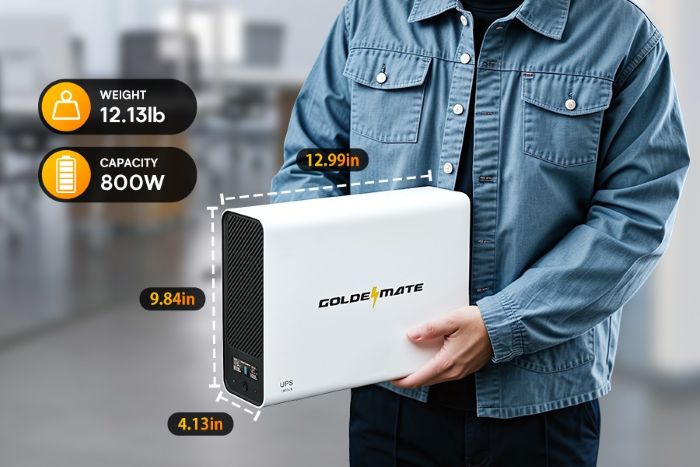
The technical solution for this high-demand scenario is the deployment of a lifepo4 ups with a dedicated NAS interface. Unlike conventional backups that merely offer raw battery power, this 1000VA/800W system acts as a smart peripheral. Through a specialized communication port, the unit speaks directly to your Network Attached Storage (NAS) or local server.
When a power event occurs, the UPS doesn’t just hold the line; it initiates an automated, graceful shutdown protocol. It signals the OS to park drive heads, close active databases, and cache all pending data safely before the battery is depleted. This level of automation is essential for SOHO (Small Office/Home Office) enthusiasts who may be away from their desks during an outage but cannot afford a “hard” system crash. By utilizing Lithium Iron Phosphate technology, the system also ensures that the voltage remains rock-steady until the very last second of discharge, preventing the “voltage droop” that often plagues legacy lead-acid units.
Solving Space Constraints in Security Systems and Minimalist Desk Setups
A recurring challenge for modern urban professionals and security installers in 2026 is the “space tax” imposed by industrial-grade backup systems. Traditional UPS units are notoriously bulky, heavy, and aesthetically intrusive, making them difficult to integrate into minimalist “Dream Desk” setups or cramped equipment closets. Furthermore, home security (CCTV) installers often face the problem of finding a flat, ventilated surface near high-mounted routers, POE switches, or NVR enclosures.
To solve the conflict between space management and hardware protection, the optimal choice is a lithium ups battery backup designed with a slim form factor. This 600VA/360W hardware is engineered for flexibility, featuring integrated wall-mounting slots that allow the unit to be tucked away behind a monitor, mounted inside a network cabinet, or hidden under a desk.
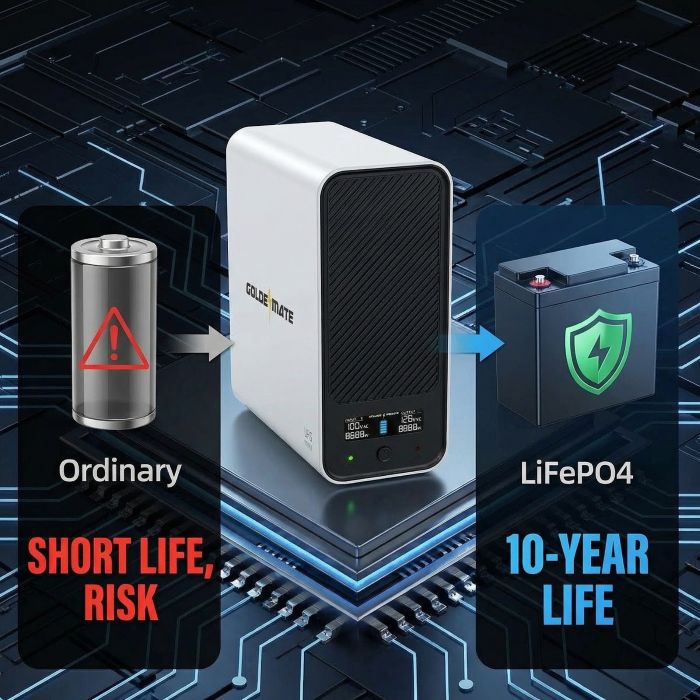
The use of LiFePO4 chemistry is the engineering breakthrough here. It allows for a higher energy density in a much smaller footprint compared to traditional batteries. Additionally, these units offer superior thermal stability. In 2026, where home network closets are often tightly packed with high-heat gear like fiber-optic ONTs and multi-gigabit switches, the fire-safe and cool-running nature of lithium iron phosphate is a critical safety differentiator. It eliminates the bi-annual maintenance cycle of checking for lead-acid battery swelling, providing a “set it and forget it” solution for essential connectivity and home security.
The ROI of Technical Resilience: Beyond the Battery
Investing in professional-grade power solutions for digital continuity in 2026 is an exercise in risk mitigation. When auditing a home setup, professionals must look at the specific failure points of their equipment. High-end workstations equipped with 1000W+ Active PFC power supplies are particularly sensitive to “dirty power.” When the incoming voltage dips below a certain threshold, the PSU’s internal protection will trigger a hard-reset to prevent internal damage. Without a Pure Sine Wave UPS, your hardware is effectively being hit with a “miniature earthquake” every time the neighborhood grid fluctuates.
The shift to LiFePO4 technology addresses the three most common “Solution Barriers” in power management:
- Life Cycle Longevity: While lead-acid backups typically fail after 200–300 cycles (or 2 years of shelf life), LiFePO4 cells are rated for over 5,000 cycles. This aligns the lifespan of your power backup with the lifespan of your computer hardware, offering a 10-year operational window.
- Fast Recovery: In areas prone to “rolling” outages or seasonal storms, the ability to recharge quickly is vital. Modern lithium systems can reach 80% charge in a fraction of the time it takes for legacy systems, ensuring your home lab is protected against back-to-back power events.
- Active Power Conditioning: These units do not just sit idle until an outage occurs. They actively “clean” the incoming electricity, filtering out the electrical noise generated by nearby appliances and electric vehicle chargers, which significantly extends the life of your high-end PC’s internal capacitors.
Implementing Your Digital Continuity Strategy
To future-proof your hybrid setup for the remainder of 2026, the implementation strategy should be based on the “Critical Path” of your data.
- For the Data Core: If you manage a local AI node, a crypto mining rig, or a media server, the 1000VA model with its NAS communication protocol is the only logical choice. It solves the problem of human error by automating the shutdown process.
- For the Connectivity Layer: If your goal is to keep the Wi-Fi, the smart home hub, and the security cameras alive without ruining your office aesthetics, the wall-mountable 600VA unit provides the necessary bridge.
Conclusion: Dominating the Grid with Intelligent Power
The freedom of the hybrid work era comes with the responsibility of maintaining your own uptime. We can no longer rely on aging municipal grids to provide the “clean” energy required by 2026-era high-fidelity electronics. Strategic resilience is about isolating your hardware from the instability of the outside world.
Whether you are preventing a database rebuild with a lifepo4 ups or securing your minimalist workspace with a lithium ups battery backup, you are making a calculated investment in your professional reputation. In a world where “offline” is not an option, taking control of your power foundation with digital continuity is the single most important upgrade you can make for your digital future.