Fast, reliable business internet keeps Georgia businesses moving. Whether you’re ringing up sales in a Savannah boutique or syncing CAD files in an Atlanta lab, you need solid bandwidth and Wi-Fi that reaches every corner.
Half of the state can now tap symmetrical fiber, and most other addresses still hit 100 Mbps via cable or 5 G. Great—until you have to untangle promo prices, contracts, and hardware options.
We built this guide to save you hours. Inside, you’ll find ten providers ranked by speed, coverage, managed-Wi-Fi quality, reliability, value, and support—plus a quick-scan comparison table.
Key Takeaways
- Georgia businesses can access various high-speed business internet options, including fiber and cable plans.
- The guide ranks ten providers based on speed, coverage, reliability, and support, along with a comparison table.
- Providers like AT&T and WOW! offer competitive packages without hidden fees, enhancing transparency.
- Managed Wi-Fi quality influences rankings as most businesses require reliable networking solutions.
- Consider contract terms and service availability to find the best fit for your specific business needs.
Table of contents
- At A Glance: Georgia’s Business-Ready Internet Bundles
- How We Ranked Georgia’s Business Internet Bundles
- 1. Wow! Business: Whole-Business Internet Wi-Fi for Worry-Free Coverage
- 2. At&T Business: Statewide Fiber Power at Straight-Up Prices
- 3. Comcast Business Internet: Feature-Rich Cable for Metro Workloads
- 4. Spectrum Business: No-Contract Speed with A Mobile Bonus
- 6. 5 G Fixed Wireless: Instant Setup from T-Mobile and Verizon
- 7. Cox Business Internet: Cable Workhorse for Middle Georgia
- 8. Mediacom Business: Budget Gigabit for South Georgia
- 9. Google Fiber: Lightning-Fast Yet Neighborhood-Locked
- 10. Earthlink: Statewide Choice When Others Say “Unavailable”
- Conclusion
At A Glance: Georgia’s Business-Ready Internet Bundles
You asked for facts first and details later. This table delivers.
Use the rows to check which providers can reach your address, their top speeds, entry rates, contract terms, and whether managed Wi-Fi comes built in or as an add-on. If two or more providers serve your street, the contract column often breaks the tie.

| Provider | Service type | Top speed (down/up) | Entry price* | Contract | Managed Wi-Fi |
| WOW! Business | Cable (fiber-backed) | 1.2 Gbps / 50 Mbps | $25–$70 | 1-year promo, then month-to-month | Whole-Business WiFi ($19.99) |
| AT&T Business | Fiber / DSL fallback | 5 Gbps / 5 Gbps | $70 | None | Gateway included; extenders optional |
| Comcast Business | Cable | 1.25 Gbps / 35 Mbps | $69 (50 Mbps) | 2-year | WiFi Pro add-on |
| Spectrum Business | Cable | 1 Gbps / 35 Mbps | $65 (500 Mbps) | None | Advanced WiFi (extra) |
| Windstream Kinetic | Fiber / VDSL | 2 Gbps / 2 Gbps | ~ $90 (500 Mbps) | Typically none | Managed router / mesh optional |
| Verizon 5G Business | Fixed wireless | 400 Mbps / 50 Mbps | $69 (100 Mbps) | None | Wi-Fi gateway included |
| T-Mobile Business Internet | Fixed wireless | 300 Mbps / 30 Mbps | $50 | None | Wi-Fi gateway included |
| Cox Business | Cable | 1 Gbps / 35 Mbps | $80 (100 Mbps) | 1–3 years | Secure WiFi add-on |
| Mediacom Business | Cable | 1 Gbps / 50 Mbps | $30–$99 | 1–2 years | Standard modem; router rental |
| Google Fiber Business | Fiber | 2 Gbps / 2 Gbps | $100 (1 Gbps) | None | Wi-Fi 6 router included |
*Published or widely advertised promotional pricing, Georgia markets, January 2026. Confirm any final quotes, taxes, and fees with the provider.
A quick look at the grid usually sparks two questions:
- Who can actually reach my building?
- Do I care more about no-contract freedom or the lowest promo rate?
Keep those answers in mind as we walk through each provider—you’ll land on the bundle that fits both your budget and your bandwidth needs.
How We Ranked Georgia’s Business Internet Bundles
Transparency matters. You deserve to know why one provider lands higher than another, so we built a scoring model that mirrors the questions business owners ask us every week.
Speed sits at the top. Fiber and multi-gig tiers earn the most points, followed by modern cable and then 5 G wireless. Raw download numbers are helpful, but symmetrical uploads and low latency carry extra weight because they protect video calls and cloud backups.
Coverage comes next. A fast plan is worthless if it stops six blocks short of your storefront. We add points for networks that reach both metro corridors and rural counties.
Managed Wi-Fi quality also matters. Georgia’s small offices rarely have full-time IT staff. Providers that ship a Wi-Fi 6 gateway, mesh nodes, or cloud management — and keep them patched — climb the rankings because they spare you weekend router reboots.
Reliability and support follow close behind. We compare uptime claims, backup options, and repair commitments with customer-satisfaction data. Spectrum, for example, finished first among small businesses in the latest J.D. Power study, while AT&T topped the large and medium segments. Those scores show which help desks answer the phone.
Price and contract flexibility round out the model. We reward honest, published rates and the freedom to walk away without penalties. Promotional bargains still count, but long-term value counts more.
Finally, we note bundle extras such as static IPs, security suites, and phone or mobile discounts that save you shopping time.
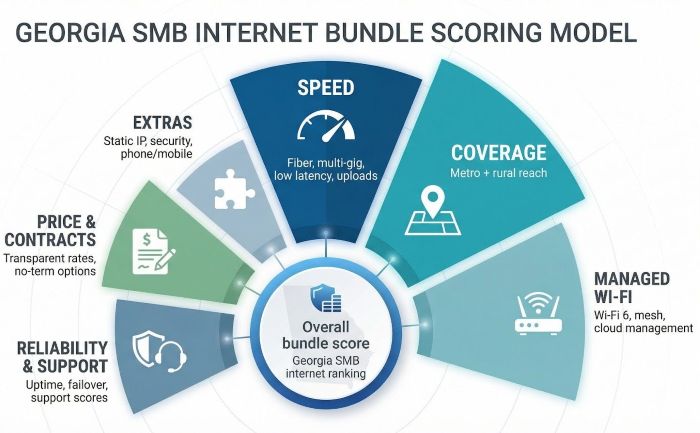
Add it up and you get the top-ten order in the sections that follow.
1. Wow! Business: Whole-Business Internet Wi-Fi for Worry-Free Coverage
If your company sits inside WOW!’s Georgia footprint (Columbus, Newnan, West Point, and nearby suburbs), you can tap one of the most cost-friendly bundles in the state.
WOW! delivers cable internet at fiber-backed speeds up to 1.2 Gbps, yet the entry tier stays affordable. In some markets, the 300 Mbps plan starts around twenty-five dollars a month, beating every large incumbent. Powered by eero mesh technology, WOW!’s whole business Wi-Fi solutions start at just $19.99 and include two nodes that pair with the provider’s modem for seamless coverage—no IT contractor required.
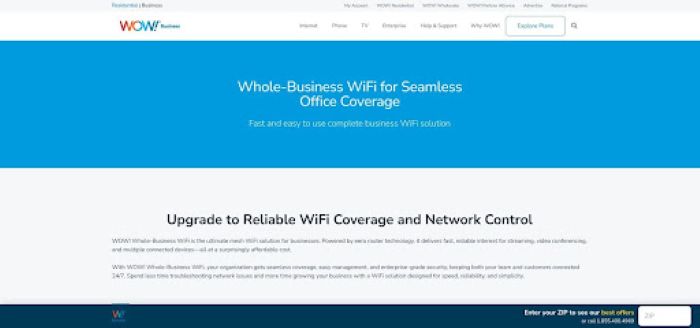
WOW! Business whole-business Wi-Fi solutions webpage screenshot
The mesh hardware pushes automatic security updates, sets up a separate guest network with a single QR scan, and lets you monitor traffic from a phone app. That trio fixes dead zones, firmware gaps, and awkward guest passwords in one move.
Speed holds steady. Uploads cap near fifty megabits on the gig tier, but most retail and professional workflows never feel that ceiling. Cafés running cloud POS systems or creative studios sending big files overnight ride a fiber-fed backbone that rarely flinches.
Customer support closes the deal. A smaller provider means shorter hold times, and field techs live in the same communities they serve. Add free installation, a brief promo term, and a 60-day satisfaction guarantee, and WOW! offers strong, worry-free value.
Ideal fit: small or midsize businesses inside WOW!’s coverage map that want “set-and-forget” Wi-Fi plus gig-class speed without a big-brand price tag.
2. At&T Business: Statewide Fiber Power at Straight-Up Prices
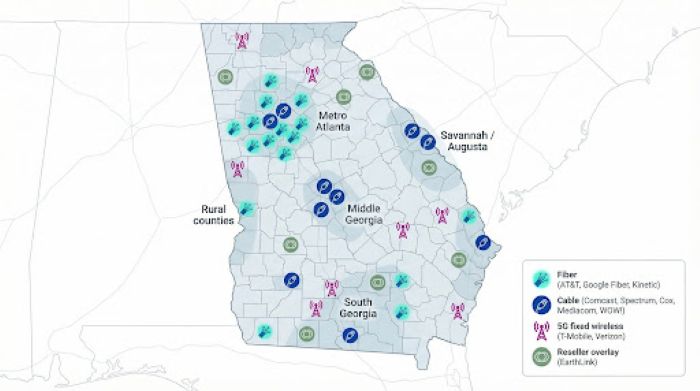
AT&T tops every Georgia coverage chart. Copper lines still cross rural counties, but fiber now drives the story: multi-gig strands reach more than half of addresses, giving downtown law firms and small-town clinics symmetrical speeds up to 5 Gbps.
Pricing stays plain. The 300 Mbps fiber tier lists at $70, installation waived, equipment included, and month-to-month billing from day one. There’s no “promo ends in 12 months” surprise, so your budget avoids year-two sticker shock.
Wi-Fi arrives out of the box. AT&T ships a Wi-Fi 6 gateway that splits private and guest networks with one toggle. Need broader coverage? Add mesh extenders or switch to the company’s managed Wi-Fi service for hands-off monitoring. Either way, you skip the weekend router hunt at a big-box store.
Reliability keeps pace. Fiber plans carry a 99.9 percent uptime target and LTE failover on select tiers, so cloud calls roll on if a backhoe cuts a line. Business owners notice: the latest J.D. Power study shows AT&T leading midsize and large-business satisfaction across the South, proof that the help desk picks up fast.
Ideal fit: any Georgia company on an AT&T fiber-lit street, especially those pushing large uploads to the cloud or insisting on a bill that never hides fees.
3. Comcast Business Internet: Feature-Rich Cable for Metro Workloads
Metro Atlanta hums on Comcast’s hybrid fiber-coax network. If your office sits inside that footprint, Comcast Business gives you downloads up to 1.25 Gbps and a stack of useful extras.
Packages start around $70 for 50 Mbps, but most owners step up to the 100 or 250 tiers because the cost jump is small and the headroom large. Every plan includes unlimited data, so nightly cloud backups never cause surprise fees.
Comcast’s default gateway offers reliable Wi-Fi 5 coverage. Upgrade to the WiFi Pro add-on and you get cloud-managed access points that carve out private, guest, and IoT networks without digging through settings. Store managers like the branded splash page; IT staff like the live analytics.
Reliability has an optional safety net. Connection Pro adds a cellular modem and flips you to LTE if a squirrel or shovel takes out the main line. It costs extra, yet the first saved lunch rush often covers months of fees.
Trade-offs? Promotional pricing locks you into a two-year contract, and uploads stop at 35 Mbps even on gig plans. Creative teams that push large files both ways may prefer true fiber, but most offices never notice the ceiling.
Ideal fit: data-hungry shops in Comcast territory that want cable speed plus enterprise-style Wi-Fi and automatic failover in one predictable package.
4. Spectrum Business: No-Contract Speed with A Mobile Bonus
Spectrum keeps things simple: fast cable internet, published pricing, and no contracts. In cities like Savannah and Augusta, the base tier now clocks in at 500 Mbps for about $65, hardware included.
That openness wins loyalty. Small-business owners dislike fine print, and Spectrum’s month-to-month model lets you scale or move without exit fees. The strategy works. In the latest J.D. Power report, Spectrum topped the South’s small-business satisfaction chart, edging past larger rivals for customer care and network reliability.
Wi-Fi setup follows the same easy path. Add the Advanced WiFi router to split private and guest networks that auto-update security settings. Want more savings? Bundle a few Spectrum Mobile lines and the company waives your internet charge entirely, a bold move that cuts costs for teams already paying wireless bills.
Speeds peak at 1 Gbps down and 35 Mbps up. That covers point-of-sale, video calls, and cloud storage, but heavy upload workflows may hit the ceiling. Spectrum sells symmetrical fiber under its Enterprise flag for those cases, though pricing climbs.
Ideal fit: shops, restaurants, and remote teams that value contract freedom, clear bills, and the chance to roll mobile and internet into one budget-friendly bundle.
5. Windstream Kinetic: Rural Georgia’s Fiber Comeback
Many small towns once crawled along on an aging DSL. Kinetic changed that by pulling new fiber down county roads from Union to Chattooga, lighting up gigabit service for businesses that had never cracked twenty megabits.
Speeds reach 2 Gbps both ways where fiber is live, and Windstream rolls trucks every quarter to add more glass. If fiber hasn’t landed yet, an upgraded VDSL line still delivers 50 to 100 Mbps, enough for point-of-sale, cameras, and steady video calls until the splice crew arrives.
Equipment stays simple. New installs arrive with a Wi-Fi 6 gateway that secures traffic and covers most storefronts. Larger offices can add mesh extenders or switch to Windstream’s managed router program for hands-off monitoring.
Contracts remain flexible. Business fiber bills month to month with no data caps, and promo pricing sits near $90 for a 500 Mbps tier. Add a digital phone line and the bill often drops by ten dollars, all on one invoice.
Ideal fit: manufacturers, clinics, and home-grown retailers outside the cable grid who need symmetrical speed and appreciate a provider investing locally instead of waiting for grants.
6. 5 G Fixed Wireless: Instant Setup from T-Mobile and Verizon
Sometimes a crew can’t pull cable. Maybe your lease is short, the landlord stalls, or you just opened a pop-up on Peachtree Street and need internet before Friday’s launch party.
That’s when 5 G fixed wireless shines. T-Mobile Business Internet and Verizon 5 G Business Internet each ship a single gateway that plugs into the wall, grabs cellular signal, and starts broadcasting Wi-Fi in about fifteen minutes. No trenching, no appointment windows, no surprise attach fees.
T-Mobile keeps it simple: one plan, $50, unlimited data, and typical speeds between 100 and 300 Mbps. Coverage blankets most Georgia highways and small towns, so if your phone shows solid bars, you’ll likely qualify.

T-Mobile Business Internet official plan page screenshot
Verizon aims at heavier workloads. It offers 100, 200, and 400 Mbps tiers starting at $69. Each plan includes a long-term price lock and, on higher tiers, a pro install that mounts an outdoor antenna for stronger Ultra Wideband signal. Uploads stay near 50 Mbps, enough for surveillance feeds and large cloud uploads.
Both gateways broadcast dual-band Wi-Fi and provide Ethernet ports for point-of-sale or VoIP phones. Many retailers keep a 5 G line as a failover behind their wired service; when a backhoe cuts the main, sales continue over the airwaves.
Limits still apply. Peak speed can drop with tower congestion, and static IP addresses need work-arounds. Even so, for fast-moving businesses or rural shops still waiting on fiber, 5 G fixed wireless supplies reliable, contract-free bandwidth at the speed of setup.
Ideal fit: temporary offices, food trucks, or any storefront that values day-one connectivity and an easy exit option.
7. Cox Business Internet: Cable Workhorse for Middle Georgia
Drive down I-75 and you’ll spot Cox trucks from Macon to Warner Robins. The company owns that corridor, delivering cable internet to offices outside AT&T’s fiber halo that still need more speed than DSL.
Plans range from 100 to 1,000 Mbps. Most clients choose the 200 Mbps tier because it balances price with headroom for cloud point-of-sale, remote desktops, and HD security cameras. Uploads, like other cable lines, stop near 35 Mbps, yet day-to-day tasks rarely hit that ceiling.
Cox likes bundles. Pair Business Internet with two digital phone lines and the monthly bill drops, plus you get a single dashboard for voicemail, call routing, and bandwidth stats. Add Secure WiFi and Cox provides a mesh-ready router that splits guest and staff networks while auto-patching firmware, sparing you late-night RDP sessions.
Contracts run one to three years, but pricing stays steady during the term and install fees often disappear during seasonal promos. Support is local; field techs work from regional hubs and know the quirks of older strip-mall wiring better than most landlords.
Ideal fit: growing firms in Middle Georgia that want dependable cable speed, unified phone options, and service crews able to arrive before the lunch rush becomes a lobby Wi-Fi complaint.
8. Mediacom Business: Budget Gigabit for South Georgia
Head south of Macon and cable choices thin out fast. That’s where Mediacom steps in, wiring towns like Valdosta, Albany, and Thomasville with coax that reaches 1 Gbps down and 50 Mbps up.
Price is the hook. Promo offers often start near $30 for a 200 Mbps plan and stay under $100 for full gigabit, installation waived. Residential tiers carry data caps, but business circuits ship unlimited, so you can stream security cameras all day without eyeing a meter.
Hardware stays straightforward. A standard modem costs nothing; lease a router or plug in your own gear. If you prefer turnkey wireless, Mediacom will rent a mesh-ready gateway and handle firmware updates, though tech-savvy owners often bring their own equipment to stretch coverage.
Support has improved alongside network upgrades. Local crews monitor nodes for congestion and schedule overnight maintenance, so daytime slowdowns rarely creep in. You’ll sign a one- or two-year term to lock promo rates, but that steadiness helps small firms plan cash flow without a month-thirteen shock.
Ideal fit: budget-minded entrepreneurs in South Georgia who need fast downloads for cloud apps and marketing uploads but can trade extra upload speed for a lower bill.
9. Google Fiber: Lightning-Fast Yet Neighborhood-Locked
Google Fiber lands late on our list only because of geography. The service threads through select pockets of metro Atlanta, and if your office ZIP code falls inside the map, you’ll tap one of the fastest, simplest connections in the country.
Plans are easy to remember. One-gig symmetrical costs a flat $100, while two-gig runs $250. No contracts, no data caps, no equipment fees. The included Wi-Fi 6 router covers most open-plan suites; add a mesh point and you’ll blanket multi-story lofts without breaking a sweat.
Performance borders on excess. Median customer downloads hover near 300 Mbps in real-world tests; that’s far above statewide cable averages and enough to upload massive video files while ten colleagues stream 4 K webinars. Latency stays low, a plus for gamers turned startup founders and creative teams pushing edits to the cloud in real time.
Support keeps the minimalist vibe. A mobile app handles install scheduling, outage alerts, and Wi-Fi tweaks. Techs show up on time, drill once, tidy cables, and head out. Bills never jump in year two because promo pricing doesn’t exist.
Coverage is the catch. If Google hasn’t trenched your block yet, you wait. Expansion crews add streets every quarter, but fiber construction favors high-density corridors first. Check availability, and if the address checker flashes green, sign up before the truck moves on.
Ideal fit: design agencies, production houses, and data-heavy startups lucky enough to work in a Google-lit Atlanta neighborhood.
10. Earthlink: Statewide Choice When Others Say “Unavailable”
You run the address checkers and strike out with the big brands. That’s when EarthLink belongs on your shortlist.
EarthLink doesn’t own last-mile lines; instead, it resells access across AT&T, Comcast, Spectrum, and several regional carriers. The result is coverage that reaches about 83 percent of Georgia business locations. If any major network passes your doorway, EarthLink can usually turn up service.
Plans mirror the underlying tech. Fiber addresses see symmetrical tiers from 300 Mbps to 5 Gbps. Cable markets top out near 1 Gbps down and 35 Mbps up. Prices stay competitive with the incumbents and often arrive contract-optional, a welcome twist when the original carrier demands a multi-year term.
Service is the differentiator. Because the internet is EarthLink’s only product, the support team lives and dies by response time. Calls route to U.S. agents who manage ticket hand-offs with the infrastructure owner, sparing you a maze of carrier directories. Static IPs, domain email, and basic security tools slide into the bundle at checkout, making EarthLink a quiet favorite among freelancers and remote-first startups.
Limits come from physics, not policy. If the underlying line is cable, uploads stay cable. If the local fiber hub is full, install dates stretch. EarthLink works the phones on your behalf but can’t rewrite a carrier’s build schedule.
Ideal fit: businesses that keep hitting “not available” pop-ups on carrier sites or just want a single point of contact for connectivity instead of juggling multiple vendor portals whenever a work order appears.
Conclusion
Georgia businesses have more high-speed options for business internet than ever. Check availability at your address, weigh contract terms against promo rates, and match managed-Wi-Fi features to your team’s workload to land the bundle that keeps your operations running smoothly.