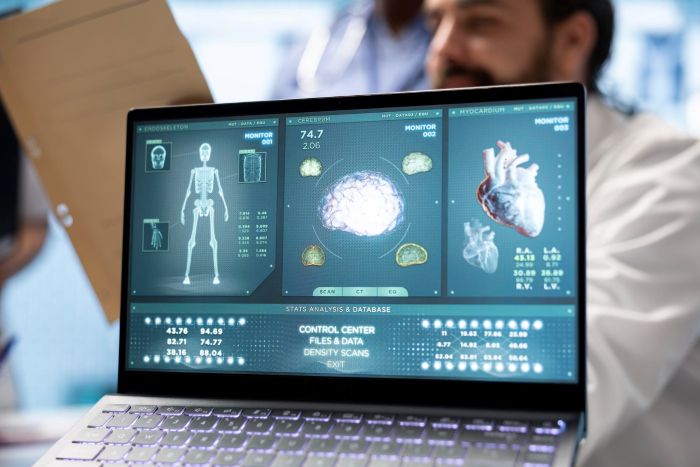
The healthcare industry is undergoing a dramatic transformation, fundamentally reinventing patient care. For decades, medical care has been reactive. Patients sought help only when symptoms appeared, and doctors prescribed treatments after a problem had already developed. Today, AI in healthcare and remote patient monitoring are rewriting that scenario.
Powered by artificial intelligence, wearable health devices, and connected data systems, modern medicine is shifting toward prevention, prediction, and personalized care. We’re entering a new era of digital health solutions that combine technology, real-time insights, and human compassion to deliver smarter, faster, and more proactive patient care.
Key Takeaways
- AI in healthcare transforms patient care from reactive to proactive, focusing on prevention and personalization.
- Connected devices enable remote patient monitoring, allowing real-time data analysis and early intervention for better outcomes.
- AI systems personalize healthcare by analyzing vast amounts of patient data, leading to tailored treatment plans.
- Telemedicine extends healthcare to patients’ homes, improving access and quality while reducing costs.
- AI empowers patients by providing direct access to health data, enhancing their involvement in care decisions.
Table of contents
The Rise of Connected and Intelligent Care
The foundation of remote patient monitoring lies in connected devices. What started as simple fitness trackers has evolved into tools capable of measuring heart rate, oxygen levels, glucose, blood pressure, and even sleep quality. The data collected from these devices is the backbone of AI-driven healthcare analytics.
Artificial intelligence algorithms can process this information in real time and identify subtle patterns that might escape human notice. Instead of waiting for symptoms to worsen, AI health monitoring systems alert doctors to early warning signs and allow timely intervention, effectively reinventing patient care through early detection.
For instance, a patient with heart disease can wear a smartwatch that continuously tracks cardiac rhythm. AI models analyze the data and send alerts if irregularities suggest a potential arrhythmia or heart failure episode. This predictive capability helps clinicians act early, adjusting medication or recommending a quick check-up before hospitalization becomes necessary.
Personalization Powered by AI In Healthcare
Traditional healthcare often struggles to provide individualized treatment at scale. Doctors face time constraints, and analyzing vast amounts of patient data manually is nearly impossible. AI in healthcare systems changes that.
Using machine learning and big data, AI platforms can study millions of patient records to identify what treatments, medications, and lifestyle changes yield the best results for specific populations. This knowledge enables deeply personalized healthcare plans.
Take diabetes management as an example. Two patients with the same diagnosis may have very different responses to food, exercise, or stress. Through AI-based remote monitoring, algorithms learn their unique behaviors and predict when blood sugar spikes or drops may occur. Instead of one-size-fits-all advice, each patient receives tailored recommendations, from dietary adjustments to insulin dose timing, all based on real-time data insights.
Reinventing Patient Care: From Hospital Walls to Home Healthcare
The convergence of telemedicine and remote patient monitoring has given rise to what some call “hospitals without walls.” This concept means quality care is no longer restricted to medical facilities. It can now extend directly into the patient’s home.
During the COVID-19 pandemic, remote healthcare solutions proved indispensable, allowing doctors to monitor patients while minimizing exposure risk. Since then, this approach has evolved into a fundamental component of modern healthcare delivery.
Home-based sensors can transmit vital signs instantly to clinicians, while AI-driven remote care platforms filter and prioritize data to highlight only the most critical cases. As a result, healthcare providers spend less time reviewing irrelevant information and more time addressing real patient needs. This shift is reinventing patient care by making high-level monitoring accessible anywhere.
This approach improves outcomes, reduces hospital admissions, and lowers healthcare costs, a clear win for both patients and health systems.
Empowering Patients Through Digital Health
What makes AI and remote health monitoring truly revolutionary is not just what it does for clinicians, but how it empowers patients. When individuals have direct access to their health data, through wearable health devices or connected mobile apps, they become active participants in their own care.
An AI-powered health app might remind users to stay hydrated, adjust diet patterns based on activity data, or nudge them to take a walk when it detects prolonged inactivity. For people with chronic conditions, this level of awareness can prevent complications and improve daily quality of life.
For families, especially those caring for elderly relatives, remote monitoring provides peace of mind. Smart sensors can detect changes in heart rate or motion and automatically alert caregivers if something seems wrong. It’s a simple example of how AI in remote healthcare can make life safer, more independent, and more connected.
Addressing Challenges in AI and Healthcare Technology
As healthcare embraces AI and connected tools, there are critical challenges to navigate around data security, reliability, and ethical AI use.
- Data privacy and security: Patient health data is highly sensitive. Advanced encryption, secure cloud systems, and strict regulatory compliance (like GDPR and HIPAA) are essential for maintaining trust.
- Algorithm transparency: AI predictions are only as accurate as the data they’re trained on. Healthcare organizations must ensure algorithms are tested across diverse populations to avoid bias.
- Human oversight: Technology should support, not replace, healthcare providers. Doctors remain central in interpreting AI insights, applying context, and offering the empathy only humans can provide.
When integrated responsibly, AI-powered healthcare technology enhances, not replaces, the human touch.
The Future Of AI-Driven Healthcare
The potential of AI and remote patient monitoring extends far beyond chronic disease management. Predictive analytics could soon detect early signs of neurological disorders, mental health concerns, and even infectious outbreaks. Combining AI diagnostics with genomic data and lifestyle information could create fully interconnected health profiles that evolve with each patient.
Imagine a world where wearable devices communicate directly with your doctor’s digital dashboard, offering daily updates about your heart, stress levels, and sleep. AI algorithms analyze these inputs continuously, detect anomalies, and send personalized recommendations or alerts, creating a continuous care loop with minimal friction.
Final Word
The partnership between AI in medicine and remote monitoring represents a shift from traditional, symptom-based care to continuous, preventive healthcare. It’s a model where small data-driven adjustments lead to big improvements in patient health.
For patients, it means earlier intervention, fewer emergencies, and more control over their wellbeing. For healthcare providers, it means greater efficiency and the ability to deliver personalized, data-driven care at an unprecedented scale. And for society, it signals a more sustainable healthcare system capable of managing aging populations and chronic diseases more effectively.
AI and remote monitoring are not just adding technology to medicine. They are reinventing patient care and rewriting what it means to care for patients. The future of healthcare is smarter, more connected, and more human than ever before.