When it comes to oral health, the use of fluoride toothpaste has been widespread and continues to be used for cavity prevention, teeth strengthening, and overall dental care. However, over the past few years, advances in oral teach brough hydroxyapatite toothpaste as a new rival.
Now, the Hydroxyapatite has drawn a lot of attention for oral health. It is due to its potential remineralization effect and its softer yet effective status as a fluoride alternative.
Key Takeaways
- Hydroxyapatite toothpaste offers a fluoride-free alternative for cavity prevention and enamel remineralization.
- Nano hydroxyapatite toothpaste penetrates deeper into enamel, enhancing strength and reducing sensitivity.
- Users report positive outcomes, including improved tooth health and less sensitivity with hydroxyapatite toothpaste.
- Some brands, like Boka and Risewell, provide effective hydroxyapatite toothpaste options suitable for various needs.
- Consult your dentist to determine whether hydroxyapatite or fluoride toothpaste is appropriate for your daily oral care.
Table of Contents
- What Is Hydroxyapatite Toothpaste?
- Hydroxyapatite Toothpaste Benefits
- Fluoride vs Hydroxyapatite: How Do They Compare?
- Hydroxyapatite vs. Fluoride: Key Performance Metrics
- Fluoride or Hydroxyapatite Toothpaste: Which Should You Choose?
- Best Hydroxyapatite Toothpaste Brands
- Tips for Choosing the Best Nano Hydroxyapatite Toothpaste
- Where to Get Hydroxyapatite Toothpaste
- Hydroxyapatite Toothpaste Reviews and What Users Say
- Is Hydroxyapatite Toothpaste Better for Everyday Dental Care?
- Conclusion
- FAQs
What Is Hydroxyapatite Toothpaste?
Hydroxyapatite (HAP) is a mineral that is naturally found and comprises approximately 97% of your tooth enamel and 70% of your dentin. It is a type of calcium-phosphate which makes teeth strong and structured. Synthetic hydroxyapatite is a substitute for this natural component in toothpaste. It helps repair and protect enamel.
There are two primary forms:
- Nano hydroxyapatite toothpaste: Smaller particles (less than 100 nanometers), which penetrate deeper into enamel to be more remineralized.
- Micro hydroxyapatite toothpaste: Bigger particles, which are on the surface, provide protection but shallow repair.
Hydroxyapatite toothpaste, and particularly the nano-hydroxyapatite toothpaste, consists of nano-sized particles of hydroxyapatite. These particles are believed to further penetrate the deeper parts of the tooth enamel. They help repair the microscopic wear and tear, aid in remineralization, and prevent tooth decay. It works like the fluoride toothpaste except that it replenishes and maintains the mineral content of your teeth directly instead of just using fluoride.
Hydroxyapatite Toothpaste Benefits
Let’s break down the key hydroxyapatite toothpaste benefits that have made it a popular choice.
- Remineralizes Enamel: It assists in restoring tooth enamel by delivering calcium and phosphate to the blood and tooth surface. This promotes healing and prevents early enamel loss and holes.
- Reduces Tooth Sensitivity: Hydroxyapatite shields nerve endings by filling small enamel cracks. This process has a massive impact on the sensitivity of teeth.
- Fluoride-Free and Biocompatible: Being a mineral of natural origin, hydroxyapatite is safe and biocompatible. It provides an alternative to people who will favor it or fear fluoride exposure.
- Soothing on Teeth and Gums: Hydroxyapatite is not rough on teeth, unlike many toothpastes. Thus, it can be used on those with sensitive receding gums or enamel.
- Protects Enamel: It enhances the overall health of the teeth. This provides lasting resistance against any disease or even against acidic foods and beverages.
- Safe to Use by all: Hydroxyapatite toothpaste is safe and suitable for all. It is especially beneficial for children and those who are concerned about fluoride-free products. Its mild and biocompatible formula makes this possible.
Fluoride vs Hydroxyapatite: How Do They Compare?
When comparing conventional fluoride toothpaste and hydroxyapatite toothpaste, it is helpful to check their performance during daily use and during long-term use.
What Is Fluoride and How Does It Work
Fluoride is a mineral that is naturally occurring and normally added to toothpaste and drinking water to prevent dental caries. It works by making tooth enamel stronger and making it less vulnerable to acid generated by bacteria in plaque. When you apply fluoride to the teeth, it reacts with the minerals in the enamel, which consists of fluorapatite. This is a more powerful and even acid-resistant mineral that remineralizes the initial tooth decay.
How Hydroxyapatite Works
Hydroxyapatite functions by placing minerals into the tooth surface to fill holes in enamel that are microscopic in scale and restoring its strength. Specifically, nano-hydroxyapatite goes deeper into cracks in the enamel, repairing and remineralizing the tooth structure. With this process, it is possible to prevent decay, decrease sensitivity, and improve the overall health of teeth by restoring the lost minerals.
Effectiveness and Research
Studies indicate that people can use both hydroxyapatite toothpaste and fluoride toothpaste to strengthen enamel and prevent early tooth decay.
- A 10% hydroxyapatite toothpaste in clinical studies is even more effective in enamel lesions at the initial stages. It prevents the demineralization effect as compared to a fluoride toothpaste.
- Systematic reviews indicate that hydroxyapatite may prove to be an excellent substitute for fluoride toothpaste. It aids in preventing caries and enamel remineralization.
The two ingredients stimulate remineralization by different mechanisms. Fluoride motivates enamel to take in fluoride ions and arrange a more fortified crystal structure. Hydroxyapatite, on the other hand, deposits minute particles straight to the tooth surface and into crevices and fissures.
Safety and Suitability
Generally, hydroxyapatite does not harm children the way excessive fluoride consumption can, which may lead to fluorosis. On the contrary, fluoride toothpaste has been under decades of regulation and daily oral care approval. Individuals concerned about fluoride exposure occasionally switch to a fluoride-free toothpaste.
Antibacterial Properties
Fluoride toothpaste has antibacterial properties that reduce harmful bacteria and plaque. This decreases tooth decay and strengthens enamel. The toothpaste is primarily used to restore and remineralize enamel. However, hydroxyapatite toothpaste is not very effective at preventing disease. It consequently contributes to a healthier mouth by strengthening enamel and reducing its tenderness.
Hydroxyapatite vs. Fluoride: Key Performance Metrics
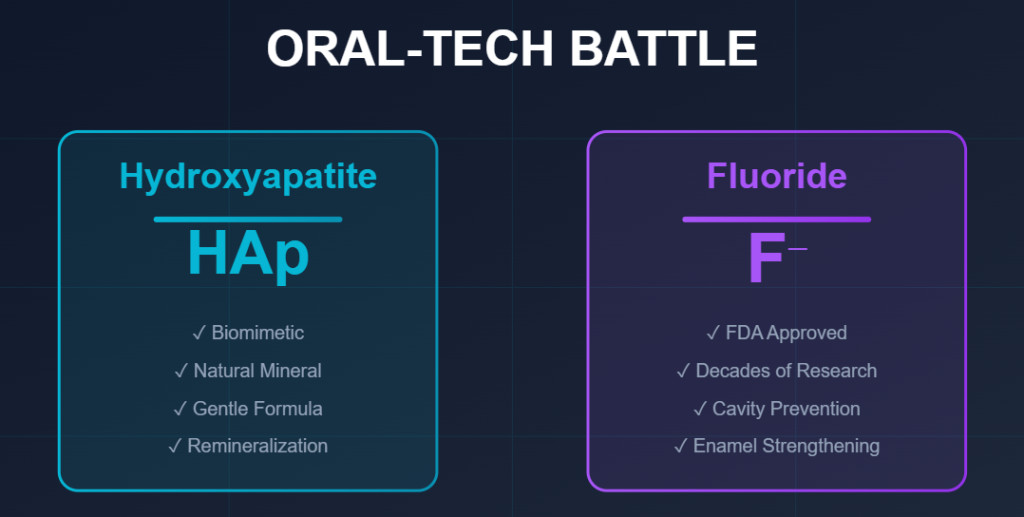
To make an informed choice, you need to see how these two stack up in the areas that matter most: stopping cavities, keeping you safe, and reducing sensitivity.
| Feature | Fluoride | Hydroxyapatite (HAp) |
|---|---|---|
| Primary Mechanism | Strengthens enamel chemically (creates fluorapatite) | Replaces lost minerals physically (biomimetic repair) |
| Safety | Toxic if ingested in large amounts; risk of fluorosis | Non-toxic; safe to swallow for all ages |
| Cavity Prevention | High efficacy; Gold Standard | High efficacy; Non-inferior to fluoride |
| Sensitivity Relief | Moderate; strengthens enamel over time | High; physically blocks nerve pathways (tubules) |
| Whitening Effect | Minimal (unless abrasives added) | High (smooths surface for natural gloss) |
Fluoride or Hydroxyapatite Toothpaste: Which Should You Choose?
The data indicate that hydroxyapatite and fluoride toothpastes can prevent cavities as well as improve enamel strength. Which is better will depend upon your priorities:
- Hydroxyapatite toothpaste is a powerful option if you want no fluoride content but the enamel protection and remineralization.
- If you are highly prone to cavities or your dentist specifically advises fluoride, the conventional form of fluoride toothpaste is highly supported by decades of research.
- For sensitive teeth, nano-hydroxyapatite would provide a greater level of comfort. It seals up the microscopic cracks in the enamel.
Many dentists see hydroxyapatite and fluoride as complementary rather than exclusive. Some people use a fluoride toothpaste most of the week. They switch to nHA toothpaste for a gentler option on other days.
Best Hydroxyapatite Toothpaste Brands
The following hydroxyapatite toothpastes stand out for their high quality and their gentle care of the gums:
- Ollie Hydroxyapatite Toothpaste: An all-inclusive toothpaste that is a balanced formula. It includes hydroxyapatite with fluoride and xylitol to promote the strength and protection of enamel and enamel cavities. It is acclaimed as having soft day-to-day care and sensitivity.
- Boka Hydroxyapatite Toothpaste: The toothpaste is non-fluoridated and composed of nano-hydroxyapatite. It promotes enamel and sensitivity reduction, among pleasant flavors, to brush away filaments.
- David’s Hydroxyapatite Toothpaste: This non-toxic, environmentally friendly paste with nano-HAP tooth remineralization and non-hostile oral care paste is typically included in the lists of dentists.
- RiseWell Natural Nano‑Hydroxyapatite Toothpaste: A light, SLS-free one with nano-HAP. It promotes sensitivity relief and daily protection with an emphasis on clean ingredients.
- Mouthology 10% Nano Hydroxyapatite Toothpaste: A 10 nano hydroxyapatite toothpaste, helpful in enhancing the healing of enamel and whitening friendly.
- Boka Kids Nano‑Hydroxyapatite Toothpaste: Designed for children with a gentler flavor. It has a safe hydroxyapatite formula that supports enamel development without fluoride.
- Ceelike Hydroxyapatite Toothpaste: A toothpaste that contains no fluoride, nano-hydroxyapatite, and is meant to strengthen the enamel. It aids remineralization and prevents sensitivity when taken daily.
These brands are a combination of generally recommended options in 2026. They cater to various segments of different requirements, including a fluoride-free formula free of fluoride, protection of sensitivity, and fortification of enamel.
Tips for Choosing the Best Nano Hydroxyapatite Toothpaste
When you pick up a toothpaste with nano hydroxyapatite, these are some of the things to consider:
- Check for nano hydroxyapatite (n‑HAP) on the label rather than just “hydroxyapatite,” because nano particles penetrate enamel more effectively.
- See better n-HAP at higher concentration (usually between 5-10 %) to achieve higher enamel support and sensitivity relief.
- Choose between fluoride or fluoride-free depending on your requirements (fluoride gives the mouth cavity protection; fluoride-free is safer when one tends to swallow a lot).
- Do not use high levels of silica as harsh abrasives since silica may wear away enamel in the presence of n-HAP.
- Look at complementary products like xylitol that give additional benefits to oral health or soothing products (aloe, mild flavours).
- Consider what you want (sensitivity relief, cavity prevention, whitening) and get a product that is made to do whatever.
- Check user reviews and brand reputation to observe the performance of toothpaste in real-life use.
- It is always better to test small tubes first, as far as taste and texture may be more different with nano-HAP formulas.
Where to Get Hydroxyapatite Toothpaste
Here’s where you can easily find and get one.
- Online Marketplaces: Amazon, Walmart.com, and other major e‑commerce sites carry a wide range of nano hydroxyapatite toothpaste and top brands.
- Drugstores and Pharmacies: Many local pharmacies stock popular options, especially larger chains that offer specialty toothpaste.
- Health & Wellness Stores: Stores that specialize in natural or holistic products usually stock fluoride-free hydroxyapatite toothpaste.
- Brand Websites: To purchase them, you may go directly to manufacturer websites such as Boka, Davids, or RiseWell to take advantage of the most recent formulations and offers.
- Supermarkets & Big Box Retailers: Larger grocery stores and retail chains sometimes have hydroxyapatite toothpaste in the oral care aisle.
Hydroxyapatite Toothpaste Reviews and What Users Say
Hydroxyapatite toothpaste is extremely popular among people to repair sensitive teeth and make their smiles healthier.
One Reddit user (BackgroundNo4159) wrote, ‘I’ve been using nano-hydroxyapatite toothpaste for nearly two years, and I no longer have extreme sensitivity, plus my teeth look whiter. It’s totally worth it!’
Another Reddit user (mrmses) shared, ‘I’ve been using it for a few months. I noticed a difference in sensitivity within about a month.’
Is Hydroxyapatite Toothpaste Better for Everyday Dental Care?
Based on evidence, yes, for many people. It is as efficient in cavity prevention and remineralization as fluoride and has fewer risks. When you are sensitive, use natural products, or are concerned about fluoride in toothpaste, use hydroxyapatite toothpaste. Depending on the situation, combining the two in different routines may help more, but you should consult a dentist first.
In everyday use, brands like Boka hydroxyapatite toothpaste offer convenience and results. With positive reviews and scientific backing, hydroxyapatite could revolutionize dental care.
Conclusion
In conclusion, hydroxyapatite toothpaste is an emerging solution to the traditional fluoride toothpaste with good enamel remineralization and sensitivity relief. Its mild, bio-compatible composition enables it to be effective in individuals seeking a fluoride-free alternative that promotes oral health over time. Regular use of these can help prevent enamel and tooth sensitivity discomfort.
Although toothpaste hydroxyapatite is a relatively new product against fluoride, there have been several success stories by its users with better enamel strength and less sensitivity. With options like Boka and Risewell, it provides a natural and safe way to maintain healthy teeth without the concerns associated with fluoride.
FAQs
The hydroxyapatite toothpaste contains a mineral found in your teeth and bones. It helps to remineralize and strengthen enamel, prevent its destruction, and make it less sensitive.
Yes, hydroxyapatite toothpaste helps repair and strengthen enamel, reduce tooth sensitivity, and support oral health. Several users have reported positive results from regular use, such as reduced sensitivity and increased tooth strength.
Many brands offer toothpaste with hydroxyapatite, including Boka, Risewell, Davids, and Mouthology. These are widely available in both fluoride-free and regular formulas.
Boka toothpaste contains 5% nano-hydroxyapatite, which strengthens enamel and reduces sensitivity. The concentration is effective in daily remineralization and supporting enamel.
Yes, hydroxyapatite toothpaste is effective because it can repair and strengthen enamel, reduce tooth sensitivity, and improve oral health. Several reports indicate that frequent use by many users has been positive, with reduced sensitivity and better tooth strength.