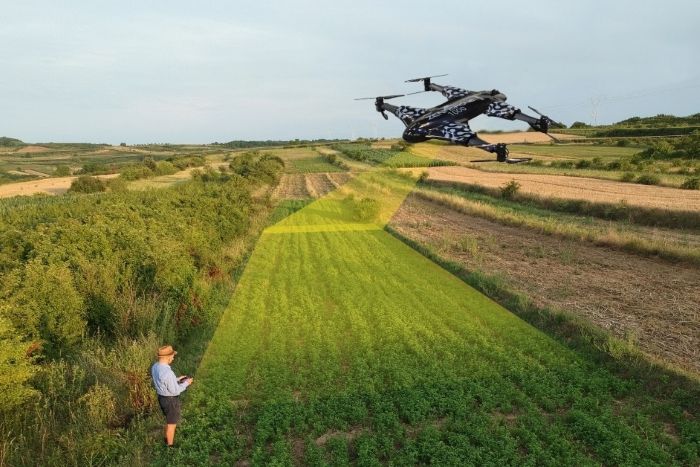
Terrain and elevation modeling help teams understand what the ground truly looks like in drone mapping by creating accurate 3D views of the land. These models capture the shape of the terrain, the rise and fall of elevations, and the layout of roads and vegetation in a way that planners can actually use. They matter in construction, engineering, mining, and environmental work because they provide dependable elevation data that supports better designs and clearer decisions.
The shift to drones has transformed how this information is gathered. With drone terrain mapping, crews can collect high-resolution images and LiDAR data in a short amount of time and with significantly reduced risk in the field. Modern tools built on photogrammetry and DSM/DTM/DEM processing turn these flights into detailed terrain models that can achieve centimeter-level accuracy. Compared to older manual techniques, drone surveying delivers stronger results with greater speed, reliability, and overall safety.
Key Takeaways
- Drone mapping transforms terrain and elevation modeling by providing accurate 3D views of land.
- It offers faster, safer, and more cost-effective surveys compared to traditional methods.
- Industries like construction, agriculture, and environmental management rely on drone mapping for essential data analysis.
- Drone mapping delivers high-resolution models, including DSM, DTM, DEM, and point cloud outputs.
- Future advancements will enhance drone mapping with AI-driven analysis and real-time 3D mapping capabilities.
Table of Contents
- Why Terrain & Elevation Modeling Matters
- Traditional Surveying vs Drone-Based Modeling
- How Drone Terrain Modeling Works (Step-by-Step)
- Types of Elevation Models Generated by Drones
- Global Industry Use Cases
- Benefits of Drone-Based Terrain Modeling
- Limitations & Best Practices
- How to Choose the Right Drone Service Provider
- Future of Terrain Modeling
- Conclusion
- FAQs
Why Terrain & Elevation Modeling Matters
Terrain and elevation models supply essential data for planning and engineering. They enable analysis of slopes, drainage, and ground modeling for infrastructure, solar farms, or irrigation. Visualizing contours and elevation helps estimate earthwork volumes, reduce flood or erosion risks, and determine project feasibility. Industries like construction, mining, renewable energy, agriculture, and environmental work rely on this data. For instance, precision models optimize agricultural irrigation and soil management, support accurate flood modeling, and improve erosion analysis.
For high-accuracy terrain elevation surveys, you can also explore our professional terrain elevation modeling services.
Traditional Surveying vs Drone-Based Modeling
Traditional land surveying is reliable but slower and labor-intensive, whereas drone mapping provides fast and high-resolution data. The table below compares key aspects:
| Speed | Slower, crews cover small areas on foot, taking days | Faster, drones capture thousands of images in hours |
| Labor & Safety | Labor-intensive and time-consuming, crews must access the site | Safer, remote aerial data collection minimizes field risk |
| Cost | Higher due to long field time and equipment setup | Lower overall cost due to less manpower and quicker data capture |
| Coverage | Detailed on small plots only | High-resolution coverage over large or difficult terrain |
| Techniques | Total stations, GNSS receivers, and leveling | Aerial photogrammetry with cameras or LiDAR scanning |
| Accuracy | Sub-centimeter on small surveys | Centimeter-level accuracy with RTK/PPK and GCPs |
This demonstrates that while traditional surveys rely on ground crews and precision instruments, drone surveying sets the standard for speed, scalability, and accuracy, particularly when deploying RTK-enabled drones or ground control.
How Drone Terrain Modeling Works (Step-by-Step)

Drone terrain modeling follows a multi-stage workflow: plan the project area, set flight paths, and place ground control points (GCPs). Next, the UAV flies the site, collecting overlapping images or LiDAR data, often using RTK GPS corrections. After the flight, use software to process data into a 3D point cloud or mesh, then generate DSM and DTM/DEM elevation models. Create contour lines and slope maps from the elevation grid. Finally, perform QA/QC by comparing the results with the GCPs before delivering the final maps and datasets.
- Plan survey: Define boundaries, set flight parameters, and place GCPs.
- Fly drone: Operate UAV along planned routes to gather data.
- Capture data: Collect aerial images or LiDAR scans with RTK GPS.
- Process images: Use software to build a 3D point cloud and mesh.
- Generate models: Create DSM/DTM/DEM from the processed 3D data.
- Create contours/slopes: Derive lines and maps for engineering analysis.
- QA/QC: Check accuracy against GCPs and adjust as needed.
Technical terms to know include point clouds (a collection of 3D coordinates representing objects’ surfaces), GCPs (ground control points, which are marked locations on the ground with known coordinates for accuracy), RTK corrections (real-time kinematic adjustments improving GPS precision), and 3D mesh reconstruction (creating a digital surface from the point cloud data).
Types of Elevation Models Generated by Drones
Unmanned aircraft can produce several kinds of elevation data outputs, each serving different purposes:
- DSM – Digital Surface Model: A grid of surface elevations including buildings, trees, and all objects, representing full surface elevation data. Used for urban planning, line-of-sight analysis, and vegetation studies.
- DTM – Digital Terrain Model: A bare-earth model that strips away structures and vegetation, useful for flood risk modeling, slope analysis, and civil design, such as cut/fill planning.
- DEM – Digital Elevation Model: A general gridded elevation dataset. It can refer to either a DSM or DTM style model and is often exported as a geospatial raster for large-scale mapping and GIS analyses.
- 3D Point Cloud Model: A collection of millions of points (x, y, z) captured by LiDAR or photogrammetry. This high-density dataset allows precise volume and shape measurements.
Topographic Contours & Slope Maps: Line-based contours and shaded slope/aspect maps derived from DEM/DTM. These simplify elevation data for land surveys, grading design, and irrigation planning. - Textured 3D Mesh Model: A realistic 3D model with photographic textures overlaid on the mesh. These are used for visualization, virtual tours, and integration into GIS and BIM systems. To generate high-resolution meshes and 3D models, you can use our advanced Drone 3D scanning services.
Global Industry Use Cases
Drone-based terrain modeling finds applications in many global industries:
- Construction & Civil Engineering: Used for site grading, cut/fill calculations, and earthwork modeling on new building projects.
- Mining & Quarrying: Enables accurate pit mapping and volumetric analysis of stockpiles for effective resource management.
- Agriculture: Provides high-resolution slope and elevation maps to optimize irrigation design, drainage planning, and precision farming.
- Energy (Solar & Wind): Assists in site feasibility and planning by analyzing terrain slopes and elevations for optimal placement of panels or turbines.
- Real Estate & Land Development: Delivers accurate surveys for land subdivision, drainage design, and landscape modeling on new developments.
- Environmental & Disaster Management: Supplies DEMs for flood modeling, erosion studies, and environmental impact assessments.
Each industry benefits from detailed analysis. For example, construction teams use elevation data for grading plans, while environmental agencies utilize it to model zones at risk for flooding and erosion.
Benefits of Drone-Based Terrain Modeling
Drone surveying offers many advantages over traditional methods:
- Faster data capture: UAVs can survey large areas 50-90% faster than ground crews.
- High accuracy: Using RTK/PPK GPS and ground control, drones routinely achieve centimeter-level precision.
- Lower cost: Reduced field time and labor translate to significant cost savings on large projects.
- Improved safety: Unmanned flights eliminate the need for surveyors to enter hazardous or hard-to-reach areas, thereby reducing the risk of injury.
- Scalability: Drones easily map large or remote sites, and repeated surveys for progress tracking can be done quickly.
- Rapid re-surveys: Since drones are quick to deploy, maps can be updated often to monitor changes over time.
These advantages in accuracy, time savings, and precision make drone terrain modeling well-suited for modern surveying.
Limitations & Best Practices
While powerful, drone surveys have some challenges to manage:
- Vegetation & terrain: Photogrammetry can struggle under dense vegetation or heavily forested areas. In such cases, LiDAR mapping is often used since it can penetrate the canopy and capture ground points.
- Weather conditions, including rain, fog, high winds, or poor lighting, can compromise data quality or necessitate grounding the drone, so surveys should be scheduled in favorable weather conditions.
- Regulatory restrictions: Aviation and privacy laws vary by country. Certified drone pilots must adhere to local regulations, including altitude limits and no-fly zones. Non-compliance can halt operations.
- Ground Control Points (GCPs): A sufficient number of accurately surveyed ground control points is essential for achieving the best absolute accuracy. Omitting GCPs can reduce map precision.
- Pilot training: Skilled operators are required. A professional survey process with strong QA/QC, utilizing checkpoints and calibrations, is key to ensuring reliable results.
By planning around these factors, mapping challenges and accuracy factors can be effectively managed, ensuring that drone surveys maintain high quality.
How to Choose the Right Drone Service Provider
When selecting a drone mapping company, look for these qualities:
- Licensed professionals: Ensure the provider has certified pilots and follows all safety and regulatory requirements.
- Equipment and techniques: They should use RTK/PPK-capable drones and offer both photogrammetry and LiDAR capabilities for flexible solutions.
- Expertise: Verify experience in terrain and elevation modeling, as well as relevant industries such as mining and construction.
- Portfolio: Review their project examples or case studies to assess the accuracy and quality of their deliverables.
- Deliverables: Ensure they clearly provide the necessary outputs, including DSM, DTM, DEM, point clouds, and contours, along with accuracy reports.
- Quality assurance: A reputable provider will emphasize a strong QA/QC process using ground control or benchmarks to validate results.
Selecting a professional drone surveying and mapping provider guarantees access to precise elevation data and consistently reliable service.
Future of Terrain Modeling
Relentless technological advancements will continue to redefine terrain modeling. AI-based analysis and machine learning already automate feature extraction and change detection from drone data. The advent of fully automated drone flights, including BVLOS in select jurisdictions, is enabling near real-time 3D mapping. Integrated systems seamlessly link drone data with BIM, GIS, and digital-twin platforms to create continuously evolving site models. In short, the future of surveying is being shaped by intelligent, AI-driven terrain mapping and true autonomy, ensuring that elevation surveys become faster, more insightful, and increasingly continuous.
Conclusion
Terrain & Elevation Modeling matters for industries all over the world, and drones make the process faster and more practical. They create high-resolution 3D terrain maps that help engineers and planners see the land clearly and make better decisions. Drone-based elevation modeling is precise, efficient, and safer than traditional methods, which is why so many projects rely on it today. If you’re interested in utilizing this drone mapping technology, please contact our team to obtain a quote or schedule a consultation for professional drone terrain and elevation mapping services.
FAQs
With proper methods, drone surveys can reach centimeter-level accuracy. Using RTK/PPK GPS and well-placed ground control points, drones typically deliver precision of 1-3 cm. This is comparable to the accuracy of traditional surveys under good conditions. Factors like sensor quality and flight settings influence the exact accuracy.
Drones complement rather than completely replace ground surveys. They excel at rapidly mapping large areas, but traditional methods are still used for fine details and critical control measurements. Combining drone data with classic survey techniques often yields the best results.
A DSM (Digital Surface Model) includes all surface features such as buildings and trees. A DTM (Digital Terrain Model) is a bare-earth surface with objects removed. A DEM (Digital Elevation Model) is a general gridded elevation dataset that can represent either a DSM (Digital Surface Model) or a DTM (Digital Terrain Model), depending on the context. In practice, DSMs and DTMs are specialized forms of DEMs used for specific analyses.
Drone mapping is legal in most countries but regulated. Operators typically require certification or a license and must adhere to aviation regulations, including altitude limits and no-fly zones. Privacy regulations may also apply. Generally, professional drone surveying is permitted as long as pilots adhere to local laws.
Delivery time depends on project size and complexity. Small sites can be flown in a few hours and processed in a day or two. Larger areas or high-resolution projects may take several days of processing. Many providers deliver completed terrain models, including DSM, DTM, and contours, within a week if all data and control surveys are in place.