The core treasury systems are undergoing a major modification in 2026, driven by advancements in cloud technology, artificial intelligence (AI), and enhanced security measures. These new systems are streamlining the complexities in the traditional treasury operations, making them more accessible and efficient. Modern TMSs are revising how organizations manage their financial processes by providing features such as real-time cash visibility, AI-driven liquidity projections, and automated reconciliation.
Security is at the center of cloud treasury solutions, and key functionality includes Type II SOC compliance, AES-256 encryption, and a zero-trust architecture. This guide covers the full range of modern core treasury systems, including the underlying architecture, bank API integrations, security standards, and smart automation transforming the world’s treasury processes.
Key Takeaways
- Core treasury systems will undergo major modifications in 2026, incorporating cloud technology, AI, and enhanced security.
- These systems streamline treasury operations with features like real-time cash visibility and automated reconciliation.
- Key functionalities include SOC compliance, AES-256 encryption, and a zero-trust architecture.
- API-based integration allows real-time data exchange with banks and ERPs, improving efficiency.
- Top brands like Kyriba and GTreasury lead in providing cloud-native treasury management solutions.
Table of Contents
- What Is a Treasury Management System?
- Treasury Automation Tools and Financial Systems Integration
- Treasury Technology Infrastructure: Architecture Powering 2026 Systems
- Capability Comparison: Legacy TMS vs Cloud-Based TMS in 2026
- Top Treasury Management System Brands in 2026
- Cloud Core Treasury System Solutions and Security Strategies
- Intelligent Treasury Management System Features in 2026
- Conclusion
- FAQs
What Is a Treasury Management System?
A core treasury system, also known as a Treasury Management System (TMS), is a comprehensive software platform for managing a company’s financial assets, liabilities, risk exposures, and cash flows. Learning about a core treasury system includes much more than just simple bookkeeping. It manages corporate treasury activities, including cash and liquidity management, debt management, investments, foreign exchange hedging (FX), and regulatory reporting.
Modern integrated treasury management systems are designed to directly connect to ERP platforms, banking networks, and payment processors. The right enterprise treasury software is the core of high-performing finance departments, as it centralizes data, automates workflows, and provides actionable intelligence.
Treasury Automation Tools and Financial Systems Integration
Treasury automation tools are where the benefits of treasury management systems are most directly measurable, in terms of productivity gains, cost reductions, and error elimination across daily operations.
1. Key Automation Capabilities
- Automated Bank Reconciliation: Intelligent bank reconciliation of bank transactions to ledger entries by automated means, just reporting actual exceptions to the human reviewer.
- Straight-Through Processing (STP): Complete payment transactions between ERP instruction and SWIFT settlement confirmation, with no manual touchpoints.
- Hedge Accounting Modules: Automated recording of hedges that are treated under IFRS 9, effectiveness testing, and journal entries with every reporting period.
- SWIFT gpi Tracking: Real-time automated payment status updates that are shown directly in core treasury system dashboards.
- ISO 20022 payment standards compliance: Structured MX message generation replacing legacy free-text MT formats across all outbound payment rails
2. Treasury Management System (TMS) Migration Phases
- Phase 1: Bank account, counterparty, and legal entity, and GL mappings master data cleansing.
- Phase 2: Compare the outcome of cloud TMS and the legacy system on a daily basis.
- Phase 3: Acceptance test on all payment, reconciliation, hedging, and reporting procedures by the user.
- Phase 4: RBAC authorization setting, segregation of duties (SoD) sign-off, and complete Disaster Recovery Planning (DRP) testing.
- Phase 5: Go-live cutover whereby the rollback triggers are automated, and at least 30 days of hypercare is provided.
Treasury Technology Infrastructure: Architecture Powering 2026 Systems
Multi-Tenant SaaS Architecture has been the foundation of the best core treasury system management in 2026. It enables enterprise customers to share cloud infrastructure while maintaining complete data separation, automatic upgrades, and on-demand elastic scaling, without any legacy hardware cycles.
1. API-Based Treasury Integration
The integration of enterprise treasury software is now mostly based on API treasury integration that links with banks, ERPs, and third-party data providers. Bank API Integration provides real-time account balance feeds, payment initiation, and payment status monitoring, all without file-based operations. This architectural shift from traditional host-to-host connections to open API frameworks is a defining feature of top-rated core treasury systems.
Common integration layers include:
- REST and SOAP APIs for bank connectivity
- Pre-built connectors for major ERP platforms
- SWIFT gpi Tracking for cross-border payment visibility
- ISO 20022-compliant message formats for structured payment data
2. SWIFT Connectivity and Messaging
Global interbank communication still relies on SWIFT connectivity and messaging. Major platforms are compatible with SWIFT Alliance Lite2 and SWIFTNet FileAct, and with the complete ISO 20022 Standard conversion of legacy MT to structured MX formats, directly enhancing Straight-Through Processing (STP) rates and providing more data to feed Automated Bank Reconciliation engines.
3. Real-Time Treasury Analytics
FX exposure, counterparty risk, and cash positions are real-time treasury analytics dashboards accessible to CFOs, with sub-minute updates from an in-memory, engine-driven treasury analytics platform. It is the most intense modernization of corporate core treasury system functions, transforming overnight batch reporting into active intraday intelligence.
Capability Comparison: Legacy TMS vs Cloud-Based TMS in 2026
| Capability | Legacy On-Premise TMS | Cloud-Based TMS 2026 | Priority |
|---|---|---|---|
| Cash Visibility | End-of-day batch updates | Real-Time Cash Visibility via live APIs | Critical |
| Bank Connectivity | SFTP / Host-to-Host file transfer | Bank API Integration + SWIFT gpi Tracking | High |
| Payment Standards | MT103 / MT202 legacy formats | ISO 20022 Standard MX structured messages | Critical |
| ERP Integration | Flat-file / custom ETL pipelines | Native ERP Interoperability certified connectors | High |
| Security Compliance | Internal audits only | SOC 2 Type II Compliance + ISO 27001 | Critical |
| Disaster Recovery | Manual DR runbook execution | Automated Disaster Recovery Planning (DRP) | High |
| Access Control | Static manual role provisioning | Dynamic Role-Based Access Control (RBAC) | High |
| Forecasting | Spreadsheet-driven manual models | AI-Powered Liquidity Forecasting Accuracy | Medium |
| Reconciliation | Manual statement matching | Automated Bank Reconciliation exceptions only | High |
| Processing Speed | Overnight batch cycles | Straight-Through Processing (STP) in real time | Critical |
Top Treasury Management System Brands in 2026
In selecting the best core treasury system for global enterprises, four vendors continue to dominate enterprise comparisons worldwide.
Here is a quick brand comparison of the top treasury management systems.
| Brand | Best For | Key Strength | Deployment | ERP Integration |
|---|---|---|---|---|
| Kyriba | Global cash & liquidity | Bank API Integration, AI forecasting | Cloud-native SaaS | SAP, Oracle, Workday, NetSuite |
| GTreasury | Modern treasury automation & payments | AI-powered automation, rapid deployment, bank & ERP connectivity | Cloud-native SaaS | SAP, Oracle, Workday, NetSuite, Infor, Dynamics 365 |
| ION Treasury (Openlink/Reval) | Multi-asset & commodity risk | Financial systems integration, ERP Interoperability | Cloud & Hybrid | SAP, Oracle, JD Edwards, Infor |
| SAP Treasury & Risk Management | SAP-centric enterprises | Core banking system, treasury direct, native ERP | SAP Cloud / On-premise | Native SAP zero middleware |
Best Core Treasury System Solutions 2026: Quick Overview
- Kyriba: Kyriba is a top cloud-native SaaS solution that integrates with more than 1,000 banks worldwide, offering AI-driven predictions and an AI-compatible API library to enable easy integration with ERP systems. It is fully SOC 2 Type II- and ISO 27001-certified, making it the standard choice when evaluating a core treasury system in 2026.
- GTreasury is a cloud-native SaaS platform designed for treasury and trading core system automation and payments. It offers real-time cash visibility, AI-powered forecasting, automated payments, and robust risk and hedge accounting tools. With fast deployment and connectivity to over 13,000 banks and major ERPs, it’s an ideal choice for mid to large enterprises seeking efficiency, automation, and compliance.
- ION Treasury (Openlink and Reval) is built to suit businesses that require broad integration across treasury, commodity trading, and risk management, with deep integration with ERP systems such as SAP, Oracle, JD Edwards, and Infor. It offers solid multi-entity corporate treasury services in dozens of legal entities and activities across continents.
- SAP Treasury and Risk Management: The ultimate solution to SAP S/4HANA businesses, integrating zero-middleware with a standard ISO 20022 payment infrastructure. It is the most robust choice in banking and ERP integration in an all-SAP architecture because it uses embedded Role-Based Access Control tied to SAP authorization objects.
Cloud Core Treasury System Solutions and Security Strategies
1. Financial Data Security and Compliance
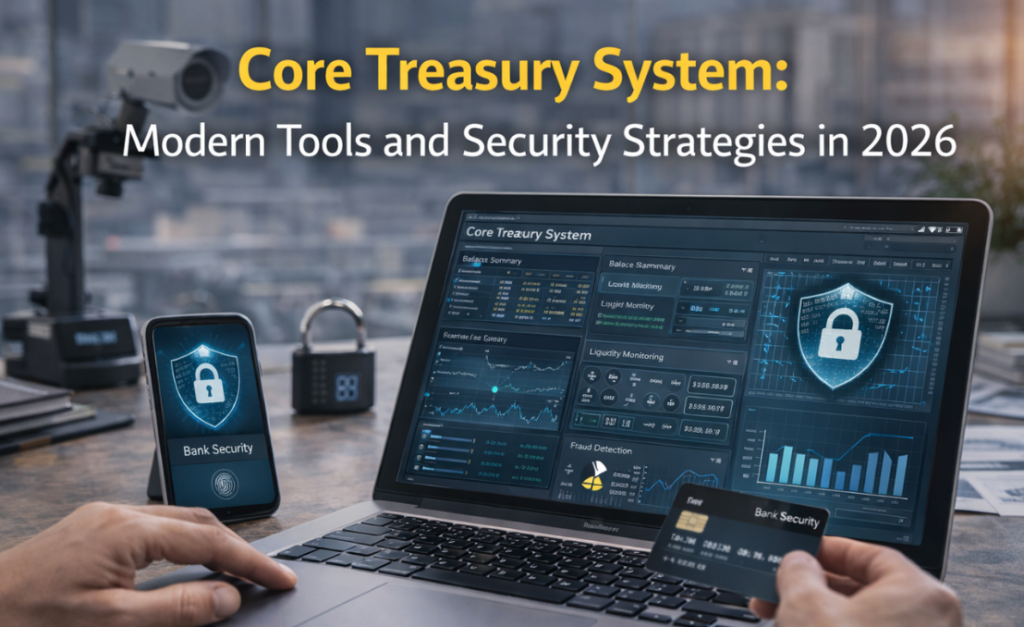
Security is non-negotiable in corporate treasury operations. The most trusted cloud-based core treasury systems are built on a layered security framework that encompasses financial data security and compliance at every level, from user authentication to data transmission.
Core treasury systems security pillars include:
- Data Encryption at Rest and in Transit using AES-256 and TLS 1.3 protocols
- Role-Based Access Control (RBAC) to enforce least-privilege principles across treasury teams
- SOC 2 Type II Compliance certification to validate security, availability, and confidentiality controls
- Multi-factor authentication (MFA) and single sign-on (SSO) integration
- Immutable audit trails for all financial transactions and system events
2. Disaster Recovery Planning (DRP)
For treasury teams, system downtime is not just an IT inconvenience; it is a financial risk. Robust Disaster Recovery Planning (DRP) ensures that treasury technology infrastructure can recover from disruptions with minimal data loss and business impact.
DRP best practices for cloud-based treasury management system:
- Recovery Point Objective (RPO) of less than 15 minutes for critical treasury data
- Recovery Time Objective (RTO) aligned with business continuity requirements
- Geographically distributed data centers with active-active failover
- Regular DR drills and third-party validation of recovery procedures
Intelligent Treasury Management System Features in 2026
The intelligent core treasury system features that separate tier-one platforms from mid-market alternatives define the best treasury management systems for corporate finance 2025 and 2026:
- Predictive Liquidity Forecasting: ML models that provide 13-week rolling predictions with Liquidity Forecasting Accuracy over 95% when deployed to the enterprise.
- Natural Language Cash Querying: Ask the system, “What is our net EUR position across Europe next Tuesday?” and receive a structured drill-down answer in seconds
- Scenario Stress-Testing: Model the full treasury balance sheet impact of interest rate shocks, currency moves, or counterparty defaults without leaving the TMS
- Embedded Compliance Triggers: Embedded sanctions screening, FBAR flags, and EMIR trade reporting hooks built natively into every deal-capture workflow
- ERP Interoperability Live Dashboards: Bidirectional real-time synchronised with SAP, Oracle, and Workday, no reconciliation break with treasury and accounting.
- Carbon-Aware Reporting: Green bond allocation tracking, Sustainable finance KPIs, and Scope 3 payment-flow carbon attribution within typical treasury reports.
Conclusion
In conclusion, the transition to a cloud-based core treasury system is a major step for companies striving to automate, enhance real-time decision-making, and respond to evolving financial regulations. By blending AI-based predictive systems, robotic bank reconciliation, and effective API systems, organizations can operate more efficiently and accurately in complex financial settings.
As we move into 2026, security and cloud-native core treasury systems continue to shape the redefinition of treasury management software. The ISO 20022 standards, SOC 2 Type II use, and real-time analytics can not only make treasury operations easier but also reduce risk, increase resilience to global financial threats, and improve transparency and effectiveness.
FAQs
A core treasury system is an enterprise-grade platform that provides a unified solution for cash and liquidity management, treasury risk management, payments, and banking relationships. Unlike a basic TMS, it offers deep banking and ERP integration, native SWIFT connectivity, and supports global, multi-entity operations at scale.
A cloud-core treasury system can bring cash, payments, risk, and bank connectivity into one controlled system, not inaccurate spreadsheets. It offers Real-Time Cash Visibility, ISO 20022, and Automated Bank Reconciliation across all entities and currencies.
The ISO 20022 Standard replaces legacy SWIFT MT messages with richer, structured payment data, directly improving Automated Bank Reconciliation, fraud detection, and regulatory reporting. Treasury teams using ISO 20022-ready treasury management system software gain faster reconciliation and better Liquidity Forecasting Accuracy.
Focus on data cleansing before cutover, validated financial systems integration with your ERP and banks, and a phased go-live with rollback options. Also, confirm that the new platform meets the licensing requirements for cloud-based treasury management systems and aligns with your long-term treasury technology infrastructure roadmap.
Any credible core treasury system vendor must hold SOC 2 Type II Compliance and ISO 27001 certification as a baseline. Additional requirements include AES-256 data encryption, dynamic Role-Based Access Control (RBAC), and annual third-party penetration testing to validate a mature, audit-ready security posture.