For decades, the product barcode had one clear job: identification. It told systems what the product was. Nothing more. No context. No story. Just a number. Back then, that was enough. Today, it no longer is. Supply chains expect more. Regulators demand more. Consumers want more. The simple barcode can’t deliver. A new-generation barcode is now available as an upgrade. GS1 QR codes improve product traceability and consumer experience by identifying a product for the supply chain while also providing detailed, verified information that supports informed purchases.
One code. Many uses.
Key Takeaways
- GS1 QR codes enhance product traceability and consumer experience by embedding detailed, verified information in a machine-readable format.
- These QR codes link to organized product data such as expiration dates and batch numbers, improving identification and tracking.
- With GS1 QR codes, consumers access useful information like ingredient lists and care instructions directly through scans.
- The improved traceability helps supply chains make faster decisions and addresses regulatory requirements effectively.
- Overall, GS1 QR codes turn product labeling into a dynamic system, providing transparency and ongoing engagement with consumers.
Table of contents
What is a GS1 Digital Link QR Code
A GS1 Digital Link QR code turns product data into an organized, machine-readable URL (website address format).
Instead of just showing a number, it organizes information like the product code, batch, or expiration date.
Because it uses a URL, this e-commerce technology can be set up to link directly to online content. This makes it easy for systems and apps to read and for consumers to access extra details.
How It Works
The information in a GS1 Digital Link is organized using GS1 Application Identifiers (AIs). Each AI tells what a piece of data is. For example:
- 01 → Product code (GTIN)
- 10 → Batch or lot number
- 17 → Expiration date
These identifiers are combined into a URL that can be scanned. Systems can read it to track products, and apps can show useful info to consumers.
Example URL
https:///01/09958374828427/10/AB123?17=251231
- 01/09958374828427 → Product code (Primary Identifier)
- 10/AB123 → Batch or lot number (Key Qualifier)
- 17=251231 → Expiration date (Data Attribute)
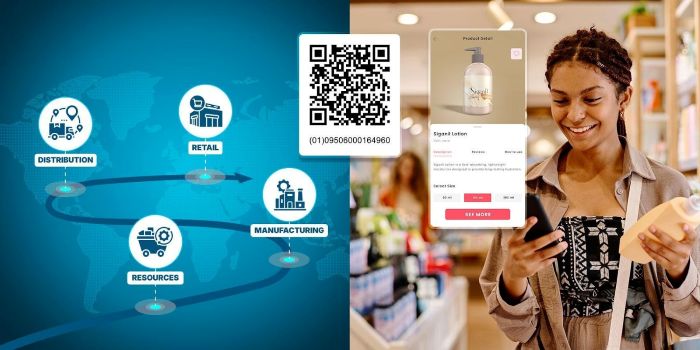
Scanners Needed
Industrial scanners, like those at checkout, require GS1 parsing to extract structured data from 2D barcodes. Without this capability, they only read web links like smartphones do.
How GS1 QR Codes Improve Product Traceability
Once detailed product data is embedded in a 2D barcode, the next question is simple. What do you do with it? That data can now be used across systems, locations, and processes.
Tracing Products Across the Supply Chain: Products can be traced both forward and backward. Scans capture where a product has been, where it is now. This visibility supports faster decisions and quicker responses when issues arise.
From Batch to Item-Level Identification: Product identification can work at different levels. Batch and lot data support grouped products. Item-level traceability is possible when serial numbers are included. This allows traceability depth to match product risk, value, or regulatory needs.
Operational Results
Better data leads to better outcomes.
- First-in-first-out (FIFO) shelf management improves because expiration dates are available at the time of scanning. Expiry monitoring becomes more accurate and less manual.
- Recalls become more targeted, since affected batches or serialised items can be isolated quickly.
- Regulatory and compliance requirements are easier to meet, as product data remains structured, verifiable, and accessible.
Traceability stops being a static record. It becomes a working system.
How GS1 QR Codes Improve Consumer Experience
When a consumer scans the code using a smartphone, the experience changes. The scan no longer stops at identification. It opens access to useful product-related information.
Transparency and Authentication
Access to trusted information builds confidence. Brands can share origin details, ingredient lists, or sourcing notes. In some cases, the information can also support basic authentication checks, helping consumers confirm they are viewing official product content.
Added Value Beyond the Label
The same scan can lead to instructions, promotions, or related content. Manuals no longer need to be printed. Updates can happen online. Engagement becomes optional, not forced.
Post-Sale Interaction
The experience does not end at purchase. Consumers can access care instructions, warranty details, or support pages after buying. Product returns also become easier, with clearer product identification and access to return policies or support channels.
Consumer experience improves because information is available when it matters. Before purchase and after.
What Happens When Barcodes Do More
When brands adopt this approach, the change is practical, not just for marketing. Product labeling becomes more than just identification. Products start sharing information at the moment it matters.
Supply chains gain clearer visibility. Decisions happen faster. Traceability becomes usable, not just documented. Regulators see structured data that is easier to check and maintain.
Consumers will notice the difference as well. Product information is available when questions come up. Before purchase. After purchase. Confidence replaces guesswork.
This is the real outcome when GS1 QR codes improve traceability and consumer experience. Brands set a new baseline. Transparency becomes expected. Updates happen online, not through reprints. Engagement continues beyond the shelf, without adding friction.