These elements shape how your brand is perceived before any message is read. Today, this matters more than ever because audiences scroll fast, and want to compare options quickly.
When visual branding for promotion is unclear or inconsistent, you can risk losing attention before you even get a chance to explain your value.
In this article we’ll explore how visual branding content supports business promotion and why it influences engagement and trust. You will also learn how you can use it more intentionally across campaigns to get better results, and scale your business.
Let’s begin.
Table of contents
What is Visual Branding Content in a Modern Marketing Context?
At a basic level, visual branding includes the elements people recognise first when they encounter a brand. This usually means:
- Logos that signal identity.
- Brand colors that create familiarity.
- Typography that sets tone and personality.
- Core visual styles used across marketing materials.
These elements matter because they help audiences recognize your brand quickly. However, on their own, they don’t explain how visual branding actually supports promotion.
In modern marketing, visual branding for promotion works as a connected system. That system shows up everywhere you promote your brand itself, for example, this could include:
- Static visuals such as ads, banners, and landing pages.
- Dynamic visuals like video, motion graphics, and on-screen interactions.
- Platform-specific visuals built for social feeds, thumbnails, and stories.
One thing to note is that visual cues often register before conscious reading begins. That speed is why visual branding for promotion often becomes the first filter audiences use to judge your relevance and credibility. In-fact, a 2024 Canva report notes the impact of visuals:
- 77% of business leaders say communicating visually has improved business performance through higher engagement, better collaboration, or faster content creation.
- 73% of organisations are increasing their investment in visual communication platforms year-over-year.
- 90% of sales leaders report that visuals in sales and marketing materials help accelerate sales cycles.
When these elements are inconsistent, even strong campaigns can struggle to convert.
How Can Businesses Use Visual Branding Content in Promotional Campaigns?
You can use visual branding for promotion by making visuals part of the campaign strategy from the start, so design choices support the goal of the promotion, not just appearance. Let’s break this down.
1. Aligning Visual Branding With Campaign Objectives
Effective visual branding for promotion starts with clarity. Every visual element, whether a banner, ad, or social post, needs a defined role within the campaign. When visuals are created without intent, they may look good but fail to move people to the next stage of the sales cycle.
Before designing visual branding for promotion, consider the following:
- Define the desired outcome the visual is meant to drive, such as clicks, sign-ups, or awareness.
- Design for the environment where the visual will appear, factoring in platform behavior, screen size, and attention span.
- Anchor the visual to a single message or emotion so the audience understands it instantly.
2. Designing Visuals for Attention, Memory, and Action
Visual branding for promotion works by guiding how audiences notice, remember, and respond to content. This typically includes three things:
- Attention: A visual must capture the viewer immediately. Bold color choices, clean layouts, and recognizable brand elements help your content stand out in crowded feeds.
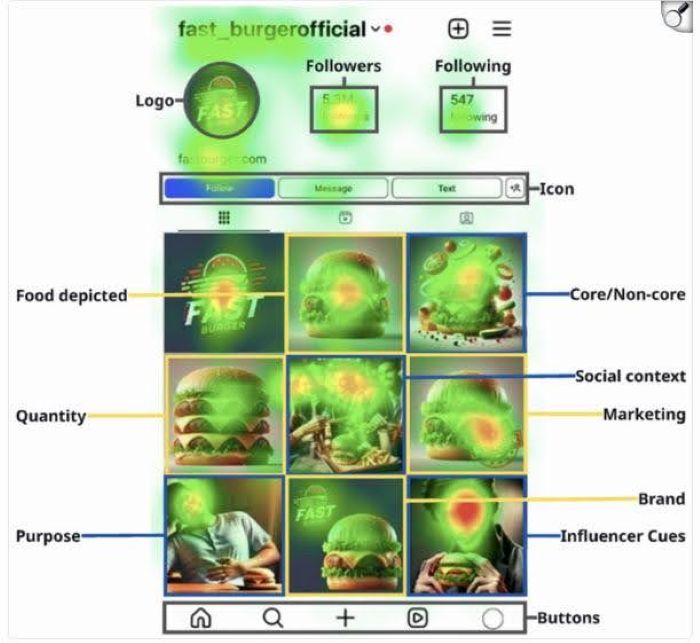
In-fact, a 2025 eye‑tracking study on social media posts found that participants’ gaze focused most on central visual elements, such as logos and influencer faces, while peripheral content received far less attention.
The study’s results show this as a heatmap, with red/yellow areas indicating the highest visual attention:
Image via PMC
- Memory: Consistency across campaigns, from fonts to imagery style, strengthens recognition. When audiences encounter the brand again, familiarity builds trust.
- Action: Every visual should subtly support the next step, whether clicking a link, signing up, or sharing content. It’s about nudging behavior without overwhelming your audience.
3. Executing and Scaling
Executing and scaling visual branding for promotion means producing multiple assets that remain on-brand, on-message, and timely, so campaigns don’t stall while waiting for design approvals or iterations.
Firstly, you need to create centralized asset libraries, shared style guides, and design tokens that define layout hierarchies, typography standards, color usage, spacing, and responsive behavior.
These systems allow visuals to be consistent across ads, social posts, emails, and landing pages banners. Additionally, reusable templates will help reduce production time, you can start designing them even if you don’t have design skills, with tools like Adobe. For instance Adobe’s banner-maker builds your brand while you focus on optimization. This tool creates professional banners in few minutes.
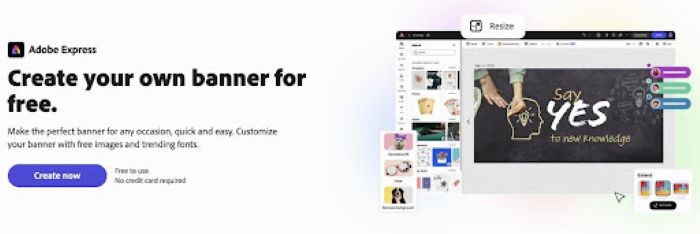
Image via Adobe
You can also invest in AI-powered design tools. In-fact, 82% of teams have used AI-powered tools to produce visual content in the past year, and 90% agree that generative AI has improved the quality of visual communication, not just speed.
It’s important to remember that visuals also shape trust, especially in SaaS and technology contexts where audiences evaluate not just the product, but the company’s direction. Transparency itself has become a promotional signal.
For example, things like public roadmaps act as a visual, outward-facing asset that communicates vision, priorities, and momentum. As part of a broader promotional strategy, they support performance by reinforcing confidence at key decision stages like initial evaluation, comparison, onboarding, and renewal.
Additionally, visual branding for promotion doesn’t necessarily “cause” results on its own, but its impact can be observed in how people move through a campaign. You should monitor signals like:
- Click-through rates.
- How long people stay on a page.
- How far they scroll.
- Whether users hesitate or convert after clicking.
These signals help you adjust visual branding alongside other elements, such as copy clarity, offer positioning, and CTAs, so that you can scale your business as campaigns are running.
Let’s take a look at some of the beginner visual branding for promotion mistakes so you can avoid them and stay ahead of the game.
What are the Most Common Visual Branding Mistakes That Weaken Business Promotion?
Some of the biggest visual branding mistakes tend to come from inconsistency and lack of purpose. When visual branding for promotion is scattered or unclear, your audience gets confused, and your business risks losing trust.
Here’s a breakdown of some of the most common pitfalls:
- Inconsistent Identity Across Touchpoints: Using different colors, fonts, or logo versions on the website, ads, and social media weakens recognition and confuses customers. Consistency builds familiarity and inconsistency breaks it.
- Overly Complex Visuals: Logos or graphics that are too detailed don’t scale well on mobile screens, ads, or small thumbnails, reducing impact.
- Poor Hierarchy and Cluttered Design: When visual elements fight for attention, audiences don’t know where to look first, lowering engagement and clarity.
- Ignoring Emotional Alignment: Colors and imagery that don’t match the brand’s message can trigger the wrong feelings.
- Reliance on Generic Visuals: Stock photos or templates that aren’t customized enough fail to convey uniqueness or build recognition, making promotions forgettable.
Avoiding these mistakes early on helps visual branding for promotion stay sharp and effective across campaigns. However, if the process gets too time consuming, you can simply hire a personal assistant to lias with your team and keep track of their progress, while updating you every step of the way.
Conclusion
Visual branding for promotion influences how people judge your business before they read a word or click a button.
Effective visuals work as a system — they guide attention, support memory, reduce hesitation, and stay consistent across ads, websites, email, and social channels. When visuals are aligned with campaign goals, and scaled using tools like templates and AI tools, promotion becomes much easier to manage.
However, to see if your efforts are working, it’s important to measure campaign results and optimize your visuals accordingly. Start today by auditing one live campaign and fix one visual inconsistency that may be slowing results, and start scaling your business.